


Afghanistan. Part 3
Description
This section is from "The American Cyclopaedia", by George Ripley And Charles A. Dana. Also available from Amazon: The New American Cyclopædia. 16 volumes complete..
Afghanistan. Part 3
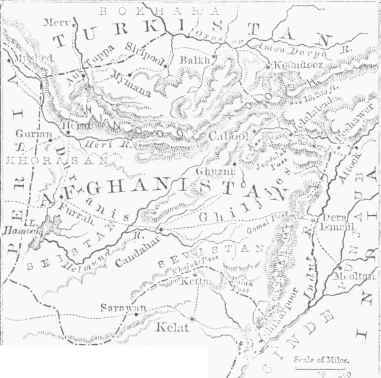
As early as 1846 he availed himself of the experience he had gained during his captivity in British India to revive hostilities. Entering into an alliance with his former enemies the Sikhs, he set on foot disturbances in the Punjaub, which were not quelled without much hard lighting. After the battle of Guzerat, however (Feb. 21,1849), the Sikhs, defeated by the English, were forsaken by the Afghans, and Dost Mohammed with 16,000 of his warriors fled over the Indus. He was not disturbed by the English government, and after having conquered Balkh (1850) and thus consolidated his forces in the north, he even succeeded in 1854 in subduing Candahar, and gaining the supremacy in the southern part of the country. He now concluded an offensive and defensive alliance with England, March 30, 1855; and goaded on by that power, as well as encouraged in his ambition by the death of Yar Mohammed, the ruler of Herat, he became involved in war with Persia (1856), which ended in the evacuation of Herat (July, 1857) by the Persians, and the appointment of Ahmed as sultan of that country.
In January, 1857, Dost Mohammed concluded a new treaty with England. In 1860 the sultan of Herat quarrelled with Dost Mohammed's son; but on this occasion, as in the following year, in the complications with the emir of Bokhara, Dost overcame all difficulties by the exercise of his wonted tact and moderation. A new Persian war broke out in 1862; but, supported by his British allies, Dost Mohammed defeated the sultan of Herat and took possession of that city after a protracted struggle, May 26, 1863.. Ahmed, the sultan of Herat, and the tool of Persia and Russia, died shortly before the capture of his capital, and Dost himself survived his victory only a few days, his death occurring May 29, 1863. He bequeathed the throne to his son Shere Ali, who was soon embroiled in a bitter contest for the succession with his brothers and nephews, and Afghanistan was plunged again into anarchy. Helpless against the many pretenders to the throne, Shere Ali appealed to the English, but he was regarded by them as an unsafe ally, and Afzul Khan, Shere's half brother, was recognized by Sir John Lawrence, the governor of British India, as the lawful sovereign.
Yacub Khan, Shere's son, had succeeded in retaining power at Herat, and sent assistance to his father, who, however, was disappointed in his hope of making the Persians his allies against his antagonists. In October, 1867, however, he succeeded in gathering an army of 17,000 men, chiefly through the monetary assistance accorded to him by the widow of Feis Mohammed of Balkh. On April 1, 1868, he took possession of Candahar, and in January, 1869, he achieved a decided victory at Ghuzni over his half brother Azim and his nephew Abd-ul-Rahman. In July, 1869, the pretenders rose anew on the boundaries of Turkistan; but Azim Khan, the most mischievous of them, died in October, 1869, and the Anglo-Indian government, afraid of Russia, which was all the time accused of a design to use Persian supremacy over Herat for her own designs on India, now came over to the side of Shere Ali. Earl Mayo, the new governor general of India, entered into a formal alliance with him, recognizing him as the legitimate sovereign of Afghanistan. At the instigation of England, the upper Oxus was at the same time fixed upon as the boundary line between Afghanistan and Bokhara (a country virtually ruled by Russian influence), and a treaty to that effect was concluded and signed in January, 1871. By bringing the difficulties between these countries to a close, Great Britain hoped to arrest the progress of Russia. Shere Ali, however, was still distrusted by his kinsmen, the pretenders to his throne.
On Sept. 21, 1870, his own son Yacub rose in revolt against his father, because the latter, owing to a palace intrigue, resolved to appoint his second son Abdullah Jaw successor to the throne, in the place of Yacub. In March, 1871, the fortress of Gurian fell into the hands of Yacub, and in May he even took possession of Herat. A protracted war between father and son was now expected, but through British diplomacy a reconciliation took place in June, in con-seqence of which Yacub was appointed governor of Herat. - Afghan Language and Literature. Afghan is a Persian word. The term Vilayet is applied by the people themselves to their country, and signifies the original land of ancestors. They also designate it as Cabulistan, and by other appellations. The inhabitants call themselves Pushtaneh or Pukhtaneh, according to the two main dialects of their language, the Pukhtu and Pushtu, which are spoken in different parts of the country. The Afghani, notwithstanding its peculiar sounds, retains the essential characteristics of the Iranic group of the Indo-European languages. Mixed with various oriental tongues and written in Persian characters, it reveals the defective cultivation of the people. There is a tradition that Mohammed described the Pukhtu as the language of hell.
Previous to the 15th century there does not seem to have existed any literature at all; but since that period there have been several poets, who took the high-flown Persian lyrical writers as their models. Abder-rahman of Peshawer was one of the earliest poets. In the 17th century Mirza Khan An-sari and Khushhal Shah Abdali distinguished themselves as Afghan poets; and Ahmed, the founder of the Durrani dynasty, was remark-able for his literary efforts. Writings on historical and religious subjects are extant among the Afghans, but none earlier than within the last four centuries. Raverty published a grammar of the Pukhtu language (London, 1860-'68), and a selection from the poetry of the Afghans (1862). Among valuable works on Afghanistan are Elphinstone's " Account of the Kingdom of Caubul" (London, 1815); Caye, "History of the War in Afghanistan " (1851); Belly, "Journal of his Political Mission to Af-ghanistan" (1862); and the travels of Connolly, Burnes, Ferrier, and Bellew.
Continue to:


My Books

