


Algae
Description
This section is from "The American Cyclopaedia", by George Ripley And Charles A. Dana. Also available from Amazon: The New American Cyclopædia. 16 volumes complete..
Algae
Algae, a large family of cellular flowerless plants, in which there is a complete series of forms, from plants of merely one or two cells to most complicated and extensive growths, as seen in many seaweeds. Algae live for the most part entirely in water, fresh, salt, or brackish, and take their food by their whole surface from the medium in which they grow.
A convenient classification divides them into five orders, diatomaceae, conferraceae, fucaceae, ceramiaceae, and characeae. - The diatoms are microscopic bodies, having a spontaneous movement through the water in which they live, and silicious skeletons or frames, often of wonderful beauty, which accumulate in vast deposits at the bottom of ponds. (See Diatomaceae.) - The confervas are plants of simple cells or series of cells, commonly found in fresh water, but also in salt, growing with great rapidity, and forming a green, red, or violet scum on water, or stain on snow or moist stones. The red snow (protococcus nivalis) consists of a single cell, which subdivides into other cells forming new individuals, so that in a few hours a large extent of snow may be covered by this plant, which is only visible by its conglomeration. A similar plant often colors many square miles of the sea, and, according to some, has given the Red sea its name. Many fresh-water confervas appear in early spring, and when examined by the microscope are shown to be delicate threads composed of a single line of transparent cells of varied shapes, containing several forms of greenish nuclei: these are the reproductive particles which are to form the spores.
The star jelly (nostoc) springs up suddenly after a rain as a greenish trembling jelly. Lavers (porphyra and ulva) are stewed and eaten in Europe, and the ulva compressa by the Hawaiian Islanders. Several confervas have been found growing in hot springs of an elevated temperature; as at the geysers in California, in a spring of a temperature of 120° F. (W. T. Brigham). - The fucaceae or seaweeds, when found in fresh water, much resemble confervas, but are distinguished from all other algae by the position of the spores in cells or receptacles sunk in the substance of the plant and opening at the surface by a small pore. The sea aprons (laminaria) have broad flattened fronds attached to a cylindrical stem, which holds the plant during growth fastened to rocky bottoms; when torn off by waves, they are found floating, and sometimes of a length of several hundred feet. The laminaria saccharina is eaten in Japan, and the laminaria digitata (called "tangle") in Scotland.
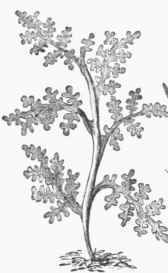
Laurencia pinnatifida.

Laminaria digitata.
Bory de St. Vincent describes an alga of this family which attains a length of 25 or 30 feet, and the trunk is often as thick as a man's thigh. The sargassum or gulf weed forms immense beds in the Atlantic, covering 40,000 square miles. The bladder-weed (fucus vesi-culosus) is common on rocky coasts in temperate regions, and is easily recognized by its olive-green, strap-shaped, branching divisions, bearing at small intervals air bladders by means of which its free end floats in the rising tide. This fucus is used for manure, and also for the manufacture of kelp, and, with other algae, as a source of iodine. A nutritious gelatine is secreted by many of the fuci, and they are eaten by swine or other animals in times of scarcity, and even by man. Perhaps the most remarkable fucus is the hydrogastrum, described by Endlicher as a branching plant, imitating the root, stem, bud, and fruit of the higher plants, but all composed of a single branching cell. - The fourth order, or cerami-aceae (rose tangles), comprises seaweeds of a rose or purplish color, seldom olive or violet; the spores are grouped in fours or threes. The order is distinguished also for the amount of gelatine many of its species contain, rendering them most useful among seaweeds.
Carrageen moss (chondrus crispus) is used in place of Iceland moss (a lichen, cetraria Islandica), and its bitter flavor is partly removed by steeping in fresh water for some time before boiling; it then takes the place of isinglass in preparing jellies and blanc-mange. Dulse (iridœa edulis) is a thin purplish seaweed, which is eaten, as well as another alga, rhodomenia palmata, by the Scotch and Irish, who call it dillesk, and the Icelanders, who name it sugar seaweed; within a few years it has become an article of food among the foreign population of Boston, and is sold in the streets. The East Indian swallows are said to construct the edible birds' nests from the gelidium, a genus of this order. The plocaria tenax (glœopeltis) furnishes so much good gelatine that it is an important article of commerce among the Chinese, many tons being annually imported at Canton for the preparation of glue and varnish for lanterns, windows, and paper umbrellas, also to give a gloss to silks and to size paper; windows are frequently made of strips of bamboo coated with this glue.
As objects of beauty this order affords many tine species, as the lau-rencia pinnatifida, shown in the first cut. - The characeœ are aquatic plants of a more obscure organization than any of the previous orders; they usually exhale a fetid odor, supposed to be unwholesome, and are curious as exhibiting under the microscope a circulation in their transparent stems and branches. - Reproduction of the algœ There are four principal ways in which algae may produce new individuals. 1. A direct action is exercised by forma-tions playing the part of male organs upon a minute mass of protoplasm, which before this action has no coating of cellulose, but now acquires this and becomes a spore. This male organ is analogous to the anther of flowering plants, and is hence called antheridium; but while the anther produces pollen, the antheridium gives birth to little bodies of a very different nature, which have the power of locomotion by means of vibratile cilia) and closely resemble animalcules; these are called anther-ozoids. An example of this method is seen in vaucheria, an alga consisting of green, one-celled filaments, common in ditches.
The antheridium develops from the side of one of these filaments as a horn-like projection, and is soon followed by a similar excrescence in its immediate neighborhood called the sporangium; these are at first continuous with the tube on which they grow, but finally form a partition completely separating their contents from the parent plant. The antheridium then opens, discharging the antherozoids, which move at once toward the opening end of the sporangium, and are met by a layer of mucilage, into which they thrust themselves and then retire, repeating this curious action for half an hour, until a thin membrane appears across the opening, due doubtless to the penetration of an an-therozoid; and then the others move more and more slowly, and at last become quite still. The fecundated sporangium when grown detaches itself from the plant as a cell filled with brownish particles. After three months it recovers its green color and elongates into a tubular filament of the perfect alga. 2. The same vaucheria often shows the extremity of its filament swollen into a club shape, and the green matter is condensed there until it assumes a blackish tint and becomes enclosed in its own membrane.
The end of the filament bursts and permits the escape of a zoospore, which is covered with vibratile cilia having so rapid a motion that to make them visible it is necessary to retard the motion by opium, or arrest it entirely by a very weak solution of iodine. The zoospores, produced apparently without the intervention of sexes, move through the water for some time, and when the cilia cease to vibrate soon germinate. 3. The ordinary fucus presents in its substance cavities or conceptacles opening when mature by small pores, through which escape, in the female plants, the sporangia, which contain eight spores in a membrane which soon dissolves, setting free in the water the spores, and in the male plants the antheridia, which also burst and discharge antherozoids, which are small bodies with two long cilia. The antherozoids meet the spores, which seem simply mucilaginous globules, and attaching themselves impart to the spores a rapid rotary motion, lasting usually six or eight minutes. The spore immediately becomes covered with a membrane, and is ready to germinate as a new fucus. 4. Reproduction by conjugation is seen in the fresh-water alga spirogyra, which is common in stagnant water in the early spring.
The slender filaments of which it is composed are divided into cells by transverse partitions, and these cells contain gelatinous endoehrome. Two adjacent filaments conjugate on contact, two cells swelling toward each other and finally uniting, when the contents of one are transferred to the other, and the communication is closed and the full cell develops a spore. The spores are formed sometimes in one filament, sometimes in the other, and when mature break away the cells and elongate into new spirogyras. This process may be seen with a microscope of low power, and so short is the time occupied that it may be easily followed from beginning to end. - Like higher plants, algae absorb carbonic acid and exhale oxygen in sunlight, although they are not so dependent on the sun for their bright colors, these existing at depths where the light would be less than half a candle. Professor Harvey has adopted a classification from the color of the spores, which is often used as exceedingly convenient, into chlorosperms, with green spores and usually with a greenish color over all the plant; rhodosperms, with rose-colored spores; melanospores, with olive-brown spores.
From the motive powers of the zoospores of algae, it is not strange that the early microscopists should have confounded the animal and vegetable kingdoms, which come so close together in the spores of algae and the lowest of animals.

Chondrus crispus.

Fucus yesiculosus.
Continue to:


My Books

