


Ancona
Description
This section is from "The American Cyclopaedia", by George Ripley And Charles A. Dana. Also available from Amazon: The New American Cyclopædia. 16 volumes complete..
Ancona
I. One of the four provinces of the department of the Marches, Italy, bounded E. by the Adriatic and traversed by branches of the Apennines, with fertile valleys, and by the small rivers Misa, Esino, and Musone; area, about 740 sq. m.; pop. in 1872, 262,359. Almost the whole province is under cultivation. It is rich in cattle, cereals, hemp, tobacco, wine, oil, and fruit, and produces some silk.
II. A fortified city and free port, capital of the above province, on the Adriatic, 132 m. N. E. of Rome; pop. in 1872, 45,741, including about 5,000 Jews and a number of Greeks, Levantines, and Turks. The city is built in the form of an amphitheatre, on the slope of two hills rising from the shores of the Adriatic. It is connected by railways and steamers with all parts of Europe and the East. The annual arrivals of ships are over 1,500, besides steamers. The chief imports are colonial produce, metals, and coals. The principal exports are corn, hemp, bacon, sulphur, and cotton. The coasting trade is also very active. The chief manufactures are woollens, cotton, silk hats, and paper. The port is formed by two moles: one, built by Trajan, is 2,000 feet long, 100 feet wide, and 65 feet above water, and is spanned by the famous arch of Trajan, considered the finest in the world; the other has a triumphal arch constructed by Pope Benedict XIV. from the designs of Vanvi-telli. The harbor, defended by several forts, had fallen into decay and was filling up; but it has recently been dredged and is now rapidly improving. Ancona, notwithstanding its fine quay and a beautiful situation, has the disagreeable appearance of a Levantine city, with dirty and narrow business streets, though with a number of good residences along the quay.
The cathedral, situated on a promontory, has a remarkable porch, a cupola reputed to be the most ancient in Italy, and fine marble pillars. The churches of San Domenico and San Francisco contain pictures by Titian; and there are also notable pictures in the other churches, most of those in St. Agostino being by Lilio, known as Andrea di Ancona. The English residents worship in the Free Church of Scotland chapel. - The city is believed to have been founded by a colony of Syracusans in the time of Dionysius the Elder. Trajan used the port as a military station. After having been governed by Romans and Lombards, and devastated by Saracens on several occasions, particularly in the 10th century, Ancona remained for a considerable period independent until 15.32, when Clement VII annexed it to the Papal States. In 1832 the citadel was seized by the French as a demonstration against the Austrians, who had occupied the insurgent Marches; but the papal authorities continued to preside over the civil administration.
The French occupation lasted till 1838. In 1849 the city surrendered to the Austrians, who evacuated it after the battle of Magenta, fought June 4, 1859. Gen. Lamoriciere, commander of the Papal troops, after his defeat at Castel-fidardo, surrendered here to the Italians, Sept. 29, 1860. Ancona became part of Victor Emanuel's possessions Dec. 17, 1860.
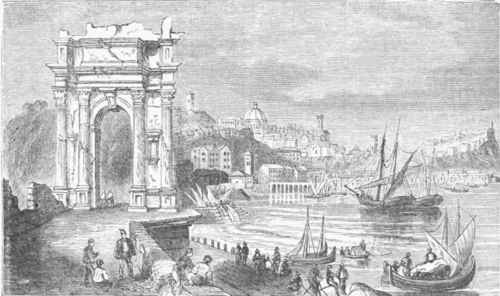
Ancona, with the Arch of Trajan.
Continue to:


My Books

