


Angel Fish
Description
This section is from "The American Cyclopaedia", by George Ripley And Charles A. Dana. Also available from Amazon: The New American Cyclopædia. 16 volumes complete..
Angel Fish
Angel Fish, the common name of the squa-tina angelus (Dum.), a representative of the family of squatinidae, intermediate between the sharks and rays. The body is flattened above and below, and discoid in shape on account of the broad pectorals and ventrals, as in rays; the mouth is very wide and at the end of the snout; the eyes small and on the dorsal aspect, with the large spout holes behind them; the head rounded anteriorly; the pectorals separated from the head by a furrow in which are the long and closely approximated gill openings; two dorsals, both on the tail, further back than the ventrals; tail keeled on the sides, and the caudal nearly or quite symmetrical; male claspers small; scales conical, with a terminal point; teeth conical, irregular, with interspaces. It is the only genus of the family, and this, the best known species, is called shark ray from its appearance, angel fish from the resemblance of the expanded pectorals to wings, monk fish from its rounded head seeming to be enveloped in a cowl, and fiddle fish from its general shape.
It attains a length of 7 or 8 feet, and is rough and mottled with brown and bluish gray above, smooth and dirty white below; the lighter pectorals are bordered with brown, the nostrils covered by a ciliated membrane, and along the back is a row of spines. It is not uncommon in the European seas, and in the Mediterranean, where it was known to Aristotle, in whose time, as now, the rough skin was used to polish wood. It is gregarious, fierce and dangerous to approach, hideous, very voracious, swimming near the bottom, and feeding on flat fishes and other species living in the mud and sand. The young are produced alive in June. The flesh is white, coarse, and tasteless, though formerly esteemed as food. A species has been described on the American coast as the S. Dumerili (Lesueur).

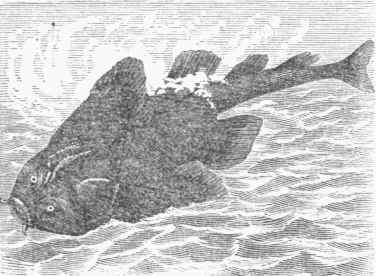
Angel Fish (Squatina angelus).
Continue to:


My Books

