


Artillery. Part 2
Description
This section is from "The American Cyclopaedia", by George Ripley And Charles A. Dana. Also available from Amazon: The New American Cyclopædia. 16 volumes complete..
Artillery. Part 2
The cannon belonging to an army, together with the wagons loaded with implements and ammunition, were collected into an artillery train, to which certain officers and artillerists were attached. The latter were looked upon as mechanics, served a regular apprenticeship, and had a guild of their own; they were divided into cannoneers, who served the guns, and artificers, who conducted vertical fire and made up warlike stores. When a war broke out, the different monarchs hired as many as they required or could get, their pay being four times that of a soldier. In battle, artillery tactics consisted in the single detail of putting the guns in position, generally in front of the line, taking care to hide them as much as possible behind troops until they were to open fire. In case of disaster they nearly always fell into the enemy's hands, from its being so difficult to move them. The German, Spanish, and Italian cannon of that age were of sizes and calibres innumerable. Charles V. had more than 50 different kinds, from 124-pdrs. down, and found this such a disadvantage, particularly in the field, that he attempted, though ineffectually, to limit their number to eight, including mortars.
About the year 1550 the French calibres, which had run all the way from 80-pdrs. down to 1-pdrs., were reduced to six, viz.: cannons, three sizes of culverins, falcons, and falconets; there were no mortars. During the last half of the century case shot (Hagelkugel) was invented in Germany, but was not brought into general use; about the same time shells were successfully fired from mortars in that country, the result being kept a profound secret. These projectiles, originally made by fastening together two hollow metal hemispheres, and known to the Chinese and Arabs, were first introduced into Europe by the Italians. In Holland, mortar shells and hand grenades were first rendered useful and effective during the early part of the 17th century, and Maurice and Henry Frede-rick of Nassau made many artillery improvements, doing away with the arbitrary distinctions between cannons and culverins, .based upon their lengths, and restricting the calibres to 48, 2-1, 12, and 6-pdrs., called cannons, half cannons, quarter cannons, and falcons, the last two being proportionally longer and heavier to prevent damage to embrasures. The dimensions of these pieces were fixed, while handles and cascables, shaped for the attachment of ropes, facilitated mechanical manoeuvres.
The gun carriages, which had limbers and ammunition chests, were similarly reduced to four, and their dimensions made so uniform that wheels and other parts were interchangeable. - About the same time Gustavus Adolphus, perceiving the advantages that would result from guns capable of quick motion and rapid fire, introduced light pieces made of thin copper and wrapped about with rope and leather; these, not proving durable, were replaced by iron 4-pdrs. weighing about 650 lbs., and drawn by a single pair of horses. Rapidity of fire was attained by the use of cartridges, the slow process of inserting the powder by ladlefuls being thus gotten rid of. Two of these guns were attached to each regiment, and were at first intended to fire canister, before that time only used in siege operations and by ships of war; but they soon came to fire solid shot, and did great execution at the battle of Leipsic in 1631. Gustavus did much also toward developing the tactical powers of the arm by massing the heavy guns in strong batteries on the wings and centre, and doing away with the old fashion of stringing them out in front of the. line of battle.
He had great confidence in his artillery, which was very strong in proportion to the other arms, there being 80 pieces in 1630 to 20,000 men, and 200 pieces before Frankfort to only 18,000. - Malthus, a nobleman who had served in the Low Countries, introduced the mortar shell into France, where it was first used in 1634. Mortars of 10, 12, and 14-inch calibre were cast under his direction, and about this time came into general use throughout Europe. The shell after being inserted was kept in place by a tamping of earth, and its fuse was lighted by hand before the mortar was fired. The small mortar which still bears the name of its inventor Coe-horn, an officer in the service of the prince of Orange, was first used in 1674. The invention of howitzers was another signal service which the Dutch rendered to the art of war, the idea having first occurred to them that shells might be used in cannon by shortening the pieces so that the projectile could be inserted by hand.
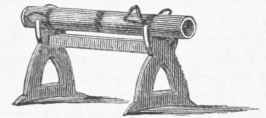
Fig. 1. - Early English Cannon. time of Battle of Crecy.

Fig. 2. - Bombard.

Fig. 3. - Mortar.
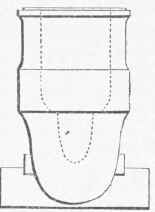
Fig. 4. - Coehorn Mortar.
Howitzers were soon adopted and improved upon by the English; like the early mortars, they were at first discharged by applying fire both to shell and charge. Light pieces called pierrieres, firing stone balls weighing from 12 to 48 lbs., were still used in some of the European services. - In France, toward the end of this century, artillery materiel was modified and improved, much attention being paid to the character of the gun metal, to the form of the chamber, and to the proper length and weight of the piece. The calibres were restricted to 33, 24, 16, 12, 8, and 4-pdrs., most of which have been retained to this day among their smooth-bore guns; the ammunition consisted of grape and canister as well as of solid shot. Gun carriages were also changed for the better and provided with limbers, while trains of wagons or carts were organized for carrying ammunition; some of the field carriages were made of wrought iron. Louis XIV. was the first sovereign to create a special artillery force; he raised in 1671 a regiment for artillery duty only, and in 1690 founded the first artillery schools.
Continue to:


My Books

