


Flying Squirrel
Description
This section is from "The American Cyclopaedia", by George Ripley And Charles A. Dana. Also available from Amazon: The New American Cyclopædia. 16 volumes complete..
Flying Squirrel
Flying Squirrel (pteromys, Cuv.; Gr. wing, and
 mouse), a genus of the family sciuridcv, differing from common squirrels principally in the expansion of the skin between the fore and hind feet, by means of which the animal sails in a descending line from one tree to another, supported as by a parachute. There are two subdivisions of the genus: pteromys, with rounded tail and complicated molar teeth; and sciuropterus (F. Cuv.), with flattened tail and molars simple as in other squirrels. The species of the United States and the single one found in Europe belong to the last subgenus. The dentition and general appearance are like those of squirrels; the head and ears are round, and the eyes large; there are four elongated toes with sharp claws, and the rudiment of a thumb, on the fore feet; five long toes, fitted for climbing, on the hind feet; the sailing membrane is attached in front to a slender movable bone about an inch long, extending at a right angle from the hand; the membrane is hairy on both sides. The common flying squirrel (P. or S. volucella, Pallas) is about 10 in. long:, of which one half is the tail; the color above is light yellowish brown, the tail being rather smoke-colored, and white beneath; the fur, as in all the species, is very soft and tine.
It is a nocturnal animal, rarely appearing until sunset, at which time its gambols and graceful flights may be often seen in places frequented by it; the large eyes indicate its habits, which make it rather an uninteresting pet, as it is lively only at night; it is harmless and gentle, and soon becomes tame, eating the usual food of squirrels. There is nothing resembling the act of flying in its movements, as we see in the flying fish; it sails from a high to a lower point, a distance of 40 or 50 yards, and when it wishes to alight the impetus of its course enables it to ascend in a curved line to about one third of the height from which it descended; running quickly to the top of the tree, it redescends in a similar manner, and will thus travel a quarter of a mile m the woods in a few minutes without touching the earth. Flying squirrels are gregarious, six or seven being found in a nest, and considerable numbers in the same hollow or artificial cavity, associating with bats and other nocturnal animals; the food consists of nuts and seeds, buds, and even meat and young birds.
They produce from three to six young at a time, and have two litters in the southern states, in May and September. This species extends from Upper Canada and northern New York to the extreme southern limits of the United States, east of the Mississippi. The northern flying squirrel (P. or S. Hudsonius, Gmel.), found from Maine to Minnesota and to the north, is considerably larger; the length of the head and body is 8 in. and the tail 5 1/2 the color above is yellowish brown, mixed with cinereous, the hair lead-colored at the root, beneath white. It is common in Lower Canada; in the Lake Superior copper region, in the new and remote mining locations, where rats and mice have not yet penetrated, this species lives familiarly in the walls of the log cabins, coming out at night in quest of food, and sometimes committing sad havoc among the miner's scanty stores. Other American species are the P. or S. alpinus (Rich.), from the Rocky mountains, resembling the last, but a little larger, and the membrane having a straight border; and the P. or S. Oregonensis (Bach.), in Oregon and California, about the size of the northern species, with a very broad membrane.-The European species (P. or S. volans, Linn.), found in Siberia, Poland, and Russia proper, is a little larger than the S. volucella, whitish gray or cinereous above, and white below; it lives wholly on trees, eating the tender shoots of resinous and other trees.
The species of pteromys inhabiting India and its archipelago attain a larger size than any of the preceding. The taguan (P. petaui-ista, Pall.) is as large as a half-grown cat; the male is bright chestnut above, and red beneath; the female brown above, whitish below. There are several species in Java, of which the best known are the P. genibarbis (Horsf.) and P. sagitta (Penn.). The former is remarkable for the radiated disposition of long slender bristles on the sides of the head; though living in a hot climate, the fur is thick and downy; the general color is gray above, with a tawny tint on the back, and white beneath; it is about as large as the common red squirrel. The second species, like the first, is rare, and lives principally on fruits; the color is brown above and white below. Several other species are described.
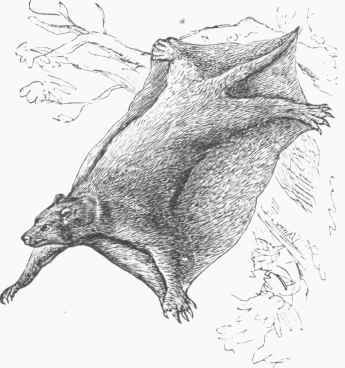
Flying Lemur (Galeopithecus volans).
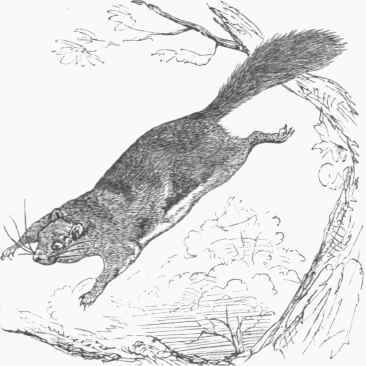
Flying Squirrel (Sciuropterus Hudsonius).
Continue to:


My Books

