


Gethsemane
Description
This section is from "The American Cyclopaedia", by George Ripley And Charles A. Dana. Also available from Amazon: The New American Cyclopædia. 16 volumes complete..
Gethsemane
Gethsemane (from Heb. gath shemen, oil press), a garden or olive plot near Jerusalem, and across the brook Kedron, to which Jesus with his disciples often repaired, notably on the night of his betrayal. The brook Kedron runs through a deep ravine, parallel with and about 200 yards from the E. wall of Jerusalem. Immediately beyond it rises the steep side of Olivet, which is still cultivated in rude terraces. The garden or olive patch of Geth-semane must have been situated somewhere on the slope. The precise spot is still an open question. There is a modern garden in which are eight ancient olive trees, with several younger ones, which have been planted or have sprung up from the roots of older trees. This spot was several years ago bought by the Latin church, and laid out in walks and flower beds. In it is pointed out the grotto of the agony, excavated in the rock, the descent to which is by a flight of rudely cut steps. The form of the interior is circular, about 15 ft. in diameter, the roof, supported by pilasters, being perforated to admit light. The Armenian and Greek churches deny that this is the true site of Gethsemane, and they have fixed upon another place a little to the north.
Dr. Robinson thinks that the site claimed by the Latins is that believed to be the true one by Eusebius and Jerome, and as likely to be so as any. Dr. Thomson thinks both sites are too near the city, and that Gethsemane was in the secluded valley still further to the northeast.
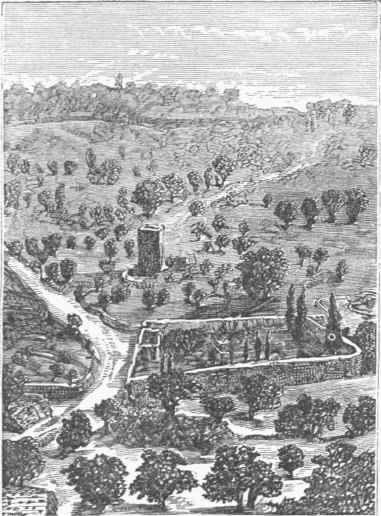
Gethsemane.
Continue to:


My Books

