


3060. Tying Down
Description
This section is from the book "Facts Worth Knowing", by Robert Kemp Philip. Also available from Amazon: Inquire Within for Anything You Want to Know.
3060. Tying Down
The operation of tying down corks merits a long notice, as without it many effervescent wines and liquids could not be preserved. The most common mode of fast-ening down works with the gingerbeer knot, which is thus made. First the loop is formed as in Fig. 1, then that part of the string which passes across the loop is placed on the top of the cork, and the loop itself passed down around the neck of the bottle, and by pulling the ends of the cord is made tight beneath the rim; the ends of the string are finally brought up, and tied either in a double knot, or in a bow on the top of the cork. When ginger-beer is made at home it will be found most advantageous to use the best corks, and to tie them down with a bow, when both corks and strings may be made use of repeatedly.
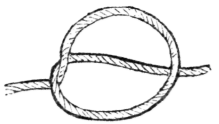
Fig. 1.
3061. For effervescent wines, such as champagne, gooseberry, etc , which require to be kept a longer time, and are more valuable, a securer knot is desirable, which may be made thus: A loop
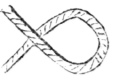
Fig 2.
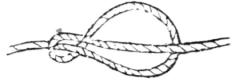
Fig. 3.
as in Fig. 2 is first formed, and the lower end is then turned upwards and carried behind the loop, as shown in Fig. 3; it is then pulled through the

Fig. 4.
Iook as in Fig. 4 and in this state is put over the neck of the bottle; the part a being on one side, and the two parts of the loop on the other; on pulling the two ends the whole becomes tight round the neck, and the ends, which should be quite opposite, are to be brought up over the cork, twice twisted, as in Fig. 5, and then tied in a single knot.
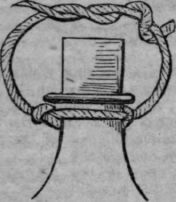
Fig. 5.
Continue to:


My Books

