


COPYRIGHT 453
Description
This page of the book is from "The New Student's Reference Work: Volume 1" by Chandler B. Beach, Frank Morton McMurry and others.
COPYRIGHT 453
COQUELIN
States have for 50 years had wonderful success with them.
Copyright is the exclusive right, under given conditions, by which an author, his executor, administrator or assignee is given control, for a definite period, of a work, whether literary, dramatic, artistic or musical—also extended to translations, abridgements, dramatic adaptations, patents and reproductions of the same and to magazine and newspaper articles. In Great Britain-the act at present in force (5 and 6 Vic. c. 45) fixes copyright at 42 years, or the period of the author's life, with a grace of seven years, whichever is the longer. To copyright a book or other article in the United Kingdom, a copy, with a fee of five shillings ($1.25) must be deposited with the Registrar, Stationers' Hall, London. The act provides that the owner of a copyright shall present one copy of the article protected, within three months of the day of publication, to the library of the British Museum without demand, and one copy each, if demanded, to the Bodleian library, Oxford; the University library, Cambridge; the Advocates' library, Edinburgh; and the library of Trinity College, Dublin. In Canada the same period of copyright is granted as is given in the United Kingdom, but the work must be registered and two copies deposited with the Minister of Agriculture, at Ottawa, accompanied by a fee of one dollar, fifty cents being required for a certified copy of the entry.
In the United States the original term of copyright runs for 2 8 years. Within six months before the end of that time, the author or designer or his widow or children may secure a renewal for -the further term of 14 years, making 42 years in all. The mode of securing copyright at Washington, D. C, is to forward prepaid to the librarian of Congress, on or before day of publication, a printed copy of the title of the book, map, chart, dramatic or musical composition, engraving, cut, print, lithograph or chromo or a description of the painting, drawing, statue, statuary or model or design for a work of the fine arts, for which copyright is desired. The legal fee for recording each copyright-claim is 50 cents, and for a copy of this record (or certificate of copyright under the seal of the office) an additional fee of 50 cents is required, making $1 in all. No copyright is valid, unless notice is given by inserting in every copy published, on the title-page or back thereof if it be a book; or if a map, chart, musical composition, cut, print, engraving, photograph, painting, drawing, chromo, statue, statuary or model or design intended to be perfected as a work of the fine arts, by inscribing upon some portion thereof, or on the substance on which the same is mounted, — the following: Entered according to Act of Congress in the year—, by------, in the office
of the Librarian of Congress, at Washington; or, at the option of the person entering the copyright, the words: Copyright, 19—, by
------. The copyright law of the United
States secures to authors and their assigns the exclusive right to translate or to dramatize any of their works; no notice is required to enforce this right.
International copyright was secured in the United States by a bill in Congress, passed in March, 1891, which took effect in the following July. This act is known as the Chase bill. It gives foreign authors a copyright in the United States of America when the book or production is from type set, or from negatives or drawings on stone made, within the United States. Musical compositions are exempted from the second condition. The act, however, applies to the work or production of a citizen or subject of a foreign state or nation only when such foreign state or nation permits to citizens of the United States of America the benefit of copyright on substantially the same basis as its own citizens, or when such foreign state or nation is party to an international agreement which provides for reciprocity in the granting of copyright, by the terms of which the United States of America may, at its pleasure, become a party to such an agreement. Th° United States has entered into agreements of reciprocal copyright with Belgium, Denmark, France, Germany, Great Britain and her possessions, Italy, Portugal Spain and Switzerland. An American may secure copyright in Belgium by registering his work at the Department of Agriculture, Industry and Public Works in Brussels. In France it is given upon the deposit of two copies of the work with the Minister of the Interior at Paris; in Switzerland, by the registration of the work at Berne in the Department of Commerce and Industry, with a copy to be there deposited, accompanied by a fee of two francs.
Coquelin (kok-lărí), Benoit Constant, a noted French comedian and, with his
brother, also an actor, a writer on stage-art, was born in 1841 at Boulogne, and educated at the Paris Conservatoire. He first appeared at the Théâtre Français in i860, and has met with great success in France, England and the United States in the representation of classic French comedy. His chief successes have been won in Le Marriage de Figaro; La Malade Imagi
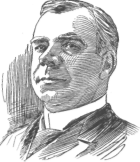
M. coquelin


My Books

