


•COTTONBOLL-WEEVIL
Description
This page of the book is from "The New Student's Reference Work: Volume 1" by Chandler B. Beach, Frank Morton McMurry and others.
•COTTONBOLL-WEEVIL
465
COUES
only with the invention of Compton's mule, invented about 1779. In 1785 came Cart-wright's power-loom and Watt's steam-engine as applied to cotton-spinning and weaving. Many improvements followed; the value of the cotton-goods exported yearly from Great Britain is over $355,-000,000, besides great quantities used at home. The first cotton-mill built in the United States was erected in 1793. The high price of cotton goods during the War of 1812 caused many mills to be built, and the drop in price when peace came caused a duty of 25 per cent, to be laid on imported cotton-goods, and the protected industry grew rapidly.
The yearly consumption of cotton is now over 16,000,000 bales. Of the cotton used in manufacture, Great Britain uses 35J per cent., the European continent 34J per cent., United States 23! per cent., and India 7 per cent.
Modern ingenuity has invented uses for nearly every part of the plant. Pulp is now made from cotton-stalks, from which is made the finest writing-paper. Cotton-seed is very rich in oil, and is now used for many purposes, especially in making lard. Cottonseed cake is largely used as food for cattle.
Cottonboll =Weevil is one of the worst foes of cotton. It is an insect that deposits its eggs on the young bolls. The larvæ bore into these, eat the inside of the seeds as well as the fibers, and ruin the fiber for spinning. The weevil lives about eighty days, and has two broods. ' It came from Mexico about 1892, and in 1907 had crossed Texas and Louisiana and invaded Mississippi. Efforts to exterminate it have failed, but native parasites and natural enemies are attacking it with increasing effectiveness. The Department of Agriculture is studying the pest and trying to breed weevil-proof varieties of cotton for infected regions.
Cotton, John (1585-1652), an eminent Puritan minister, was for 20 years pastor of Boston in Lincolnshire, England, and for almost as long in Boston, New England. Cotton, whose Puritan leanings made him an object of suspicion under the primacy of Laud, was to have been brought before the Court of High Commission for trial. He escaped, however, to London and, later, to Boston, New England. Both in England and in New England, the reputation of Cotton for learning was of the highest. Hehad an absolute command of Latin, Greek and Hebrew; and loved "to sweeten his mouth with a piece of Calvin" at the close of his day of twelve hours' study. Cotton opposed Anne Hutchinson, whom he had at first been disposed to favor; and disputed also with Roger Williams. Among his many works was the catechism Milk for Babes.
Cottonworm, the larva of a moth doing great damage to the cotton-plant by eat-
ing the foliage. It is estimated by officials of the United States government that the loss occasioned by this insect in a year of great abundance of cotton-plants amounts to 30 million dollars. The average loss is placed at 15 million dollars. The perfect insect is a small, brownish moth, which flies at night and deposits eggs on the under side of the leaves of the cotton-plant. These eggs hatch in mid-summer within three days, and at once is begun the destruction of the leaves. The larva, when full-grown, is about an inch and three fourths in length, of a light-green color, striped with white and black and spotted with black and yellow. When through feeding, the caterpillar folds a leaf about itself, spins a cocoon and pupates; shortly after emerging, the moth lays her eggs. There may be seven broods in a single season. A related species destroys cotton in the ball. See Riley: Entomological Commission's 4th Report (Washington, 188 5) ; Bulletin No. 18, New Series (Washington, 1898). Cotyledon ( kŏí'ĭ-lē' dŏn ), the first leaf or leaves developed by an embryo. In seed-plants the cotyledons are developed in the seed, and are more or less different from the usual leaf-form, often being fleshy from containing stored food, as in the bean and acorn. Generally the cotyledons escape from the seed during its germination, but in some cases, as in the acorn, they never leave the seed. See Embryo.
Couch, Darius Nash, an American general, was born on July 23, 1822, in Putnam County, New York; and died at Norwalk, Conn., Feb. 12, 1897. After graduating at West Point, he served in the Mexican War as lieutenant of artillery. He entered the Civil War as colonel of the 7th Massachusetts. He took part in the battles of Yorktown, Williamsburg, Fair Oaks, Malvern Hill, Fredericksburg and Chancellorsville. He was made major-general in 1862, and was in command of a division in the battle of Nashville.
Coues ( kouz ), Elliott, a notable American ornithologist, was born at Portsmouth, N.H., Sept. 9, 1842; and died at Baltimore, Md., Dec. 25, 1899. After graduating at Columbian University, Washington, D. C, in 1861, he entered the military medical service, and was for a time surgeon and naturalist on the U. S. northern-boundary commission. He was
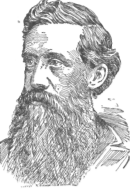
ELLIOTT COUES


My Books

