


DICHOGAMY 529 DICKENS
Description
This page of the book is from "The New Student's Reference Work: Volume 1" by Chandler B. Beach, Frank Morton McMurry and others.
DICHOGAMY
529
DICKENS
worn a crown. Instead, he cut his official salary to$i5,000 a year, and shamed wealthy officials from accepting any salary at all.
When Diaz became president in 1877, Mexico had about 9,000,000 people, of whom 8,000,000 or more were ignorant, poverty-stricken peons. To-day there are 20,000,000 people with a large middle class of public-spirited citizens capable of voting intelligently. Of railroads it had 500 miles, to-day 19,000, of which 10,000 are partially owned by the government. The revenues of $15,000,000 have been increased to $120,000,000 with a constant decrease in taxes. Thirty years ago Mexico had no credit. To-day it has a bonded debt of $200,000,000 and a surplus of $78,000,000. Its debt doubled by depreciation of silver, it adopted the gold standard and met its obligations. The sum of $12,500,000 has been spent on Vera Cruz harbor and $30,000,000 on the National Railway and on two harbors on the Isthmus of Tehuantepec. The imports and exports have grown from $18,000,000 to $90,000,-000. Foreign capital to the extent of $1,-200,000,000 has been invested in Mexican mines, railways, factories and plantations, and $200,000,000 of new money are pouring in every year. Public education has been established, manufacturing and trade are on the increase, The revenues are honestly collected and expended. There have been no public scandals. The uncrowned king of this republic has no private fortune. He lives on his salary of $25,000 a year, in a modest house in the city or in Cha-pultepec Castle, in simpler style than do many citizens. Once, when Diaz was reported to be seriously sick, Mexican bonds fell several points. This is one of the reasons he gives for remaining in office so long. When, however, he believes Mexico has learned the lesson of self-government, he proposes to retire. Heretofore there has been but one political party. Now he hopes to see a healthy division on patriotic lines, to stimulate interest and knowledge of public affairs. In the method employed to educate a people, for centuries under despotic rule, for self-government Diaz compares with the emperor of Japan. Both have been distinguished by such singular loftiness of purpose and practical success as to furnish a model for belated peoples and paternal governments. Dichogamy (dî-kŏg'ă-my) (in plants). The condition in flowers in which the stame ns and pistils do not mature at the same time. For example, the stamens may be ready to shed pollen when the stigma is not yet ready to receive it, or the stigma maybe ready to receive Collen before the stamens are ready to shed it. here thus are two forms of dichogamy, one in which the stamens mature first (protandry), the other in which the stigma is ready first (protogyny). See Pollination. .
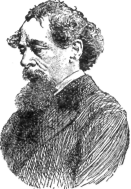
CHARLES DICKENS
Dichotomy (in plants). The method of branching in which the tip of the axis divides. The contrasting method is mono-podial branching. See Branching.
Dick'ens, Charles, a great English novelist, was born at Landport, near Portsmouth, Feb. 7, 1812; and died at Gadshill, near Rochester, England, June 9, 1870. When he was nine years old, the family fell into poor circumstances and moved to one of the poorer quarters of London, where the father was soon after arrested for debt, and Charles was placed in a blacking-factory. Not long after, his father was released and Charles was sent to school once more, where he stayed for three or four years. He then prepared himself to be a journalist, and became reporter on a London paper when he was 22. He then began writing for magazines and journals, and in 1836 his success was assured by the appearance of Pickwick Papers. Others of his works soon followed, and the remainder of his life was a record of one literary success after another. In 1842 Dickens visited America. His American Notes and Martin Chuzzlewit are satirical accounts of American manners and life. In 1850 he founded Household Words, a weekly periodical, in which several of his works appeared as serials. In 1859 this periodical ceased to be published, but Dickens issued another, called All the Year Round, for which were written several other of his novels. Dickens always had a strong liking for the drama, and often acted in private theatricals. His real ability as an actor was shown in his public readings of selections from his works. He gave many of these readings both in England and America, and it is said that his receipts in money from them were more than from all his novels. Perhaps more than any other English writer, Dickens put his own boyhood into his novels. Mr. and Mrs. Micawber are drawn from his own father and mother. David Copperfield, probably his greatest work, is said to be largely a story of his own life; while many others of his characters he had met when a boy, in his work at the blacking-factory, when visiting his father at the debtor's prison, at the Portsmouth dock where his father was a navy-clerk, or while he was at school. Few novelists are so universally read; prob-


My Books

