


55. Yale modification of Princeton wedge.
Description
This section is from the book "A Scientific And Practical Treatise On American Football For Schools And Colleges", by A. Alonzo Stagg, Henry L. Williams. Don't miss: The Blind Side: Evolution of a Game.
55. Yale modification of Princeton wedge.
This wedge differs in one very important respect from the preceding. Instead of being a part of the wedge formation the guards are placed outside of the wedge directly abreast of c.
Diag.55
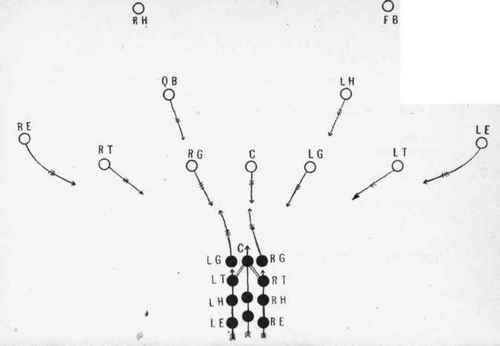
The instant the ball is put in play, lg and rg spring forward in advance of the wedge, and meet the opposing guard and center midway between the wedge and the point from which their opponents start.
Lg jumps directly into his man and attempts to throw him to the left, while rg, meeting the opposite c in the same manner, attempts to throw him to the right.
The wedge advancing immediately behind is thus saved the shock of being struck by the opposing guards under full headway.
The wedge may charge thus at an angle slightly to the right or left, the guards taking the opposing c and rg or c and lg, as the case may be.
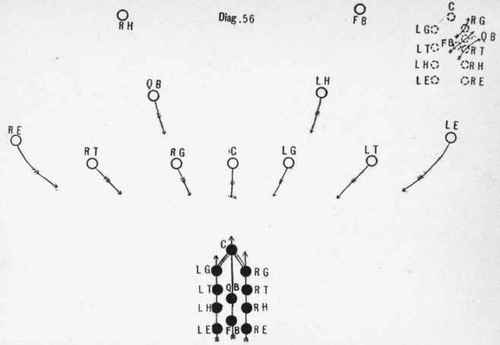
Note. As it is highly desirable that the men without the wedge be swift and dashing, it may be found more advantageous to place the tackles, or two comparatively light men, in these positions, while the guards are retained within the wedge itself.
Continue to:


My Books

