


The Upper Danube. Part 7
Description
This section is from the book "The Upper Danube - John L. Stoddard's Lectures", by John L. Stoddard. Also available from Amazon: John L. Stoddard's Lectures 13 Volume Set.
The Upper Danube. Part 7

Monument To La Tour D'Auvergne At Oberhausen.
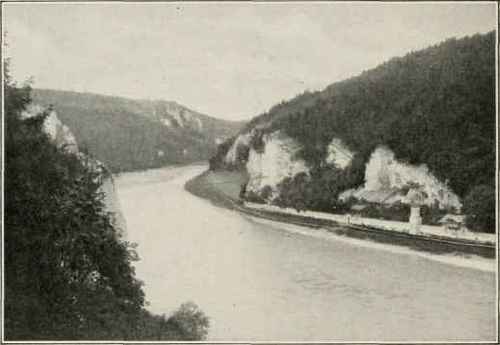
Historic Shores.

Roman Ruins At Abusina.
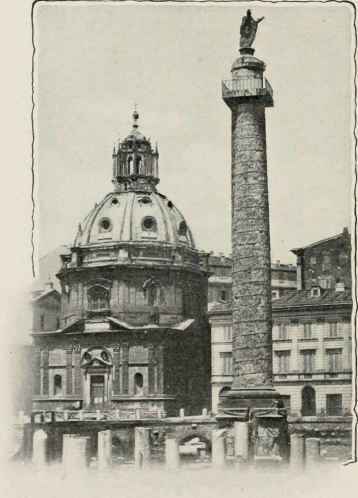
Trajan's Column In Rome.

Monastery Of Weltenburg, The Site Of A Roman Stronghold.
For we must not forget that the vast territory, now divided into Austria, Bavaria, Hungary, and the Tyrol, was not then the explored and traversable country that it is to-day.
Unknown and half-impenetrable swamps and forests covered thousands of square miles; the mountains were appalling in their sullen gloom; no proper roads existed; the streams were practically bridge-less; and the whole vast expanse swarmed with courageous warriors, against whom Roman legionaries had to fight, not with the scientific weapons of the moderns, whose Mauser rifles and machine guns mow down at a distance relatively unarmed natives, but man to man, and hand to hand. Yet in the face of such stupendous obstacles they not alone subdued the warlike tribes, but laid throughout these subjugated wildernesses a network of those splendid roads which form the skeleton of modern Europe, establishing along them also for enormous distances forts, camps, and colonies at hundreds of strategic points.
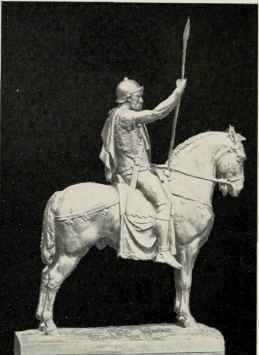
A Roman Horseman.
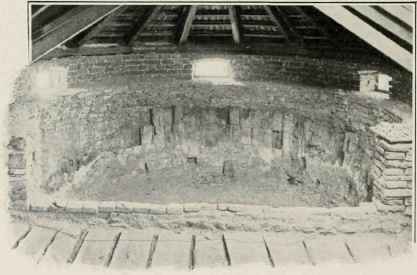
Base Of An Old Roman Tower, Near The Danube.
Singularly enough, however, in this same cliff-lined portion of the Danube we find a modern engineering triumph, not unworthy of the Romans. Before arriving here, had any one asked me if a boat could pass through a continuous waterway from the terminus of the Danube in the Black Sea to the Hook of Holland, nearly three thousand miles away, I should have promptly answered in the negative. Yet such is actually the case, the passage through the centre of the continent being effected largely by the Ludwig Canal, completed here in 1845 by the enterprising king of Bavaria, Ludwig I. Beginning at Kelheim on the Danube, it traverses Bavaria northward for one hundred and sixteen miles to Bramberg on the Main; and since the latter river joins the Rhine at Mainz, there is established thus direct communication between one end of Europe and the other. The idea of this long, connecting link between the North Sea and the Euxine is magnificent; but, as a matter of fact, the work has not proved the success which was anticipated. It suffers from too many-narrow locks, and is in all respects too small to be a serious rival to the numerous railway lines, built since the date of its construction.

The Danube, Near Kelhe1m.
The confluence of two rivers, even in a wilderness, forms always a conspicuous landmark, and in a civilized country plays a prominent part in its development. Strategic or commercial reasons lead inevitably to the founding there of fortress or of settlement, each destined to become a kind of loom, on which are woven infinitely varied threads of individual and collective lives, whose mingled patterns ultimately form vast tapestries of civic history or golden-tissued veils of legend and romance. Each affluent of the Danube, therefore, brings to it not only an increase of volume, but also makes with it a nucleus for countless human struggles, failures, and achievements. Nowhere is this more evident than at the spot where, at the union of the Regen with the Danube, lies the historic town of Regensburg, called by the French and English Rat-isbon. Quite early in the Christian era this became a frontier fortress of the empire, known as Castra Regina, and many a Caesarian legion had its station here on what was then the edge of the barbaric world. Few Roman relics now remain in Regensburg; but its stone bridge, eleven hundred feet in length and built eight centuries ago, reminds us of the city's golden age, when it held rank among the richest and most influential capitals of Germany. There is a proverb to the effect that of all German bridges that of Dresden is the handsomest, that of Prague the longest, and that of Regensburg the strongest. The last is certainly the highest praise, and doubtless this substantial structure symbolized the sturdy character of those who built it. It is not only in the Orient and on the Mediterranean littoral that one finds evidences of departed glory. Northern and central Europe also furnish many pictures of decadence. . The grass is growing in the streets of Bruges; Augsburg and Nuremberg, while still attractive, are but shadows of their former selves; and Regens-burg, although to-day a fairly prosperous Bavarian city of forty thousand inhabitants, is nothing in comparison with what it was from the eleventh to the fifteenth century. For then the path of commerce between central Europe and the Orient coincided with the Danube, and trading vessels from the Black Sea went and came along its current, while from this city, as a great distributing market, goods which had lately left the Eux-ine or the Bospho-rus, were carried by a score of lesser streams, or over inland highways, through the rest of Europe.
Continue to:


My Books

