


Athens. Part 2
Description
This section is from the book "Athens - John L. Stoddard's Lectures", by John L. Stoddard. Also available from Amazon: John L. Stoddard's Lectures 13 Volume Set.
Athens. Part 2

Through Grecian Waters.
But the Piraeus, after all, is merely a doorway to glories beyond. Hence one quickly leaves the steamer here, and hastens to the capital itself, six miles away. A train of streetcars, drawn by a steam-engine, was one of the first objects that confronted us in the streets of Athens, but even this reminder of the nineteenth century could not dispel the fascination of antiquity. It all swept back upon me. The locomotive and the tram-cars faded from my view, and in their place I saw again my school-room, with its rows of well-worn desks. Once more was felt the summer breeze, as it stole through the open window, and lured me from my lexicon to the fair fields. Xenophon's graphic prose and Homer's matchless verse at last seemed real to me; for over the shop-doors were the Greek characters that I had learned in boyhood, and on the corners of the streets were words once uttered by the lips of Socrates.
Even before the tourist reaches the outskirts of the city of Minerva, he plainly sees rising in bold relief against the sky, what was in ancient times the gem of Athens, the casket of the rarest architectural jewels in the world, - the temple-crowned Acropolis. It is a memorable moment when one first beholds it. No other citadel in the world has embraced so much beauty and splendor within its walls. Not one has witnessed such startling changes in the fortunes of its possessors. Its history reaches back over a period of two thousand four hundred years. Wave after wave of war and conquest have beaten against it. It has been plundered by the Persian, the Spartan, the Macedonian, the Roman, the Venetian and the Turk. Yet there is now a modern city at its base, astonishingly new and fresh, compared with its historic background. The buildings of to-day and those of two thousand years ago seem gazing at each other with surprise. Yet there is no hostility between them. Despite her tattered robes of royalty, Old Athens sits enthroned as the acknowledged sovereign. New Athens kneels in reverence before her. For the modern Greeks still cling with pride to the memories of Pericles and Phidias, and sigh when they think of the glory that once was theirs.
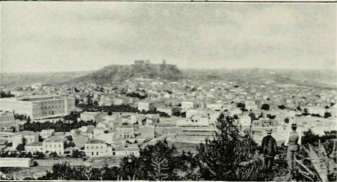
The Distant Citadel.
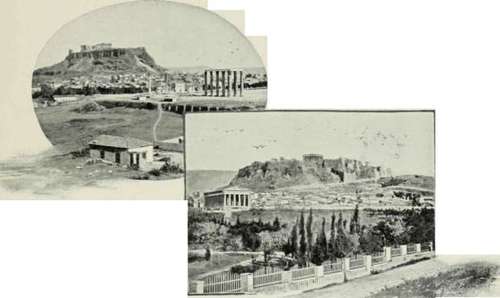
A Walk Around The Acropolis.
A walk around the Acropolis reveals the fact that it is a natural mass of rock, built up in places by substantial masonry. On three sides it is practically perpendicular. Two thousand years ago its summit rose toward heaven, like a magnificent altar consecrated to the gods. There, elevated in the sight of all, and overlooking the adoring city on the one side and the blue AEgean on the other, stood those incomparable specimens of architectural beauty, grace and majesty, which have made Athens immortal. Even now, although its temples are in ruins, the few remaining columns of the Parthenon stand out in delicate relief against the sky, like strings of an abandoned harp, which even the most skilful hand can never wake again to melody.
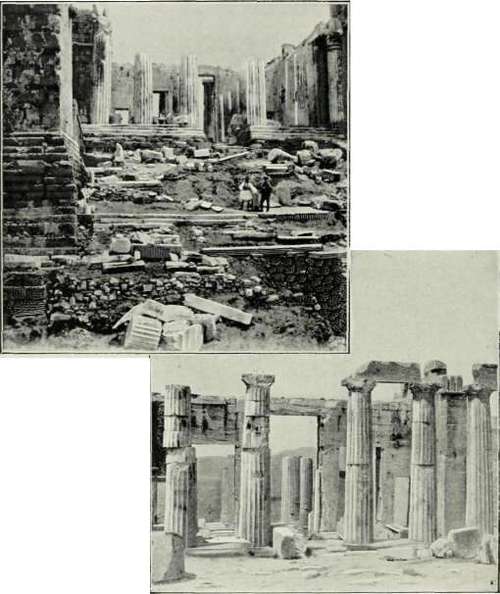
The Propylaea.
In making the ascent of this historic eminence by the only avenue of approach, the traveler soon finds himself before the ruined entrance to the Acropolis, - the Propylaea. This was originally a majestic gateway of Pentelic marble, crowning a marble staircase seventy feet in breadth, which led up from the city to the brow of the Acropolis. Its cost was two and a half millions of dollars. It was considered, in its prime, equal, if not superior, to the Parthenon. Nor is this strange, for this portal was a veritable gallery of art. Along its steps were arranged those chiseled forms that almost lived and breathed in their transcendent beauty, - the masterpieces of Praxiteles and Phidias, the mutilated fragments of which we now cherish as our most perfect models of the beautiful.
Yet there was nothing effeminate in this magnificence. Solidity and splendor here went hand in hand. When the Propylaea was finished, under Pericles, more than four centuries were still to pass before the birth of Christ; yet so much strength was here combined with beauty, that, if no human hands had striven to deface it, its splendid shafts would, no doubt, still be perfect. The columns that remain appear to stand like sentinels, guarding their illustrious past. It thrills one to reflect that these identical pillars have cast their shadows on the forms of Phidias, Pericles, Demosthenes, and indeed every Greek whose name has been preserved in history.
Continue to:


My Books

