


Ireland. Part 25
Description
This section is from the book "Ireland - John L. Stoddard's Lectures", by John L. Stoddard. Also available from Amazon: John L. Stoddard's Lectures 13 Volume Set.
Ireland. Part 25
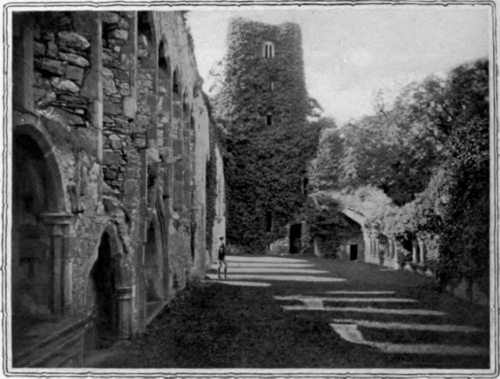
Relic of Ireland's golden age, adfert abbey.
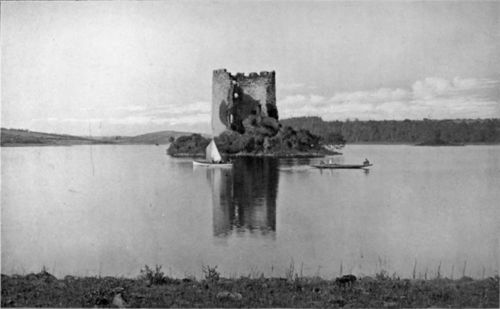
An Irish Stronghold.
In this connection it is impos-sible not to dwell a moment on the second grand ecclesiastical figure in Ireland in those early days, - Saint C o 1 u m b a. Around Saint Pat-rick, who introduced Christianity there, many myths have gathered; but of the character and life of his remark - able successor there exists a vast amount of undisputed and indisputable testimony. Of princely birth, and closely related to one of the supreme kings of Ireland, this wonderful man received in his youth part of his education from Saint Finnian, surnamed "The Wise," whose oratory is one of the interesting ecclesiastical sights of Killaloe. His name, Colum-ba, signifies a Dove; but if he resembled that gentle bird in the sweetness of his character, he was more like an eagle in the energy which he exhibited, and the lofty heights to which he rose. In his extraordinary career he is said to have founded one hundred monasteries and three hundred and sixty-five churches, and to have ordained three thousand priests. In the year 565 a.d., when forty-four years old, Columba with twelve of his disciples left Ireland, to preach the Gospel to the inhabitants of Scotland, crossing the intervening water in small, primitive boats, which were nothing more than baskets made of willow twigs covered with skins, such as, in fact, are used even now by some of the natives on the river Boyne. Establishing himself on the island of Iona, off the Scottish coast, he speedily made of it a stronghold of religious influence, which presently became so reverenced, as the " Holy Island," that to its consecrated soil the bodies of the kings of Scotland, Ireland, and Norway were often brought for burial.

ST. columba's house, kells.

A Wicker Boat.

ST. columba's bedroom.
Difficult as it may be for some to think of Ireland as a seat of learning, it is a fact that in the sixth and seventh centuries students flocked to her shores from every part of Europe, eager to gain instruction in her schools. Adhelm, an English bishop of the sixth century, states that they went to Ireland from Great Britain in "fleet-loads." The Emperor Charlemagne, also, admired the scholarship of the Irish so much that he invited several of them to his Court, and placed them in positions of high honor. In the meantime England had practically lapsed into paganism. It was recovered to Christianity by two vigorous attacks: one on the south, conducted by Saint Augustine, sent out from Rome; the other from the north, accomplished by the followers of Columba. We have already seen how many of the fine arts flourished at this time in Ireland. Never had any Christian people better prospects of a glorious future. But suddenly the dark clouds gathered; a chilling, deadly storm swept downward from the distant north; and the fair blossoms, flowers and fruits of Erin's national greatness and prosperity were blighted for a thousand years. This storm was the invasion of the Danes. The Scandinavian Sea Kings command a certain amount of admiration because of their indomitable courage, energy and spirit of adventure. In these qualities it is probable that the world has never seen their equals. But they were certainly for centuries a frightful scourge to western Europe, and they injured Ireland irreparably. When their ships swept for the first time toward the Celtic coast, the Irish had become converted to the milder doctrines of Christianity. Thousands of priests had risen from the ranks of pagans, and world-famed scholars had succeeded warlike savages. A new ideal had been placed before the nation. Hands that had grasped the sword, now held the pen.

ST. Bridget's Well, Armagh.

The Work Of The Iconoclast.

A Celtic Stronghold, Near Derry.
Cromlech and cairn were less conspicuous than church and cross. Upon this promising field of intellectual culture and national development the Scandinavian invasions fell. The worshipers of Odin met the followers of Christ in a prolonged and fearful struggle which lasted for two hundred years. The latter ultimately triumphed; but when, in 1014, the last Dane had been killed or driven into the sea by the great king of Munster, Brian Boru, it was perceived, alas, that, just as the king himself, as well as his son and heir, had perished in the decisive battle, so, in the long-continued conflict of two centuries, Ire land had been wounded well nigh unto death. What wonder? Year after year the Danish hordes had rushed out from their northern lairs, like packs of famished wolves. Making descents upon the Irish coast, they fought with desperation, plundered, murdered, and were quickly off again upon their boats, laden with spoils and captives. Libraries, monasteries and churches were their favorite looting ground; for they had found that in them were preserved the island's greatest treasures, manuscripts, ecclesiastical ornaments and sacred vessels. Moreover, when these buildings had been pillaged, so bitter 0was the Scandina-vian's hatred of Christianity that the edifices themselves were as far as possible destroyed. Weary at last of going home and coming back again, the northern vandals built for themselves towns and fortresses at certain advantageous points in Ireland, from which they could conveniently make raids, when they felt so inclined. Two hundred years is a long time to live in such perpetual insecurity; and after churches have been sacked and burned a score of times, one has no longer courage to rebuild them. Accordingly, the result of these repeated acts of rapine and disorder was disastrous to the culture and Christianity of the island. Still, after the expulsion of the Danes, a slow recovery might have been possible, if Erin had had time in which to recuperate, before another calamity fell upon her. But great confusion had at first prevailed after the death of Brian Boru, and in 66 occurred the invasion from England, which inaugurated a conflict that continued more or less openly for nearly seven hundred years. Even to-day its fires are still smoldering. Whatever, therefore, we may think of Ireland's rights and wrongs, the fact remains - persistent, sad and terrible - that the superlatively brilliant prospects of her early national life have never been fulfilled. Conquest, oppression and bad government are principally responsible for the blighted fruit. And how the sons of Ireland have felt it! How they have longed for the revival of her ancient glory! In every speech of her unrivaled orators, in every stanza of her gifted poets, the same lament breaks passionately forth, the same fond hope is uttered with the fervor of a prayer. Driven by hunger from their mother's side, their love goes back to her across the sea. The Irish exile's heart is never cold. If, therefore, on the grave of Ireland's blighted promise an epitaph could be inscribed, I would select for it these words, which I discovered on a tombstone near the ruined church of Glendalough:
Continue to:


My Books

