


Ireland. Part 35
Description
This section is from the book "Ireland - John L. Stoddard's Lectures", by John L. Stoddard. Also available from Amazon: John L. Stoddard's Lectures 13 Volume Set.
Ireland. Part 35
On one of those memorable days whose sunshine, lingering far into the night, makes summer in the north of Europe so delightful, I sat in a secluded spot upon the Irish coast, from whose sea-sculptured cliffs the ocean stretched away, with not a sound of surf or glint of passing sail. Absorbed in reading Irish history, I had not noticed an approaching squall, which struck the shore so suddenly that I had hardly time to reach a neighboring cabin, from whose rude shelter I looked out upon the tumult of the elements. The ocean, recently so beautifully clear, was soon completely hidden by a steel-gray wall of slanting rain. Upon a cloud of inky blackness unseen fingers traced at intervals mysterious characters of fire. Between loud peals of thunder, the wind moaned mournfully around the cliffs, as if their splintered crags were strings of an Eolian harp. This tempest seemed a fitting background for the mental picture I had just been forming; for where indeed can Ireland's tragic history be more appropriately read than in the midst of lurid lightning and appalling thunder, suggestive of the storms of human passion which have so often drenched with blood and swept with flame her naturally fertile fields? The page grew blurred before my eyes as I recalled the long, long list of Ireland's calamities, and thought of all that she had given promise of becoming, when she was famous throughout Europe for her piety and learning. Summed up in a few words, a study of her history leaves upon the mind the sad conviction that, on the whole, no country in the world has suffered more, and probably none, but for man's wickedness and folly, need have suffered less. Filled with these thoughts, I once more walked out on the lonely cliffs. The storm had swept across the water to the distant west. Its rear-guard of black clouds dropped, one by one, below the edge of the Atlantic, until at last, in a long, radiant curve, the ocean's dark-blue rim met that of heaven's turquoise dome. The solemn, limitless expanse, unruffled by the transient agitation of the previous hour, heaved gently in the opalescent light of summer's waning day. " Poor Ireland," I murmured, " would that this harmony of cloudless firmament and tranquil sea might be symbolic of thy future, as the departed storm is emblematic of thy past! " At present I believe that wish is likely to be realized. A brighter sky than ever yet made luminous this emerald of the northern seas is dawning on her happier, hope-inspired children. The melancholy years of her heart-breaking history, dark with innumerable clouds of misery, have sunk below the horizon of the Past. Heaven forbid that any child of Albion or Erin should seek to resurrect the ghosts of those crime-blackened centuries! Let them remain, amid the countless other wrecks of poor humanity, forever buried in the ocean of oblivion.

Solitude, Kilkee.
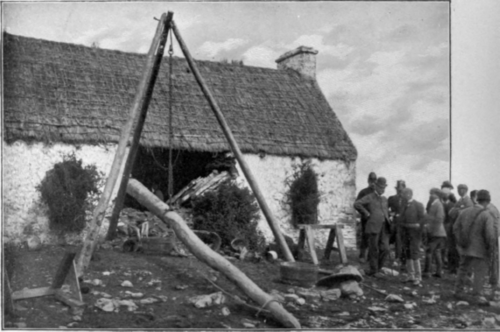
Battering Down A Home, An Eviction Scene.
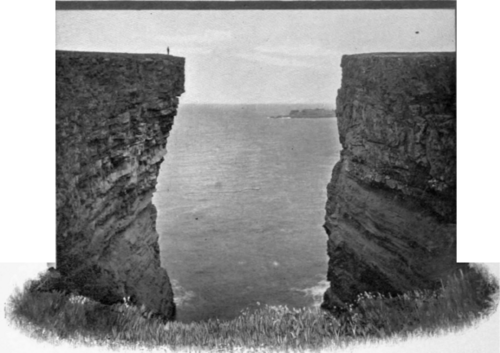
The Sea's Great Sepulchre, Horseshoe Cliff, Kilkee.
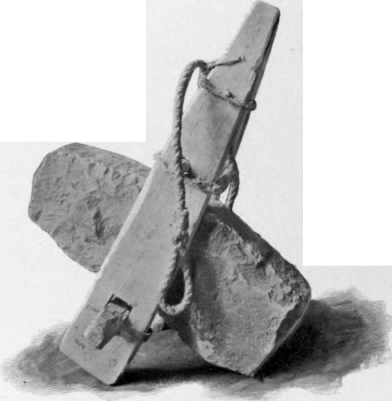
A Primitive Irish Anchor.
Continue to:


My Books

