


Genoa. Part 2
Description
This section is from the book "Genoa - John L. Stoddard's Lectures", by John L. Stoddard. Also available from Amazon: John L. Stoddard's Lectures 13 Volume Set.
Genoa. Part 2
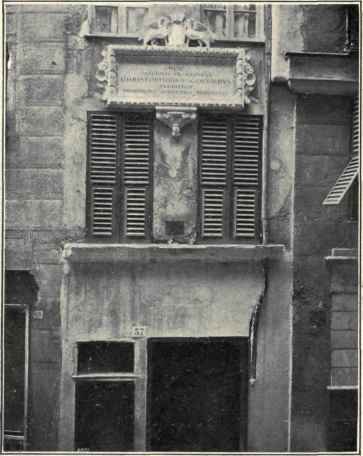
Early Home Of Columbus, Genoa.

A Corner Of Genoa's Harbor.
With these advantages, Genoa naturally grew to be a financial centre of the first importance, and her once celebrated Banco di San Giorgio, founded in 1407, commanded for four hundred years the admiration of all Europe, and was the first bank in the world to issue circulating notes, negotiable by indorsement and not made merely payable to bearer. This was the place of registration, too, of Government loans, the interest and sinking fund of which were secured by a stated branch of the public revenue, so that the shares, which were always promptly paid, were as negotiable as United States bonds and English consols are to-day. In respect to national credit, therefore, Genoa was several centuries in advance of England, where market dealings in State funds began only in 1689. In fact, until the downfall of the Genoese Re-public at the time of the French Revolution when it was not alone plundered by French troops, but when at one fell swoop the sponge was passed over all of its outstand-ingaccounts, the Banco di San Giorgio had a credit no less solid and substantial than that which is enjoyed to-day by the Bank of England, and both the latter institution and the Bank of Amsterdam were practically modeled after Genoa's "St. George's." Within this ancient edifice still hangs the bell which formerly called the Council of Directors to their meetings; and this was presented to the bank, in the seventeenth century, by the Dutch Republic in return for a copy of its rules and regulations with which the Hollanders had asked to be supplied. But now thisold, financial stronghold, which once administered to some extent the affairs of Corsica, as well as those of several ports in Asia Minor, and even of colonies in the Crimea, is no more. It has become an ordinary customhouse, with nothing to remind us of its ancient glory, save its handsome, monumental hall, made interesting by its numerous statues of Genoa's illustrious benefactors. The fact that some of these figures are seated and others standing is not, as might be fancied, due to a wish on the part of the sculptors to exhibit here variety, but to a rule established by the Council. Thus the distinction of a seated statue belonged exclusively to those who had contributed to the State a sum equivalent to fifty thousand dollars; but standing statues could be gained by smaller gifts. In every case, however, the method of the donors was to leave their money in the bank at compound interest for at least half a century, and then, when the amounts had grown to very large proportions, to let them be applied to the removal or the diminution of some tax, which had weighed heavily upon the poor.

Bronze Statue Of Columbus, Palazzo Rosso, Genoa.

Old Bank Of San Giorgio.
In this connection a curious feature of the olden times is called to mind by the ancient title "Banco di San Giorgio," as well as by the name of the Genoese Exchange, - the "Loggia de' Ban-chi," or the Portico of the Benches. For in the days when both these institutions flourished here, it was the custom in Italy for money lenders - principally Jews - to come together in the market places, where each one had his special bench, or "banco," which served at the same time as seat and counter. Whenever one of these bankers failed, his bench was broken, and he himself was called a "Bancorotto" or a "Broken Bench," the force of which expression still remains, though rarely borne in mind by those who use it, in our modern "Bankrupt." In view of this peculiar strength of Genoa in the past, it is interesting to remember that her banking business even now surpasses that of any other town in Italy. Moreover, since the opening of the St. Gotthard tunnel, Genoa has become not only the chief commercial city of the kingdom, but also, with the exception of Marseilles, the principal port in the Mediterranean. Indeed, if the recent lamentable strikes in Marseilles are repeated, the balance will perhaps be turned in favor of the Italian town.
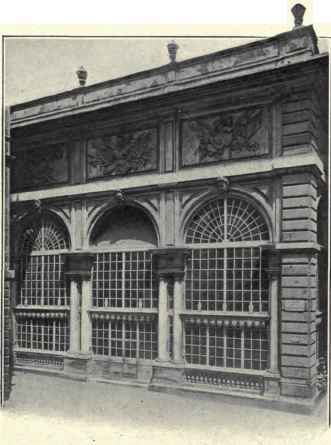
The Bourse, Genoa.
Continue to:


My Books

