


Around Lake Garda. Part 3
Description
This section is from the book "Lake Garda - John L. Stoddard's Lectures", by John L. Stoddard. Also available from Amazon: John L. Stoddard's Lectures 13 Volume Set.
Around Lake Garda. Part 3

Old Roman Tower Near Waidbruck, On The Brenner.

An Olive Grove Near Arco.

Old Gothic Church, And Vogelweide's Statue, Botzen.
A little more than thirty miles below their point of union, and just before we leave the valley for Lake Garda, we reach a city so conspicuously picturesque, with towers, battlements, and walls, that it deserves from every tourist more than a passing glance; for this is not alone the second largest city in Tyrol, but is the old Tridentum of the Romans, the shortened syllables of whose ancient name are now heard in our own concise word Trent, and in the softer Italian title Trento. The frontier line, which, after the victories of Louis Napoleon and Victor Emmanuel, had to be drawn anew between United Italy and Austria, left Trent some twenty-five miles north of the Italian boundary. One naturally feels, on this account, a certain amount of sympathy for its inhabitants: not that their lot is any harder under Austrian than it would be under Italian government, but from the fact that Trent seems naturally to belong to Italy. One hears in its cafes, shops, streets, and churches practically nothing but Italian; and its piazzas, market-places, and old marble palaces give it a close resemblance to Verona. Moreover, the principal modern monument in Trent is not the statue of some famous Austrian, but a memorial in bronze of the great Florentine poet, Dante.

An Old Inn At Botzen.
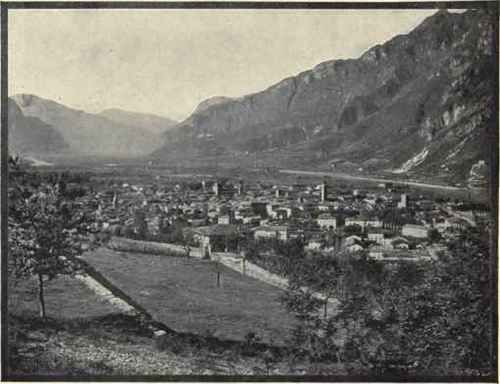
Trent, And The Valley Of The Ad1ge.
There is a melancholy sense of faded glory and of vanished grandeur in this ancient city. Its site is one of those which civilized men inevitably choose for an abode; and, lying, as it does, directly on an international highway, it has had for two millenniums an eventful history. Hence, if some Tyrolese Walter Scott should undertake to write romantic stories, based upon the battles, feuds, crimes, glories, and imposing pageants which this frontier town has witnessed, he would find ready to his hand as much material as Scotland's border land furnished for the Waverley novels. But of that olden time little remains in architecture save an outer shell of former power and splendor. Most of its stately palaces - well worthy of a place in Genoa or Florence - have fallen into sad decay, or are now used as banks and shops; while the Palazzo Tabarelli, designed by the illustrious architect Bramante, the predecessor of Michael Angelo in the building of St. Peter's, has been transformed into a restaurant. Even the massive castle, once the lordly residence of the prince-archbishops who ruled the entire Trientino district for more than seven centuries, is now dilapidated, and its old Roman tower looks down no longer on a splendid court of temporal and spiritual sovereigns, but on the barracks of an Austrian garrison.

The Memorial To Dante At Trent.
But that which gives to Trent its greatest prominence in history is the ecclesiastical council, held here in the sixteenth century. Far be it from the author to allow himself to make the least digression here into the barren field of theological controversy. Suffice it only to remark that this great convocation of cardinals, patriarchs, archbishops, and bishops, together with twenty-nine ambassadors from secular princes, had for its primary purpose to bring about, if possible, some reconciliation between the newborn Protestantism of Luther and the Church of Rome, and to avert the perils of a crisis, which had already passed from words to deeds, and threatened Europe with religious war. Tedious and long had been the diplomatic wrangling as to a suitable city for this ecumenical assembly - the German emperor and princes objecting to its being held upon Italian soil, the Pope as strenuously opposing any site in Germany. Finally Trent - a city of Tyrol - was chosen as the result of mutual concessions; and, after many postponements and delays, the famous council was convened in 1545, a few months previous to the death of Luther. It may be said to have been in session here for eighteen years; for whatever meetings it did hold took place in this city, and it was not officially disbanded until 1563. But during that long period it had many interruptions, one of which lasted for ten years.
Continue to:


My Books

