


Venice
Description
This section is from the book "Venice - John L. Stoddard's Lectures", by John L. Stoddard. Also available from Amazon: John L. Stoddard's Lectures 13 Volume Set.
Venice

Venice is still victorious over Time. Despite her age, the City of the Sea is fascinating still. She has successfully defied a dozen centuries; she may perhaps defy as many more. All other cities in the world resemble one another. Venice remains unique.
She is the City of Romance - the only place on earth today where Poetry conquers Prose. The marriage of the Adriatic and its bride has never been dissolved. She is to-day, as she has been for fourteen hundred years, a capital whose streets are water and whose vehicles are boats. She is an incomparable illustration of the poetical and the picturesque; and, were she nothing else, would still attract the world. But she is infinitely more. The hands of Titian and Tintoretto have embellished her. She wears upon her breast some architectural jewels unsurpassed in Italy. And, finally, the splendor of her history enfolds her like the glory of her golden sunsets, and she emerges from the waves of Time, that have repeatedly endeavored to engulf her, as do her marble palaces from the encircling sea.

Statue Of Victor Emanuel.
The charm of Venice begins even at what is usually the most prosaic of places - a railway station. For, to a city where there are no living horses, the iron horse at least has made its way; and by a bridge, two miles in length, Venice is now connected with the outer world by rail. A quick, delicious feeling of surprise comes over one to see awaiting him in the place of carriages a multitude of boats. The pleasing sense of novelty (so rare now in the world) appeals to us at once, and, with the joyful consciousness of entering on a long-anticipated pleasure, we seat ourselves within a gondola, and noiselessly and swiftly glide out into the unknown.
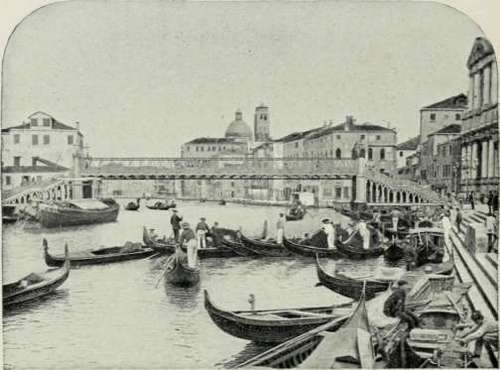
The Railway Station.
The first surprise awaiting almost every visitor to Venice is that of seeing all its buildings rise directly from the sea. He knows, of course, that Venice rests upon a hundred islands, linked by four hundred and fifty bridges. Hence, he expects to see between the houses and the liquid streets some fringe of earth, some terrace or embankment. But no: - the stately mansions emerge from the ocean like a huge sea-wall, and, when the surface of the water is disturbed by a light breeze or passing boat, it overflows their marble steps as softly as the ultimate ripple of the surf spreads its white foam along the beach. As, then, our gondolier takes us farther through this liquid labyrinth, we naturally ask in astonishment, "What was the origin of this mysterious city? How came it to be founded thus within the sea?" The wonder is easily explained. In the fifth century after Christ, when the old Roman empire had well-nigh perished under the deadly inroads of barbarians, another devastating army entered Italy, led by a man who was regarded as the "scourge of God." This man was Attila. Such was the ruin always left behind him, that he could boast with truth that the grass grew not where his horse had trod. A few men seeking to escape this vandal, fled to a group of uninhabited islands in the Adriatic. Exiled from land, they cast themselves in desperation on the sea.
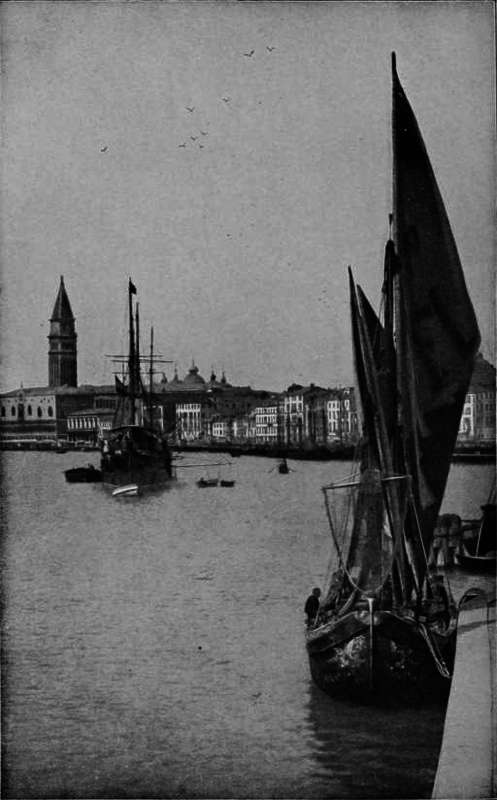
The Bay Of Venice.
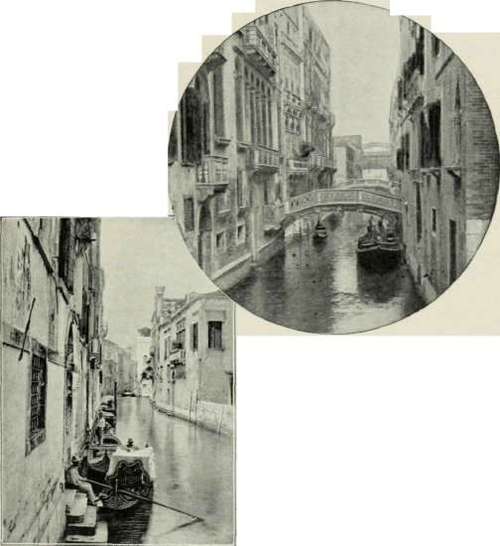
A Liquid Labyrinth.
Like A Huge Sea-Wall.
But no one can behold this ocean-city without perceiving that those exiles were rewarded for their courage. The sea became their mother, - their divinity. She sheltered them with her encircling waves. She nourished them from her abundant life. She forced them to build boats in which to transport merchandise from land to land. And they, obeying her, grew from a feeble colony of refugees to be a powerful republic, and made their city a nucleus of vast wealth and commerce, - a swinging door between the Orient and Occident, through which there ebbed and flowed for centuries a tide of golden wealth, of which her glorious sunsets seemed but the reflection.
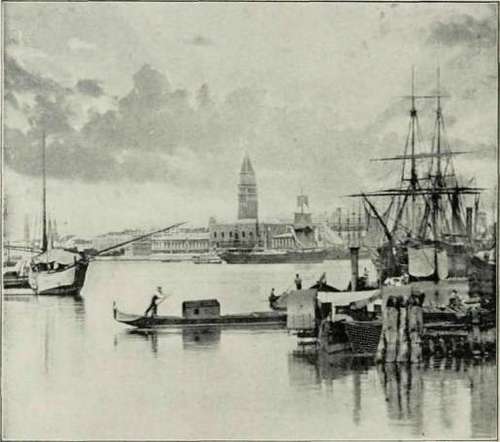
The Ocean City.
Who can forget his first glimpse of the Grand Canal? Seen at a favorable hour, the famous thoroughfare delights the senses as it thrills the heart. For two miles it winds through the city in such graceful lines that every section of its course reveals a stately curve. Upon this beautiful expanse the sun of Venice, like a cunning necromancer, displays most marvelous effects of light and shade, transforming it at different hours of the day into an avenue of lapis-lazuli, or emerald, or gold, - an eloquent reminder of the time when Venice was a paradise of pleasure, when life upon its liquid streets was a perpetual pageant, and this incomparable avenue its splendid promenade. Its curving banks are lined with palaces.
Continue to:


My Books

