


St. Petersburg. Part 5
Description
This section is from the book "St. Petersburg and Moscow - John L. Stoddard's Lectures", by John L. Stoddard. Also available from Amazon: John L. Stoddard's Lectures 13 Volume Set.
St. Petersburg. Part 5

The Nevski Prospekt.
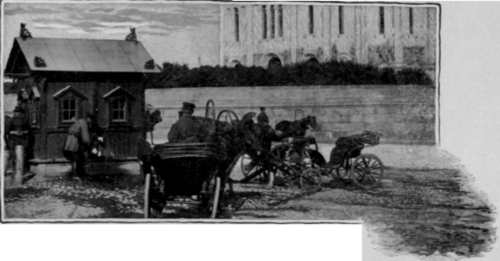
A Characteristic Scene.
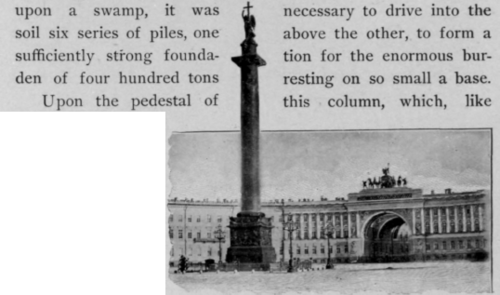
The Alexander Column.
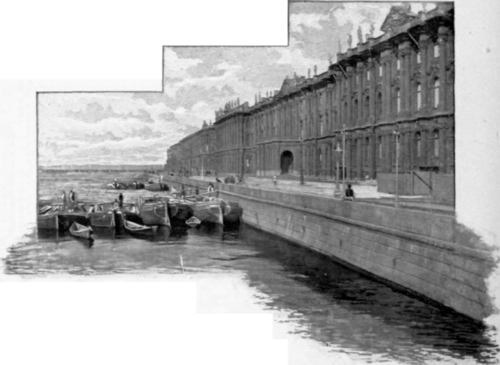
The Palace Quay.
Close by the Alexander Column stands the Winter Palace,-one of the largest buildings in the world, - and, during the greater part of the year, the residence of the Tsar. It is imposingly designed, for its dimensions are gigantic. It is also superbly situated, for close beside it rolls the Neva, like a flood of silver.
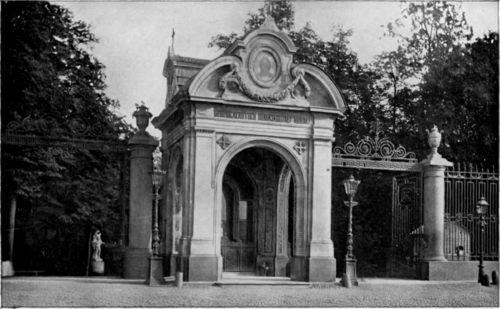
Memorial Chapel To Alexander.
How vast must be the expense of keeping this monstrous residence in perfect order! It would be great enough, if managed honestly; but it has recently come to light that there have been " political" housecleaners in this imperial abode. Thus, for a long time fifteen hundred roubles were charged annually merely for brooms to sweep this palace; but, on examination, it was found that, at that rate, fifty brooms must have been worn out every day during the reign of Alexander II. From this single item one can imagine what other frauds have been perpetrated here, and can understand the remark of the Tsar Nicholas, when he exclaimed sadly, " My son and I are the only men in Russia who do not steal."
In winter, when a ball is given, these halls are sometimes converted into tropical gardens, by the introduction of exotic plants and flowers. The guests then pass, as if by magic, from snow-covered streets and a temperature of thirty degrees below zero, into the gorgeous splendor of a southern carnival; and, only a few feet distant from icicles and the glacial blasts of the north, they inhale the fragrance of orange blossoms, and feel upon their cheeks a warmth soft as the breath of Egypt. Such scenes are characteristic, too, of entertainments given by wealthy nobles; for, born amid snow and ice, the Russians have a passion for these emblems of a warmer clime.
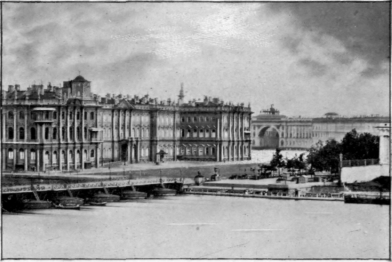
The Home Of The Tsar.
In one room of the Winter Palace, guarded night and day, are kept the Crown Jewels of Russia. It would be difficult to imagine anything more magnificent than the imperial crown. It is in the form of a dome, the summit of which consists of a cross of large diamonds resting on an immense ruby. This ruby, with its cross, is poised upon arches of diamonds, whose bases rest upon a circle of twenty - eight other diamonds, that clasp the brow of the Emperor. The crown of the Empress, also, contains no less than one hundred splendid diamonds; and is, perhaps, the most beautiful mass of these precious stones ever formed into a single ornament.

A Palatial Hall.
The Empress' Room.
The chief of, the superb collection is the Orloff diamond, which sparkles on the summit of the imperial sceptre. Its history is as interesting as the stone itself is dazzling. It formed at one time the eye of an idol in a temple of India. A French soldier, pre tending to have been converted to the native religion, gained access to the idol's temple one dark night, and, by some surgical operation best known to himself, deprived the deity of its bright eye, and fled with the prize. Then, after passing through several hands, it was finally purchased, for over half a million of dollars, by the famous Count Orloff, who laid it at the feet of Catharine II., as the most magnificent jewel in the world.
One portrait in the Winter Palace made an indelible impression on my mind. It was that of Alexander II. It showed few traces of his youthful beauty and magnificent physique ; for the last years of his reign changed him greatly. The settled melancholy, characteristic of the Romanoffs, apparently reached in him its climax. His eyes, said to have been always sad, assumed at last a pathetic expression, as though the spectres of conspiracy, assassination, Nihilism, disappointment, and thwarted ambition were preying, vulture-like, upon his heart. In looking at them I could half believe that they foresaw the awful doom which Destiny was holding for him, - waiting until the fatal hour should come. That hour came all too soon, and proved more tragic than even in his wildest dream he could have imagined. It was on the 21st of March, 1881, that the remains of Alexander II., killed by the bombs of Nihilists, were conveyed with solemn pageantry from the Winter Palace to the last resting-place of the Romanoffs, on the opposite bank of the Neva. So long was the mournful procession that it took two hours to pass a given point. It was of almost unexampled splendor, for all that was regal and warlike in the empire had its representation there. The funeral car was of ebony and silver, and was drawn by eight black horses, shrouded in sable draperies; while the coffin of the Tsar was nearly hidden by a golden pall, lined with white satin. Sixteen generals held the silken cords of the canopy above ; and behind his murdered father walked Alexander III., in his imperial solitude, bearing alone his griefs and his responsibilities.
Continue to:


My Books

