


Southern California. Part 2
Description
This section is from the book "Southern California - John L. Stoddard's Lectures", by John L. Stoddard. Also available from Amazon: John L. Stoddard's Lectures 13 Volume Set.
Southern California. Part 2
Teasing and jesting with the latter were the negro porters of the train, who, though their ancestors were as little civilized as those of the Indians, have risen to a level only to be appreciated by comparing the African and the Indian side by side. There, also, was the Mexican, the lord of all this region in his earlier and better days, but now a penniless degenerate of Old Castile. Among them stood the masterful Anglo-Saxon, whose energy has pushed aside the Spaniard, civilized the Negro, developed half a continent, built this amazing path of steel through fifteen hundred miles of desert, and who is king where-ever he goes. While I surveyed these specimens of humanity and compared them, one with another, there suddenly appeared among them a fifth figure, - that of Sing Lee, formerly a subject of the oldest government on earth, and still a representative of the four hundred millions swarming in the Flowery Kingdom. Strangely enough, of all these different racial types, the Mongol seemed the most self-satisfied. The Yankee was continually bustling about, feeding passengers, transporting trunks, or hammering car-wheels; the Negroes were joking with the Indians, who appeared stolidly apathetic or resigned; the Mexicans stood apart in sullen gloom, as if secretly mourning their lost estate; but Sing Lee looked about him with a cheerful calmness which seemed indicative of absolute contentment and his face wore, continually, a complacent smile. What strange varieties of human destiny these men present, I thought as I surveyed them: the Indian and the Mexican stand for the hopeless Past; the Anglo-Saxon and the Negro for the active Present; while Sing Lee is a specimen of that yellow race which is embalmed in its own conservatism, like a fly in amber.
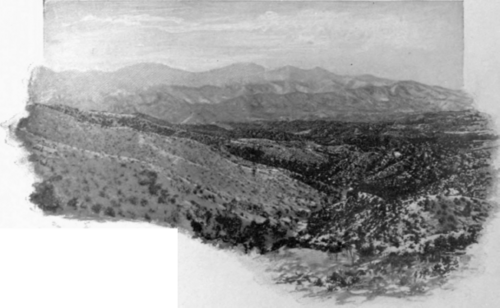
Looking Back At The Mountains.
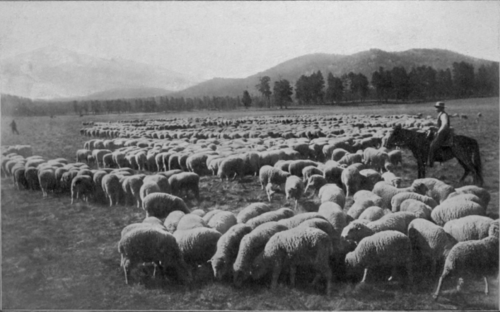
A California Ranch Scene.
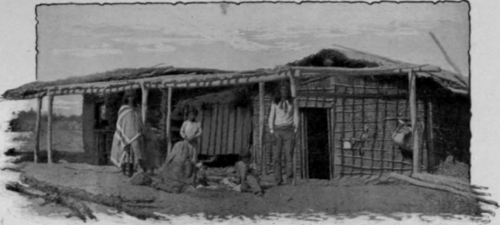
Indian Huts.

A Fallen Race.

A Mexican House And Family.
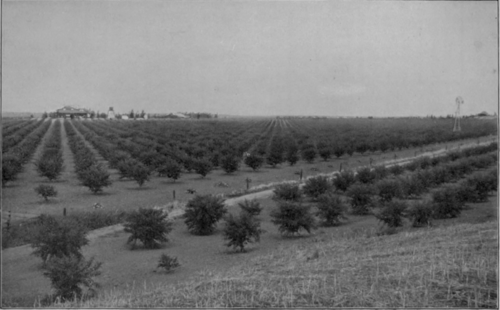
The Blossoming Wilderness.
The unsuspecting traveler who has crossed the Colorado River and entered Southern California, naturally looks around him for the orange groves of which he has so often heard, and is astonished not to find himself surrounded by them; but, gradually, the truth is forced upon his mind that, in this section of our country, he must not base his calculations upon eastern distances, or eastern areas. For, even after he has passed the wilderness of Arizona and the California frontier, he discovers that the Eldorado of his dreams lies on the other side of a desert, two hundred miles in breadth, beyond whose desolate expanse the siren of the Sunset Sea still beckons him and whispers: "This is the final barrier; cross it, and I am yours." The transit is not difficult, however, in days like these; for the whole distance from Chicago to the coast can be accomplished in seventy-two hours, and where the transcontinental traveler of less than half a century ago was threatened day and night with attacks from murderous Apaches, and ran the risk of perishing of thirst in many a waterless "Valley of Death," the modern tourist sleeps securely in a Pullman car, is waited on by a colored servant, and dines in railway restaurants the management of which, both in the quality and quantity of the food supplied, even in the heart of the Great American Desert, is justly famous for its excellence.
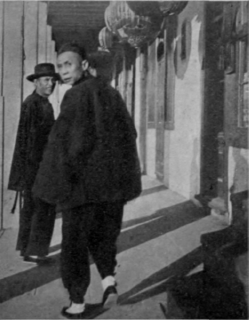
Complacent Mongols.

Characteristic Scenery.
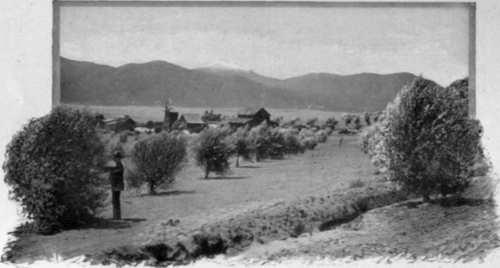
Striking Contrasts.
At San Bernardino, we enter what is called the Garden of Southern California; but even here it is possible to be disappointed, if we expect to find the entire country an unbroken paradise of orange trees and roses. Thousands of oranges and lemons, it is true, suspend their miniature globes of gold against the sky; but interspersed between their groves are wastes of sand, reminding us that all the fertile portion of this region has been as truly wrested from the wilderness, as Holland from the sea. Accordingly, since San Bernardino County alone is twice as large as Massachusetts, and the County of Los Angeles nearly the size of Connecticut, it is not difficult to understand why a continuous expanse of verdure is not seen. The truth is, Southern California, with a few exceptions, is cultivated only where man has brought to it vivifying water. When that appears, life springs up from sterility, as water gushed forth from the rock in the Arabian desert when the great leader of the Israelites smote it in obedience to Divine command. Hence, there is always present here the fascination of the unattained, which yet is readily attainable, patiently waiting for the master-hand that shall unlock the sand-roofed treasure-houses of fertility with a crystal key. It can be easily imagined, therefore, that this is a land of striking contrasts.
Continue to:


My Books

