


Pollen Carriers
Description
This section is from the book "The Busy Little Honeybee", by Josephine Morse True. Also available from Amazon: The Busy Little Honeybee.
Pollen Carriers
Before a young bee begins to gather honey, she serves the hive for a while by gathering pollen. Pollen is the dust, usually yellow, which lies on the tip of the tiny stalks in the center of a flower. The bees use it as food for their baby bees, so beekeepers call it "bee bread. "
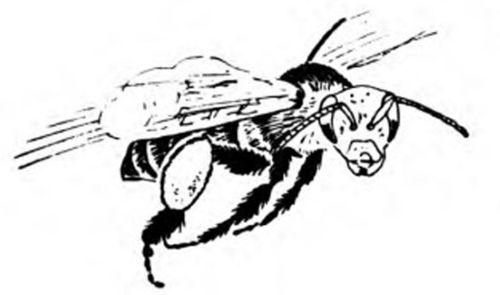
A pollen gatherer rolls herself around in the cup of the flower, covering her body with pollen. Then she combs the pollen from her fuzzy hair with the little combs on her legs, and packs it into her "pollen baskets. " These pollen baskets are under the knees of her hind legs, where small stiff hairs come together in such a way that they hold in the pollen while the honeybee is carrying it to the hive.
When the pollen gatherer has filled her baskets, she looks as though she had a tiny yellow muff on each hind leg. Or, if the flower she has been visiting has red or brown pollen, the muffs are red or brown.
The pollen carrier flies slowly, because she has such a heavy load. When she arrives at the hive, she puts the pollen into a wax cell, and one of the nurse bees packs it tightly into the cell with her head. There it stays until it is needed for the baby bees' dinner.
Bees not only use pollen as food for themselves; they also carry it from plant to plant. In this way they are useful to fruit and vegetable growers. When a bee settles in the cup of a flower, some of the flower's pollen sticks to her fuzzy hair, so that she carries it with her to the next flower she visits. There some of it will be rubbed off as she reaches down for nectar into the flower's cup. The mixture of pollen from two different plants of the same family fertilizes the seeds which will some day be plants, too. Farmers who have apple orchards often keep bees in them, because this carrying of pollen from the blossoms of one tree to those of another helps the trees to bear finer fruit. Farmers who have cucumber greenhouses usually keep bees, too.
Continue to:


My Books

