


Honey
Description
This section is from the book "The Busy Little Honeybee", by Josephine Morse True. Also available from Amazon: The Busy Little Honeybee.
Honey
People keep bees in hives now, but long, long ago nobody kept them at all. They lived wild in the woods, and built their combs in large holes of half-dead trees. When people wanted something sweet to eat, they used to steal honey out of the bee trees. For centuries honey was the only sweet that people ate, except sweet fruits.
There was no beekeeping in America before the coming of the white man. But the early colonists began bringing bees, especially queen bees, over from Europe, and now there are bees everywhere in America where flowers bloom. In some parts of the West, in the mountains and near the desert, there are no trees large enough to have big holes in them where bees can live. So the bees build their combs underneath or behind rocks where they are protected from rain, cold winds, and sun, as well as from bears and other wild animals that like honey.

All Bears Love Honey
All bears love honey. They can rob a bee tree or rock without being badly stung, since their thick fur protects them. The only part of their body which is unprotected is their nose. That soon gets smeared with honey, so that any bee who tries to sting it finds herself stuck there and tries very hard to get away.
There are several races of bees. Most beekeepers prefer the Italian bees. Italian workers have yellow stripes on their bodies, and their queens are either golden or leather color. They are usually more gentle and easier to handle than any other kind of bee. But even among Italian bees there is a great difference in different colonies. Sometimes all the bees in one hive are cranky, while those in another hive have nice, quiet dispositions.
In the United States honeybees make honey from the nectar in apple blossoms, clover, orange blossoms, sage, sumac, blueberry, buckwheat, goldenrod, wild asters, and many other flowers. In England and Scotland bees make a fine thick honey from heather.
Honey has a different color and flavor according to the flowers visited by the bees. Apple blossom, clover, orange, and sage honeys are all light yellow or golden in color, but blueberry honey is dark amber, and buckwheat honey is almost black. Some people prefer one kind, and some another.
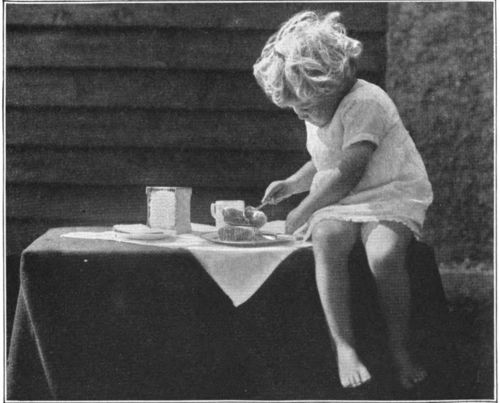
Bread and Honey-How Delicious!
Light-colored honey does not taste nearly so strong as dark honey.
Honey is the most healthful of all sweets. It is delicious on cereals instead of sugar. Hot rice with milk and honey makes a fine dessert, and most children like honey on vanilla ice cream.
At the store the grocer sells honey in the comb in small square boxes. He also sells strained honey, which has no comb, in jars.
It used to take a long time to strain the honey out of the little cells in the combs. But nowadays the beekeeper puts the combs inside a large can, turns a handle, and whirls them around very fast. In this way all the honey is thrown out of the cells. Then the beekeeper strains it and puts it into bottles or cans. This straining does not change the honey in any way.
It is pleasant when eating a spoonful of honey to remember where it came from. It was not made in a factory by machinery, but was carried by "bee plane" straight from the heart of the flowers to the honeybees' comb - and from there to the breakfast table.
Continue to:


My Books

