


Barraband Ring Parrakeet
Description
This section is from the book "Parrots", by Prideaux John Selby. See also: Alex & Me: How a Scientist and a Parrot Uncovered a Hidden World of Animal Intelligence.
Barraband Ring Parrakeet
Palaeornis Barrabandi. - Vigors.
Palaeornis Barrabandi, Vigors, in Zool. Journ. vol. ii. p. 56, Sp. 10 - Psittacus Barrabandi, Swains. Zool. Illust. vol. i. p. 59. - Polytelis Barrabandi, Wagler, in Abhand. etc, p. 519 - Scarlet-breasted Parrot, Lath. Gen. Syn. vol. ii. p. 121, P. 24, Ed. 2.
In this handsome bird, we have one of those interesting forms which so beautifully connect groups, otherwise distant and far removed; tor though the character and shape of the tail, the well-defined ring or neck-collar, the proportions of the wings, etc, evidently place it in this genus, its elevated tarsi and feet shew an approach to the Broad-tailed Division (Platytercinae), which stands at the further ex- tremity of the Psittacean Family. It is also a native of New Holland, in which interesting country so many species of Platycercus have been discovered, the rest of the ring-parrakeets, being the greater part of them natives of Continental India, and its neighbouring islands, and one or two are also met with in Africa. It was first figured by Mr Swainson, in his elegant and valuable "Illustrations," under the name of Psittacus Barrabandi, from a skin in the possession of Mr Leadbeater; but as no observations or notes appear to have accompanied the remains of the bird, we are without information as to its peculiar economy. Judging, however, from the proportions of its legs and feet, we are led to suppose that it is more terrestrial in its habits than its congeners, or that, in addition to its scansorial or grasping powers, it possesses superior activity, and moves with greater facility upon the ground. In size it is about equal to the Rose-ring Parrakeet, its length being full 15 inches, of which the tail alone measures 8 3/4 inches. The bill is red ; the sinciput, throat, and fore-neck of a rich yellow, the latter terminated by a collar of brick red; the space between the bill and eyes, and the ear-coverts, are clear grass green; the upper and under parts of the body are green, tinged with blue upon the hind head and outer margins of the quill-feathers. The upper surface of the tail is green, the two intermediate feathers about two inches longer than any of the others, with their extremities widened and rounded; under surface of the wings and tail blackish-brown ; legs black. By Wagler this bird was removed from the genus Pa-laeornis, and constitutes his genus Polytelis; but as the only character upon which it is established consists in the slight elongation and slenderness of the tarsi and toes, we have retained it among the Ring-Parrakeets, where it was first placed by M. Vigors, and of which group it may be considered a slightly aberrant form. The next figure represents the typical species of this genus; it is the Alexandrine Ring-Parrakeet.
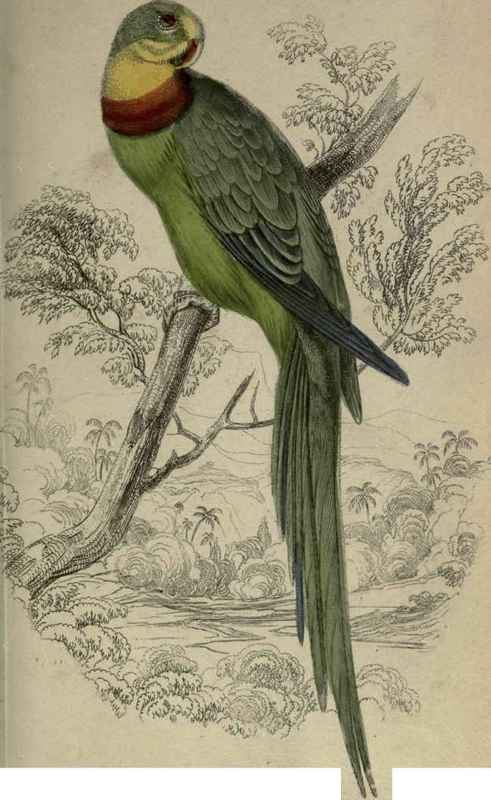
Plate I. Palaeornis Barrabandi.
E. Lear del.
Barraband Ring Parrakeet.
Native of N. Holland.
Lizars Sc.
Continue to:


My Books

