


Alexandrine Ring-Parrakeet
Description
This section is from the book "Parrots", by Prideaux John Selby. See also: Alex & Me: How a Scientist and a Parrot Uncovered a Hidden World of Animal Intelligence.
Alexandrine Ring-Parrakeet
Palaeornis Alexandri. - Vigors.
Palaeornis Alexandri, Vigors, Zool Jour. vol. ii. p. 49 - Wagler, in Abhand, etc, p. 506 - Psittacus torquatus Macrourus antiquorum, Aldrov. Aves. vol. i. p. 678; Icon. p. 679. - Psittacus Alexandri, Linn. Lath. etc. - Perruche a Collier des Isles Maldives. Buff. PL Enl. p. 642. - Le Grand Perruche a collier, Le Vaill. Hist. des Per. pl. 30. - Alexandrine Parrot, Lath. Syn. vol. i. p. 234, No. 37 - Ring-Parrakeet, Edwards, pl. 292. - Alexandrine Parrakeet, Shaw's Zool. vol. viii. p. 423.
In the figure of this elegant bird, our readers are introduced to a well known and favourite species of modern times, and which is generally supposed to have been the first, and by many the only one known to the ancient Greeks, having been discovered during the expeditions of the Macedonian conqueror, by whose followers it was brought to Europe from the ancient Tabropane, now the Island of Ceylon. At all events, it is evident from the concurrent testimony of various ancient authors, that whatever par'ots were known, either to the Greeks or Romans, previous to the time of Nero, were exclusively brought from India or its islands, and that the species, if more than one had been introduced, also belonged to the genus now in the course of illustration, the description they have given of the plumage of these birds pointing distinctly to this, and possibly one or two other nearly allied species, as not only the prevailing colour of the body, but that of the bill, and the distinguishing characteristic, the neck-rollar, are particularly mentioned. By Aristotle it is called  - the Indian Bird; and Pliny not only mentions the country from whence it came but adds, "Sittacen vocat, viridem toto corpore torque tantum miniato in cervice distinctam." Its imitative qualities and powers of articulation, and the high estimation in which it was held among the great, are also frequently adverted to by the poets; and it was in commemoration of a favourite bird of this species, that Ovid composed that beautiful elegy, commencing - "Psittacus, Eois imitatrix ales ab oris, Occidit".
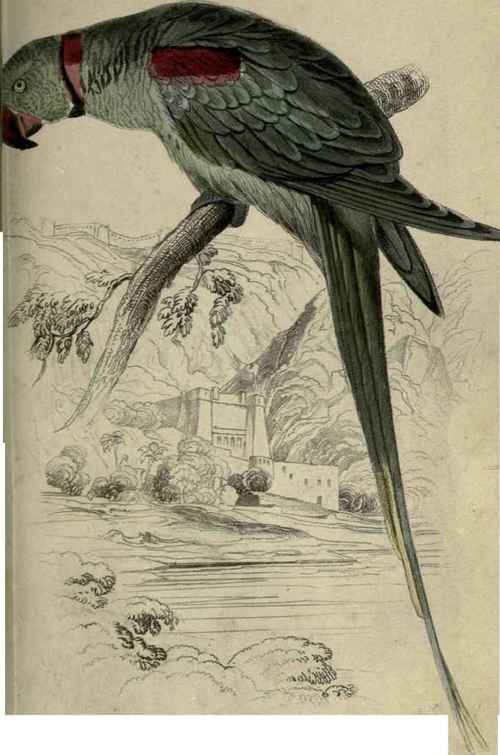
Plate 2. Palaeornis Alexandri.
E. Lear del.
Alexandrine ring-Parakeet. Native of the Island of Ceylon.
Lizars sc.
Of this elegy a free translation is given in Shaw's Zoology, to which, from its length, we must refer our readers. The Alexandrine, as well as its congener the Rose-ring Parrakeet, are still highly prized, and frequently brought from the East Indies, as, in age, they possess great docility, and a facility of pronunciation inferior to none of the race. Of their habits in a state of nature we remain comparatively ignorant.
Continue to:


My Books

