


Blue-Banded Nanodes
Description
This section is from the book "Parrots", by Prideaux John Selby. See also: Alex & Me: How a Scientist and a Parrot Uncovered a Hidden World of Animal Intelligence.
Blue-Banded Nanodes
Nanodes venustus. - Vig. et Horsf.
Nanodes venustus, Vig. et Horsf. Linn. Trans. b. 15, p. 278. - Euphemia chrysostoma, Wag. Mon. Psitt. in Abhand. etc, p. 492 and 544, No. 2. - Psitt. chrysostomos, Kuhl, Conspec. Psitt. in Nova Acta, etc, p. 50, No. 78. - Psitt. venustus, Temminck in Trans. Linn. Soc. b. 13, p. 121. - Blue-banded Parrakeet, Latham's Gen. Hist. ii. p. 188, No. 109.
This pretty species, whose extreme length is about nine inches and a-half, of which the tail alone measures four, is a native of New Holland and Van Diemen's Land, in which island it is called the Ho-bart Ground Parrot, an adjective epithet, which evidently points to its terrestrial habits, and these are further indicated by its lengthened tarsi and toes, which in this and Nanodes pulchellus, a nearly allied and still more beautiful species, closely resemble those members, as exhibited in the genus Pezoporus, illig., or Proper Ground Parrot. It feeds upon the seeds of various grasses, and is generally seen upon the ground. As a site for its nest, it selects a hole or excavation in the stump of an Eucalyptus or gum tree, and lays its eggs, to the number of seven or eight, upon the decayed particles of wood at the bottom of the hole, without the addition of any other materials. The eggs are white and immaculate. The bill is grey, the under mandible paler than the upper. The frontal band, which crosses from eye to eye, is narrow and of a deep azure-blue, the space between the bill and eyes gamboge-yellow. The crown of the head is green, deeply tinged with sulphur-yellow, the cheeks, throat, and the upper part of the breast are of a delicate siskin-green, passing gradually into a rich yellow, the head, neck, back, upper tail-coverts and scapulars are of a pale olive-green, with a greyish tinge, the lesser and greater wing-coverts are deep glossy azure-blue. The quills black, with their outer webs margined with azure-blue. The two middle tail feathers are pale azure, tinged with grey, the lateral with their bases azure-blue, their tips gamboge-yellow, passing gradually into primrose-yellow, the feet and claws are grey.
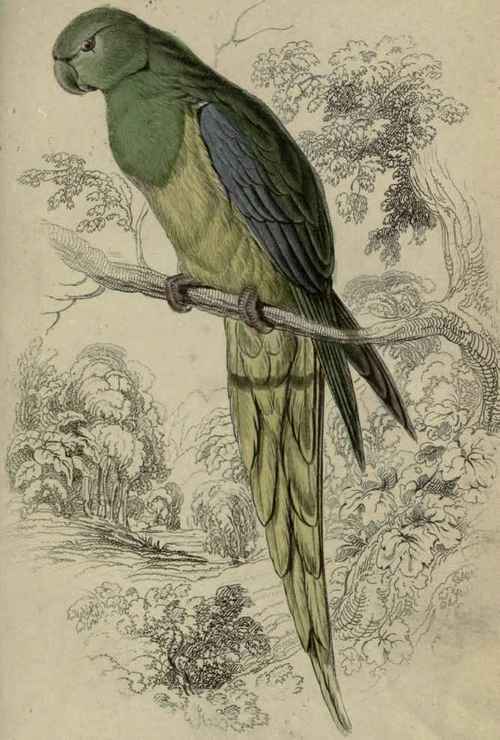
Plate 27. Nanodes Venustus.
E. Lear dl.
Blue-Banded Nanodes. Native of New Holland.
Lizars sc.
Our next figure represents another species of this group: it is the Undulated Nanodes.
Continue to:


My Books

