


Undulated Nanodes
Description
This section is from the book "Parrots", by Prideaux John Selby. See also: Alex & Me: How a Scientist and a Parrot Uncovered a Hidden World of Animal Intelligence.
Undulated Nanodes
Nanodes undulatus - Vig. Et Horsf.
Nanodes undulatus, Vig. et Horsf. Trans. Linn. Soc. b. xv. p. 277. - Psittacus undulatus, Shaw's Nat. Mis. pl. 673. - Kuhl, Nov. Acta, etc., p. 49, No. 76. - Euphemia undu-lata, Wagler, Mon. Psitt. in Abhand. etc., p. 492 and 545.
This little species, which scarcely exceeds seven inches in length, approaches still closer than its congeners in colour and appearance to the Ground Parrot, and brings the genus Pezoporus, Ilig. into immediate connexion, with that to which it belongs. Its habits and mode of life are supposed to resemble those of its congeners, but we unfortunately possess too little information upon these interesting points, the skins we receive from abroad being mostly collected by persons who take no other interest in the pursuit except the mere acquisition of the bird, are rarely accompanied by any notes or observations illustrative of the natural history of the species they belong to. The head and nape are of a yellowish-green, with very fine dark undulating lines; upon each cheek is a small patch of azure-blue, the upper parts of the body are of an oil-green, with darker undulations, the lower parts are plain yellowish-green. The two intermediate tail feathers are green at the base, passing towards the tips into azure-blue, the lateral feathers are green, with a broad yellow fascia in the middle. The bill and legs are grey.
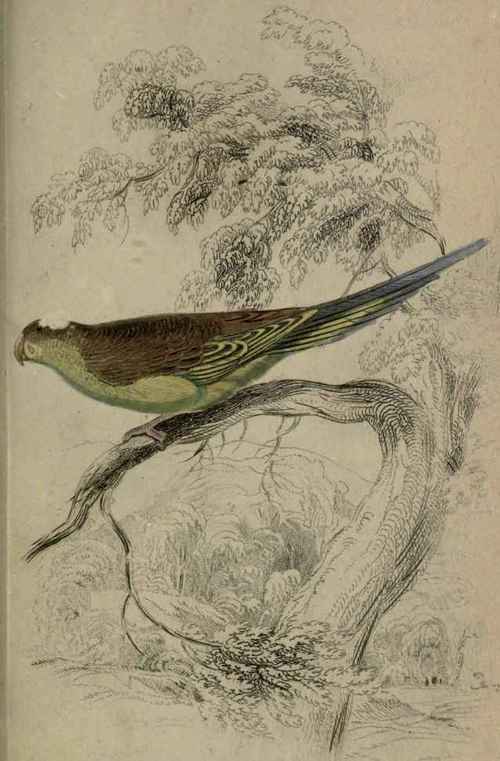
Plate 28. Nanodes Undulatus.
E. Lear del.
Undulated Nanodes.
Lizars sc.
In near connection with the birds we have just been describing, stands the genus Pezoporus, Illiger, represented by the Pezoporus formosus, Illiger, the Ground Parrot of Latham's General History. The characters of distinction are drawn from the still greater elongation of the tarsi and toes, and the usually straight claws, indicating habits strictly terrestrial, with trifling or greatly diminished powers of prehension. The tail also is less depressed, and the feathers are narrower and more pointed than in Na-nodes venustus and pulchellus, with those slight modifications of character it might perhaps with equal propriety be considered a constituent or aberrant member of the genus to which they belong, probably its rasorial type. We retain it, however, in its present station, until a stricter analysis of the family has been instituted. It is represented by the next figure under the title of the Ground Parrot.
Continue to:


My Books

