


Blue-Bellied Lorikeet
Description
This section is from the book "Parrots", by Prideaux John Selby. See also: Alex & Me: How a Scientist and a Parrot Uncovered a Hidden World of Animal Intelligence.
Blue-Bellied Lorikeet
Trichoglossus Swainsonii. - Jardine and Selby.
Trichoglossus haematodus, Vig. and Horsf. in Linn. Trans. vol. xv. p. 289 - Trichoglossus multicolor, Wagler, Mon. Psitt. in Abhand. etc, p. 553 - La Peruche atete bleu, Male, L' Vaill. His. des Per. i. pl. 24 - Peruche des Moluques,Buff. Pl. Enl. No. 743 - Blue-bellied Parakeet, Brown, Ill. of Zool. pl. 7; Illus. Orn. pl. 3 - Blue-bellied Parrot, White, Voy. N. S. W., plate at p. 140.
This beautiful species is a native of New Holland, where it is found in large flocks, wherever the various species of Eucalypti abound, the flowers of those trees affording an abundant supply of food to this as well as to other species of the Nectivorous Parrots. According to the observations of Mr Ca-ley, as quoted by Messrs Vigors and Horsfield in their description of the Australian birds in the collection of the Linnsean Society, "Flocks of these birds may be seen in the eucalypti-trees, when in flower, in different parts of the country, but in the neatest number near their breeding places." They do not, he adds, eat any kind of grain, even in a domesticated state; a fact curiously illustrative of their peculiar habits, and the situation they hold in the family of the Psittacidse. It appears that they seldom live long in confinement, and that when caged they are very subject to fits. This in all probability arises from a deficiency of their natural food ; and the instinctive feeling or appetite for its favourite diet is strongly exemplified in the fact; that one kept by Mr Caley being shewn a figure of a coloured plant, used to put it3 tongue to the flowers, as if with the intent of sucking them, and this it even did when shewn a figured piece of cotton furniture. By the natives it is called War-rin; the settlers call it by the name of the Blue Mountain Parrot, though the term seems to be misapplied, as it is a frequenter of the plains, and not of the hilly districts. Its flesh is excellent, and highly esteemed. This bird was confounded with two other species, viz. the Psitt. haematodus of Linnaeus, and the Psitt. amboinensis varia of Brisson. The subject, however, has been thoroughly investigated by Mr Swainson, and the result of that investigation is given in the "Illustrations of Ornithology,*" where it is clearly shewn to be a species distinct from the other two, and as such it received the name we now attach to it, which we think it proper to notice, as it has since been designated by Wagler, in his Monograph of the Parrots, as the Trichoglossus multicolor.
* Illustrations of Ornithology by Sir William Jardine, Bart, and P. J. Selby, v. 2. part 8, pl. 112.
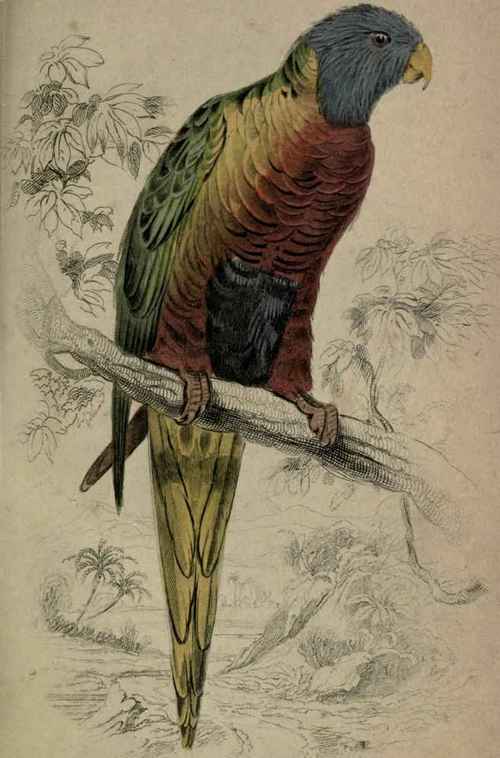
Plate 20. Trichoglossus Swainson Blue Bellied Lorikeet.
E. Lear dl.
Lizars sc.
Mr Lear's beautiful and accurate figure renders it almost unnecessary to give a description of the plumage; but as the bird has so frequently been confounded with two other species, it may perhaps be satisfactory to some of our readers to give it in detail. Length about 13 inches, of the tail alone 6 inches; bill, in the dead bird, pale saffron yellow, in the living, inclining to orange; head and throat of a fine bluish-purple, the feathers rigid and subulate, upon the lower part of the throat they are more inclined to lavender purple, and lose the rigid and subulate character; nuchal collar yellowish or vivid silken green; lower neck and breast bright vermilion-red, passing on the sides of the breast into rich king's yellow; middle of abdomen of a deep imperial purple, the feathers towards the sides vermilion, tipped with vivid green; hypochondria green, the basal part of the feathers varied with vermilion and yellow; tibial feathers vermilion-red; under tail-coverts, with the base of the feathers, red, the middle part yellow, the tips green; under wing-coverts rich vermilion-red; margin of the wings and all the upper plumage bright grass-green; the feathers upon the lower part of the back of the neck with their bases vermilion, margined with yellow; tail with the four middle feathers entirely green, the remainder of the lateral feathers with part of the inner web rich yellow, increasing in extent to the outermost, where the whole of the web, with the exception of a small spot at the tip, is of that colour quills with the inner webs dusky, and each with a large oval central spot of king's yellow, forming a broad fascia on the under side of the wings; legs and toes grey, the lateral membranes broad; the claws strong and greatly hooked.
The next figure represents another beautiful species of this group : it is the Varied Lorikeet.
Continue to:


My Books

