


Papuan Lory
Description
This section is from the book "Parrots", by Prideaux John Selby. See also: Alex & Me: How a Scientist and a Parrot Uncovered a Hidden World of Animal Intelligence.
Papuan Lory
Charmosyna Papuensis. - Wagler.
Charmosyna Papuensis, Wagler, Mon. Psitt. in Abhand. etc, p. 555. - Psittacus Papuensis, Lath. Ind. Orn. vol. i. p. 88, sp. 20. - Psitt. omnicolor, Lich. Catal. Rer. Nat. Rar., p. 5, No. 48 - La Peruche Lory Papou, Le Vaill. p. 9, t. 77.
To great elegance of form, this species unites a plumage of the richest description, the ground-colour of the body being of a deep but brilliant scarlet, relieved in parts with deep azure-blue, yellow, and green. The tail, or at least the two narrow central feathers, greatly exceed the rest of the body in length, as they measure upwards of 11 inches, while the former does not exceed 6; the lateral feathers are regularly graduated, as in the other Lories, the longest measuring about 4 inches, or one-third the length of the two intermediate plumes. The bill is of an orange-red colour; the upper mandible is long, with the tip or hooked part projecting far beyond the under one, which is conic and narrow. The tongue is similar in structure and appearance to that of the other members of the group, the tip being furnished with delicate papillae. Upon the vertex and nape are two irregular bars of azure, margined with purplish-black. The lower parts of the tibiae, lower back, and rump, are also of a deep azure. Upon the sides of the breast and thighs are patches of rich yellow. The wings are green; the interior webs of the quills blackish. The elongated tail-feathers are pale grass-green, passing towards the tips into yellow; the lateral have their basal half dark green, the remainder deep saffron yellow. This lovely species is an inhabitant of Papua, and other parts of New Guinea, and, as might be expected in countries rarely visited by the naturalist, little is known of its history or peculiar habits. Its remains, like those of the birds of Paradise, frequently reach us in a mutilated state, being deprived of the legs, and often wanting the long feathers of the tail; and from such specimens have been derived the imperfect descriptions of various authors.
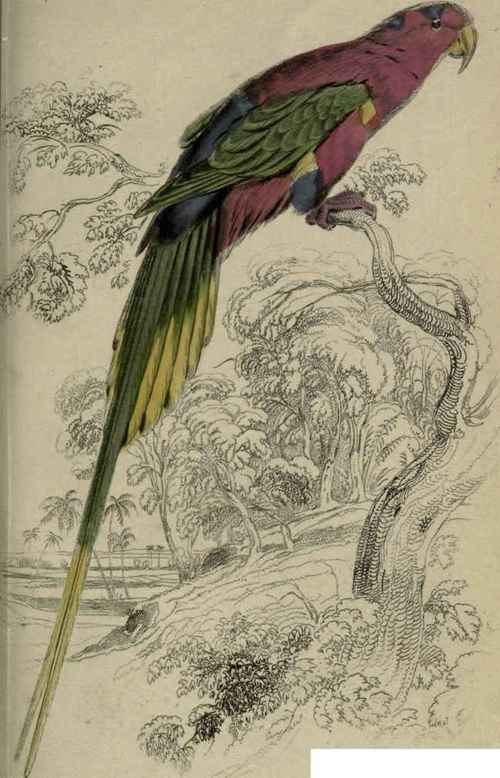
Plate 19. Charmosyna Papuensis.
E. Lear dl.
Papuan Lory.
Native of Papua.
Lizars sc.
We now enter upon an Australian group, which, in that division of the globe, takes the place of the Indian Lories. The members belonging to it, instead of having the ground or prevailing colour of the plumage of a red or vermilion tint, have it green, of brighter or deeper shades, according to the species, variegated, however, in many of them, with masses of the first-named colour. In this genus, the tail is more elongated than in the true Lories, and regularly graduated, with the tips of the feathers narrow; the wings are also narrow and pointed. It constitutes Vigors's genus Trichoglossus, and is thus characterized: - Bill subelongate, compressed, weak, the inferior mandible slightly convex, longer than high, narrowed towards the tip, with the margins thin and entire; inner surface of the projecting tip of the upper mandible smooth, or but slightly striated; tongue furnished near the tip with a pencil of bristly papillae , wings of moderate length, narrow, the first quill longest, the second and third a trifle shorter, the webs entire; feet, the tarsi short, feathered below the joint; toes strong, with the soles broad and extended; the claws greatly falcated, strong and sharp; tail graduated, with the feathers narrowing towards the point. The members of this genus are birds of elegant form, and some exhibit a great variety and richness of plumage; they are strictly arboreal and scansorial, as indicated by the form and strength of their feet and claws. In the quality of their food, and the structure of their tongue, they shew their typical station in this representative section of the Tenuirostral Tribe, their principal nutriment being derived from the nectar of flowers; they also eat or suck the juices of the soft or exterior portion of various fruits, but do not attempt the kernels or actual seeds, which constitute the general and favourite pabulum of the rest of the Psittacidae. In their contour, and the indications of a nuchal collar which several of the species possess, we also trace a resemblance to the Parrakeets, or genus Palaeornis, Vigors and this analogy we might expect to find, if, as we suppose, the Parrakeets in their own circle constitute the Tenuirostral type. In the present genus, we are also induced to retain the Orange-winged Parrot of authors (Psittacus pyrrhopterus), for which bird Mr Vigors instituted the genus Brotogeris, as we cannot observe any character of sufficient import-ance to warrant a generic separation, the only difference seeming to be a slight elongation of the tip of the upper mandible; but this is rendered less abrupt by the intervention of another species, the Trichoglossus palmarum, in which it is of a size intermediate between that of Trick, chlorolepidotus, T. Swainsonii, etc., and that of Trick. pyrrhopterus. The first example we give of this genus is the Blue Bellied Lorikeet.
Continue to:


My Books

