


Orange-Winged Lorikeet
Description
This section is from the book "Parrots", by Prideaux John Selby. See also: Alex & Me: How a Scientist and a Parrot Uncovered a Hidden World of Animal Intelligence.
Orange-Winged Lorikeet
Trichoglossus pyrrhopterus - Wagler.
Brotogeris pyrrhopterus, Vig. Zool. Journ. ii. p. 400 - Psittacus pyrrhopterus, Lath. Ind. Orn. Sup. p. 22, No. 7; Vig. in Zool. Journ. i. 535. - Orange-winged Parrakeet, Lath. Syn. Sup. ii. p. 90, No. 16.
From this bird, which Mr Vigors described in the first volume of the Zoological Journal, under Latham's title of the Orange-winged Parrakeet, he afterwards formed his genus Brotogeris; but, as we have previously observed, the characters upon which it is instituted seem to vary so little from those of Trichoglossus, that we have followed the example of Wagler, and retained it in the latter genus, in close association, however, with Trichoglossus palmarum, another Pacific species, which, as a slightly aberrant form, seems gradually to lead to other and stronger billed groups of the Psittacidae. It is a native of the Sandwich Islands, and not of the Brazils, as at first supposed by Dr Latham; and the two individuals which we well recollect seeing, when in Mr Vigors's possession, were brought to England in the same vessel which conveyed hither the late unfortunate King and Queen of these Islands. As any information tending to elucidate the habits and manners of species cannot fail to be equally interesting to the naturalist and the general reader, we make no apology for quoting largely from the account given by Mr Vigors of these two lovely birds. "In their manners," he observes, "they are peculiarly interesting. Strongly attached to each other, like the individuals of the small species, so well known in our collections, and which we familiarly style Love Birds, they assert an equal claim to that title, if it is to be considered the reward, or the distinctive sign of affection. They will not admit of being separated even for a moment; and, whether in their cage or at liberty, every act and every movement of one has a reference to the acts and movements of the other. They are lively, active, and familiar, distinguishing and following those who attend to them, with perfect confidence, but always in concert." Their movements, he adds, are less constrained than those of Parrots in general, approaching, both on the ground and the wing, to the quick pace and short and rapid flight of the more typical perchers. They have apparently less powers of voice than the greater part of the family, uttering only a sort of chirrup like that of the sparrow; this is shrill, it must be confessed, at times when rivalship or any particular incitement induces them to exert it to the utmost: but at other times it is far from unpleasing, more especially when they employ it, as is their custom, either in welcoming the approach of the morning, or acknowledging the attentions of a favourite." In size it is inferior to the species already described, measuring not more than 7 1/2 inches in length. The bill is pale, slightly tinged with pink; the upper mandible with the tip attenuated and long; the tomia slightly sinuated. The crown of the head and parotic region is of a delicate greenish-blue; the sides of the neck and throat, and indistinct nuchal collar, are greyish-white; the rest of the body, with the exception of the under wing-coverts, which are of a rich orpiment-orange colour, is green, palest upon the flanks, thighs, and the margins of the tail-feathers. The feet are of a pale flesh-colour.
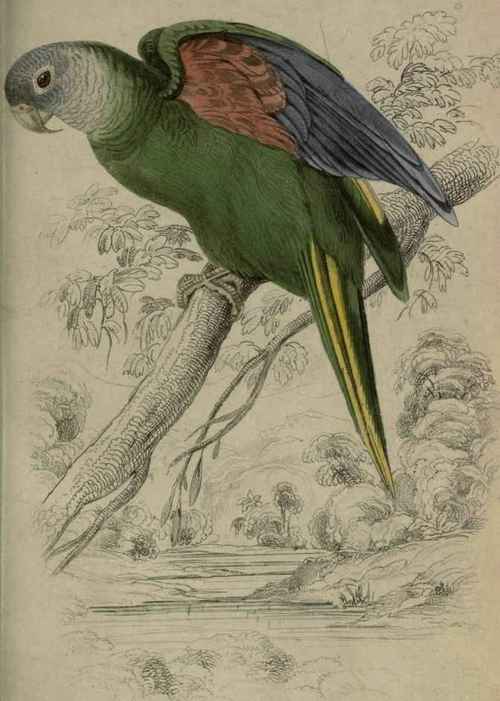
Plate 22. Trichoglossus Pyrrhopterus.
E. Lear del.
Orange-Winged Lorikeet Native of the Sandwich Islands.
Lizars sc.
Nearly allied to the genera Trichoglossus and Lo-xius, in the form of the bill, the tongue, and feet, is another beautiful group inhabiting the islands of Australia, and characterized by Wagler, in his monograph of the family, under the title of Coriphilus. They feed upon the softer fruits, particularly that of the Musa Paradisiaca, and live amid the foliage of the highest palm-trees. The structure of the tongue in these birds is curious, according to the naturalists who accompanied Duperney in his "Voyage autour du Monde:" it is tipped by a kind of crown, formed by a number of long stiff filaments, regularly placed, and which M. de Blainville considers as the nervous elongations or papillae of the lingual or gustatory branch, enormously developed. Their voice is weak and sibilous; and, when alarmed or irritated, they erect the feathers of the hind-head, which are narrow and elongated. The sexes are remarkable for their affection to each other, and direct all their movements in concert. The characters of the genus are: - Bill small, the upper mandible without a distinct tooth, the cere large and prominent, the under mandible weak, slightly convex. Nostrils open, round, in the basal cere. Tongue papillose near the tip. Head crested. Wings long and pointed. Tail of moderate length, broad, rounded at the tip. Feet strong. Claws falcate. This group is illustrated by Coriphilus Kuhlii - Wagler.
Continue to:


My Books

