


Pale-Headed Broadtail
Description
This section is from the book "Parrots", by Prideaux John Selby. See also: Alex & Me: How a Scientist and a Parrot Uncovered a Hidden World of Animal Intelligence.
Pale-Headed Broadtail
Platycercus palliceps.
Platycercus palliceps, Lear's Parrots.
ThIs species, in form and habit, as well as tbe general disposition of its colours, is nearly allied to the Plat, eximius, Vig. (Nonpareil Parrot of Latham's Gen. Hist.), for, with the exception of the head, breast, and belly, the rest of the plumage is almost precisely the same. Like the majority of the members of this now extensive genus, it is a native of New Holland.
We regret that our limits will not admit of our giving more examples of these lovely birds, particularly of such as, by a slight deviation from the typical form, lead to other genera, or serve to connect the present subfamily with the conterminous divisions, such are some of the species inhabiting the Pacific Islands, in which the tail feathers are more attenuated towards the tip; such also the Plat. sca-pulatus, Vig. (King's or Tabuan Broad-Tail), in which the bill is less bulging, the tail very broad, and not so cuneiform as in the other species, and such would appear to be the New Guinea Broad-Tail (Plat. NovOb Guinea, Wagler), in which the ophthalmic region is naked, a character that may perhaps imply the propriety of further generic division.
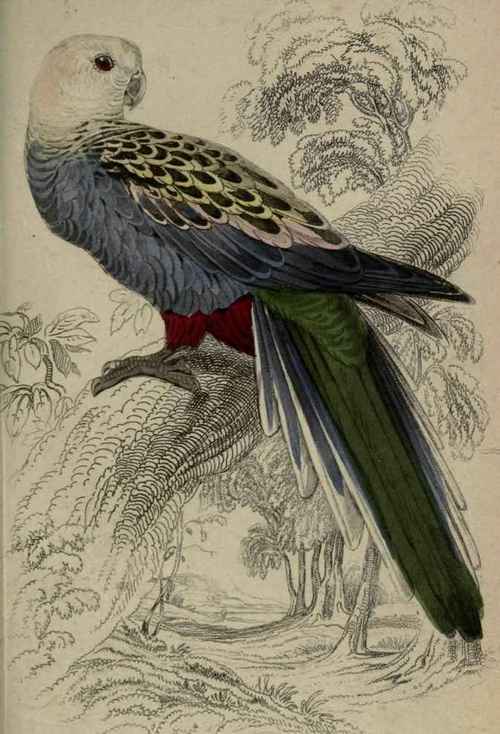
Plate 26. Platycercus Palliceps.
E. Lear del.
Pale Headed Broad-Tail.
Native of New Holland.
Lizars sc.
Continue to:


My Books

