


Pennantian Broad-Tail
Description
This section is from the book "Parrots", by Prideaux John Selby. See also: Alex & Me: How a Scientist and a Parrot Uncovered a Hidden World of Animal Intelligence.
Pennantian Broad-Tail
Plaiycercus Pennantii. - Vig. & Horse.
Platycercus Pennantii, Vig. & Horsf. Linn, Trans, v. 15. p. 250. - Wagler, Mon. Psitt. in Abhand. etc. p. 535, pl. 17 - Psitt. Pennantii, Lath. lnd. Orn. p. 90, No. 26. - Psitt. gloriosus, Shaw's Nat. Mus. pl. 53. - Psitt. elegans, Kuhl, Nov. Acta, etc., v. 10. p. 55, pl. 89. - Perruche a large queue, Le Vaill. Hist, des Psitt. pl. 79. - Pennantian Parrot, Phill. Bot. Bay, pl. p. 154. - White's Journ. pl. in p. 174 - Lath. Gen. Hist. 11. p. 131, No. 34.
The rich crimson-red which forms the ground colour of this beautiful species, recals to mind the Scarlet Lories, and it is no doubt from this general resemblance the name of Lory has been given to it by the settlers in New Holland, of which country it is a native. It appears to be numerous and widely dispersed, congregating in large flocks, and frequently doing considerable damage to the wheat and Indian corn - the Cerealea constituting a favourite food with several species of this genus. On this account it is persecuted by the farmer, who endeavours to reduce their numbers by the gun, as well as by traps, in which they are readily taken. The expense and trouble incurred in their capture is, however, in part repaid, not only by a saving of their crops, but by the acquisition of a wholesome addition to the table, as this as well as other species are reported to he of excellent and delicate flavour. According to Mr Caley, whose account of this bird we quote from the Linnaean Transactions, "it is called by the natives Dulang and Julang. Like the King's Parrot (Plat. scapulatus), it is found in large flocks among the ripe Indian corn, both species intermixed. It varies much in colour, but as the greater part of the flock is of the colour of the female, it may also be taken for granted that they are young birds. The natives tell me it makes its nest chiefly in the Peppermint-tree (Eucalyptus piperita), always in the body, but never in the boughs. Sometimes it enlarges the hole through which it enters. Year after year the same place is frequented for the purposes of incubation. It makes no nest, but from the decayed parts of the tree. It has four young ones. The eggs are white. I have met with this bird in November in the most mountainous parts of the country; but I apprehend it leaves these parts in the winter."
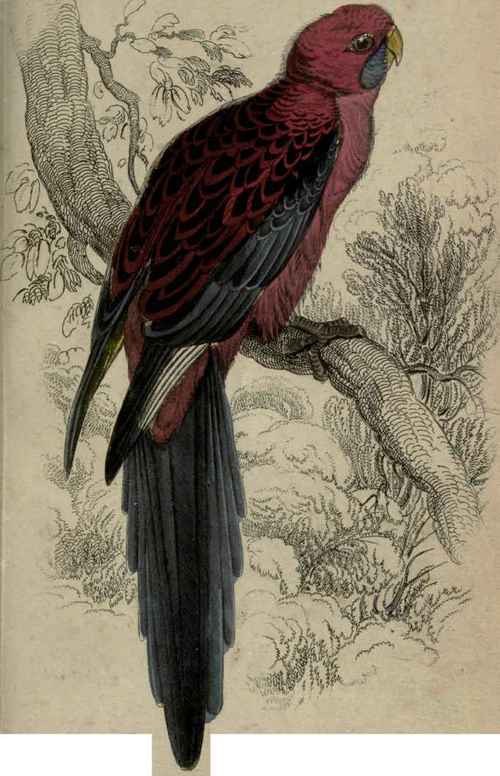
Plate 25. Platycercus Pennantii.
E. Lear dl.
Lizars sc.
Pennantian Broad Tail.
Native of New Holland.
In its motions it exhibits great activity and liveliness, and it walks upon the ground with facility, and without any of that awkward gait, so conspicuous in the typical Parrots. It is frequently kept in a tame or caged state, chiefly for the beauty of its plumage and handsome carriage, as few or none of this division possess the imitative powers exhibited by members of other genera. The beautiful and characteristic figure from Mr Lear's drawing, and the accurate manner in which the engraving is c loured, renders it unnecessary to give a decaued description of the plumage of the adult. The young bird differs in having the under parts of an obscure green, sometimes varied with spots of red; the azure patch upon the cheeks is also of a pale colour. The mantle dusky, each feather margined with pale red, and the two middle tail feathers green. The dimensions are as follows: - Total length about 15 1/2 inches, length of the tail 8 inches, of the tarsi 3/4 ths of an inch, of the upper mandible, from the gape to the tip, 3/4ths of an inch, height at base nearly 1 inch.
Our next plate represents another beautiful species of the same genus: it is thePlatycercus palliceps.
Continue to:


My Books

