


Patagonian Arara
Description
This section is from the book "Parrots", by Prideaux John Selby. See also: Alex & Me: How a Scientist and a Parrot Uncovered a Hidden World of Animal Intelligence.
Patagonian Arara
Arara Patagonica. - Lesson.
Psittacus Patagonicus, Arara - Arara Patagonica, Lesson, in Dupp. Voy. autour du Monde, Part Zool. tab. 35. - Sittace Patagonica, Wagler, in Abhand. etc, p. 659 - Patagonian Parrakeet Maccaw, Lears' Parrots.
This large and fine looking species, whose total length is seventeen inches, the tail measuring nearly nine, was first described by Azara, and is a native of Paraguay, the districts of Buenos Ayres, Patagonia, and Chili. In the latter country, it is described as a most abundant species, and is resident the whole year, frequenting the hilly and subalpine regions during the summer, where it breeds in the holes of trees and rocks, but descending as autumn approaches to the lower levels, where it congregates in immense flocks, and frequently does great injury to the produce of the gardens and cultivated fields of the inhabitants. It is said to be of a bold and fearless disposition, admitting of a near approach, which subjects it to be killed in immense numbers by those who suffer from its depredations. Like its congener the Carolina Arara, it is continually uttering its piercing screams, as well when perched as upon wing. It is easily tamed, and can be taught to imitate the human voice, but more imperfectly than some of its congeners, on which account it is held in slight estimation, and but seldom domesticated by the inhabitants. In Patagonia, it extends nearly as far as the straits of Magellan, a southern latitude much higher than any frequented by this tribe in the northern hemisphere, where the limit of their distribution rarely extends beyond the 32d degree. The drawing from which our plate is engraved, was taken by Mr Lear, from a living specimen in the Zoological Gardens, and though inferior in scale, possesses perhaps as much of life and character as that contained in his large and beautiful work, "Illustrations of the Psittacidae." The bill is of a blackish colour, short and thick at the base. The orbits are naked and white, the space between the bill and eyes feathered, the head and upper part of the neck are blackish-green, tinged with yellow around the eyes, the lower neck is greenish-grey, succeeded by a pectoral collar or gorget of greenish-white, the lower part of the breast is deep greenish-grey. The sides and flanks are yellow, upon the thighs tinged with green. The middle of the abdomen is vermilion red. The back and lesser wing coverts are dusky yellowish-green, the greater coverts and secondary quills are bluish-green, narrowly margined with yellow. The tail is long and lanceolate, of a dingy yellowish green, the tips of the feathers passing into bluish-green. The under surface is greenish-black. The legs and toes are flesh red, tinged with grey.
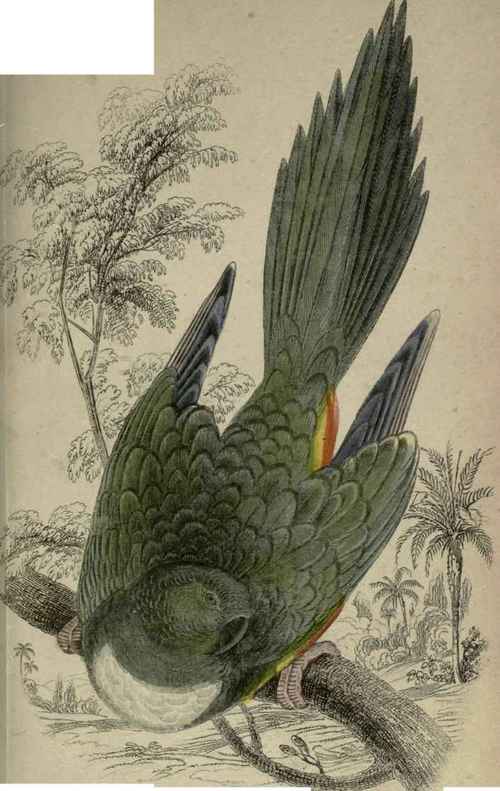
Plate 4. Arara Patagonica.
E. Lear dl.
Native of Paraguay.
Lizarus Sc.
Continue to:


My Books

