


Malacca Ring-Parrakeet
Description
This section is from the book "Parrots", by Prideaux John Selby. See also: Alex & Me: How a Scientist and a Parrot Uncovered a Hidden World of Animal Intelligence.
Malacca Ring-Parrakeet
Palaeornis Malaccensis - Vigors.
Palaeornis Malaccensis, Vig. Zool. Journ. ii. p. 52; Wag-ler, Mon. Psit. in Abhand. etc. p. 514 - Psittacus Malaccensis, Gmel. vol. i p. 325, No. 74 - Psittacus erubescens, Shaw's Zool. vol. viii. p. 437. - Psittacus barbatulatus, Bechst. Kuhl. Nov. Acta. etc, No. 38. - La Peruche a nuque et joues rouges, Le Vaill. pl. 72. - Blossom-cheeked Parrakeet, Shaw.
A drawing of this beautiful species having been made by mistake, instead of a bird belonging to a different division, but bearing the same specific title, is the cause of a third illustration of this genus being given. In its form and aspect it appears eminently typical, the two intermediate tail-feathers being very long, and extending far beyond the others, narrow, but equal in breadth towards their tips, which are blunt or slightly rounded. As its name imports, it was first observed and introduced from Malacca. Its distribution, however, is not confined to that part of India alone, as Mr Vigors mentions in his observations on this group of the Psittacidae, that several specimens were brought to this country from Sumatra by the late lamented Sir Stamford Raffles. In size it about equals the Palaeornis Bengalensis (Rose-headed Ring-parrakeet, a bird of very similar form and habit), its extreme length being generally full fourteen inches, of which the tail alone measures eight. The upper mandible is of a fine lively red, the tip paler, the under mandible black tinged with red. The crown of the head is sap-green; the cheeks, nape, and back part of the neck, are of a beautiful deep rose-red, tinged with lilac-purple upon the latter part. The oblique mustachio-like collar is deep black. The lower part of the neck and mantle are fine greenish-blue; the rest of the upper awl under plumage is yellowish sap-green, palest upon the thighs and vent. The quills are margined with blue, their under surface being black. The two long intermediate tail-feathers are azure-blue, tinged with purple towards their tips; the lateral tail-feathers are yellowish-green. The legs and feet are grey, tinged with flesh-red.
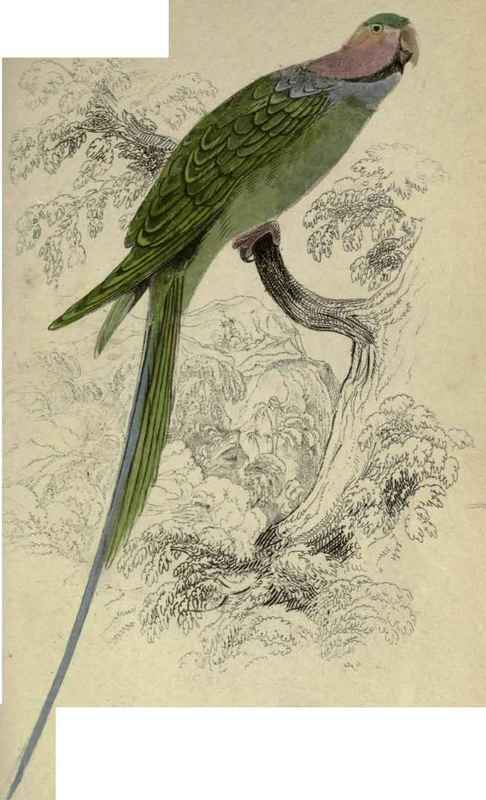
Plate 3. Palaeornis Malaccensis.
E. Lear del.
Malacca Ring-Parrakeet ya.
Lizars Sc.
Besides the three species here figured, ten or eleven more are described by Mr Vigors and Wagler; the latter, in his Monograph of the family, has bestowed much attention in collating the various synonyms of the species. According to his list, they consist of, - 1. Pal. Alexandri; 2. Pal. cubicularis, identical with the P. torquatus and bitorquatus of Vigors, and the young of which is supposed to be the Pal. inornatus of the same author; 3. Pal. Borneus, apparently referable to the P. erythrocephaius, Vigors; 4. Pal. melanorynchus, a species apparently hitherto confounded with the Pal. Pondicerianu3, of authors, and not distinguished by Vigors; 5. Pal. Pondicerianus; 6. Pal. barbatus, by other writers a supposed variety of P. Pondicer., not distinguished as a species in Mr Vigors's list; 7. Pal. Malaccensis; 8. Pal. Bengalensis; 9. Pal. cyanocephalus, the same as the P. flavitorquis of Vigors; 10. Pal. columboi-des, first described by Mr Vigors in the Zoological Journal; and Pal. inornatus, the Psittacus incarna-tus of authors, a bird whose station in this group, according to Wagler's own account, appears very doubtful. The engraving expresses so correctly the character and plumage of the bird, as to render it unnecessary to give a detailed description. We may mention, however, that the young bird is without the black and rosy coloured collar which distinguishes the adult, in which state it is known as the Psittacus eupatria of authors.
From the Ring-Parrakeets of Asia and Africa we now pass to the Long-tailed groups of South America, the great metropolis of the Macrocercine Division ; for here are found not only the typical forms of the subfamily as exhibited in the large and splendid Maccaws, but other species more nearly connected in habit and appearance with the birds belonging to the ancient world. Among these may be particularized an extensive group, mostly consisting of birds of moderate size, in which the immediate orbits of the eyes alone are naked; these form a part of M. Spix's genus Aratinga, and, as representatives of it, the Psittacus cruentatus, Temminck, and Psitt. leucotis, Lich., may be quoted. From this group we would separate several larger species, as Psitt. Carolinensis, Auctor, etc, under the name of Arara, Spix, reserving the title of Psittacara for another group, in which the bill is much larger, with the tip drawn to a fine point, and having the orbits and part of the face naked, characters which bring it in near connexion with the large bare-cheeked Maccaws. Of this group, the Psittacus nobilis, Linn., Psittacara frontata, Vig., is an example. As the limits of the volume only permit of a certain number of illustrations, we have selected a species of the second or Arara genus, which, from its size and appearance, seems to lead directly to the genus Macrocercus; it is the Patagonian Arara.
Continue to:


My Books

