


Pesquet's Dasyptilus
Description
This section is from the book "Parrots", by Prideaux John Selby. See also: Alex & Me: How a Scientist and a Parrot Uncovered a Hidden World of Animal Intelligence.
Pesquet's Dasyptilus
Dasyptilus Pequetii. - WAGLER.
Dasyptilus Pequetii, Wagler Mon. Psitt. in Abhand. etc. p. 502, 601. - Psittacus Pequetii, Less, Illus. Zool. pl. 1.
Named from the hairy or setaceous nature of the feathers upon the head and neck, and the general rigid nature of the whole plumage. The dominant colour is black, in which respect it resembles the Geringores, and the bird last described, but the form of the bill (without adducing other characters) is so different from that of the species alluded to, as to make it very doubtful whether the station assigned to it is that to which it properly belongs. For ourselves, we have had no opportunity of examining or comparing it with other species, as it is a bird of great rarity, and but lately discovered, and we are indebted to the liberality of the Noble President of the Linnaean Society, for permission given to Mr Lear to make the necessary drawing, from a specimen in the collection at Knowsly Park. It is a bird of considerable size, measuring upwards of twenty inches in length. The bill is not so deep at the base as in the great majority of the tribe, and its length is greater than its height. The upper mandible is but moderately curved at the base, but bends suddenly down towards the tip, like that of the Raptorial Birds, and overhangs the under, which is shorter, moderately convex and carinated, with the tip narrowed and strongly emarginated on each side. The nostrils are round, placed in the cere at the base of the bill, the orbits and cheeks naked, thinly beset with hairs, the head and upper neck is also nearly bare, being thinly covered with setaceous feathers. The tarsi and feet are strong, the former short and reticulated. The tail consists of ten rigid feathers, of mean length and rounded. The wings are ample, the first quill short, the third and fifth of equal length, the fourth the longest in the wing. The upper plumage is of a shining or velvet black, with the exception of the greater wing-coverts and upper tail-coverts, which are crimson, and the secondary quills, which have their outer webs of the same colour. The lower neck and upper part of the breast is black, the belly, vent, and thighs crimson-red.
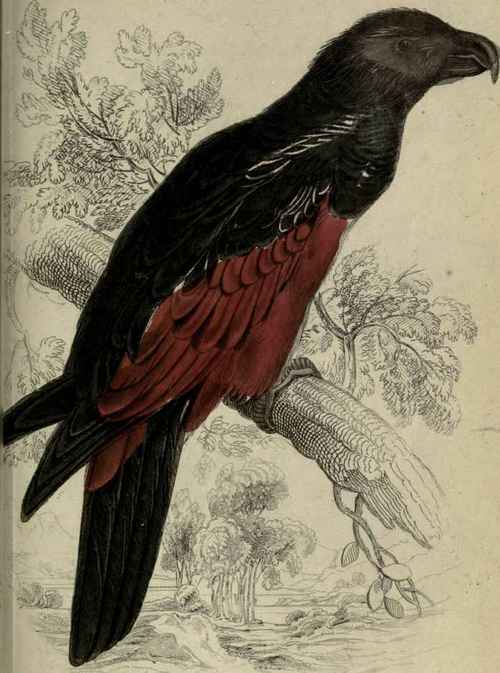
Plate 17. Dasyptilus Pequetii.
E Leardel.
Dasyptilus.
Native of Australia.
The next subfamily or primary division of the Psitticidae upon which we enter, is that of Loriana, so named from the beautiful Scarlet-coloured Lories, natives of continental India and its islands, and which appear to constitute one of its typical forms.
Continue to:


My Books

