


Purple-Capped Lory
Description
This section is from the book "Parrots", by Prideaux John Selby. See also: Alex & Me: How a Scientist and a Parrot Uncovered a Hidden World of Animal Intelligence.
Purple-Capped Lory
Lorius domicellus.
Psittacus domicella, Auct. - Domicella atricapilla, Wagler, Mon. Psitt. in Abhand. x. p. 567 - Peroquet lori a collier jaune, Le Vaill. p. 95. - Second black-capped Lory, Edw. pl. 171.
This beautiful bird is a native of the Moluccas, and other Eastern Islands, from whence we occasionally receive it, being held in high estimation, not only on account of its elegant plumage, but for the docility it evinces, and its distinct utterance of words and sentences. It is also lively and active in its disposition, and fond of being caressed. In size it is amongst the largest of the group, measuring upwards of 11 inches in length. The general or ground colour of the plumage is rich scarlet, this tint occupying all the lower parts of the body, with the exception of a collar of yellow upon the upper part of the breast. The neck, back, upper tail-coverts, and basal part of the tail, are also of the same colour. The crown of the head is blackish-purple in front, passing into violet-purple on the hinder part. The wings on the upper surface are green, the flexure and margins violet-blue, as are also the under wing-coverts. The feathers of the thighs are azure-coloured exteriorly, their basal parts being greenish. The bill is orange yellow; the under mandible conic, and narrow towards the tip. In this species, the tongue exhibits in an inferior degree the filamentous character so characteristic of the division, and it is probable that, with three or four others, such as Lorius puniceus, gurrulus, etc., it will be found necessary to separate them from such as exhibit the tubular and papillary structure of that member in greater extent and perfection.
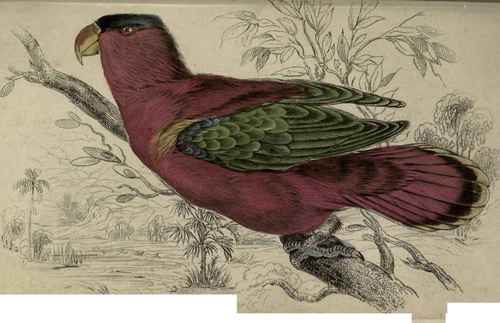
Lorius Domicellus. Purple Canned Lory.
E Leardel.
Lizars se.
The next form we have to notice is one of great interest, partaking of the essential characters of the Lories, in the form and structure of its bill and tongue, as well as in the prevailing tints of its plumage. At the same time, it shews a strong analogy to the Ring. Parrakeets, or members of the genus PalcBornis, in the peculiar form of its tail, which nearly resembles that of Palaeornis Alexandri. By Wagler it is considered as generically distinct from the other Lories, as well as from the Trickoglossi, or Lorikeets, and of it he institutes his genus Charmosyna ; but as no other species has yet been discovered, and the prolongation of the two middie tail-feathers appears to be the only character of distinction, we have for the present retained it as an aberrant form of the genus Lorius. It is the Papuan Lory.
Continue to:


My Books

