


Red And Blue Maccaw
Description
This section is from the book "Parrots", by Prideaux John Selby. See also: Alex & Me: How a Scientist and a Parrot Uncovered a Hidden World of Animal Intelligence.
Red And Blue Maccaw
Macrocercus aracanga.
Sittace aracanga, Wagler, in Abhand. etc. p. 672 - Psit-tacus aracanga, Auct. - L'Ara canga, Ve Vaill. Hist. des Per. t. 2. - The Red and Blue Maccaw, Edwards, 4. t. 158.
This large and splendid species has frequently been confounded with its nearly related congener, the Psittacus macao of authors, from which it may always be distinguished, by the want of the narrow rows of red plumes upon the naked part of the face, and in having the middle wing-coverts of a bright yellow, instead of green. In dimensions it is fully equal to the other species, frequently attaining 39 inches in extreme length, of which the tail measures nearly 24: The bill is large, and very powerful: the upper mandible yellowish-white, except near the angles of the mouth, where it is varied by a dark streak or spot; the under mandible is black. The cheeks and orbits are covered with a rough pinkish white skin, without any rows of small feathers; the rest of the head, the neck, back, scapulars, breast, and abdomen, are vermilion-red. The middle wing-coverts are bright yellow, tipped with bluish-green. The spurious wing, the secondaries, and greater quills, are of a deep azure-blue; the lower back, rump, upper and under tail-coverts, are pale azure and ultramarine blue. The four intermediate or longest tail-feathers are deep vermilion-red, the next feather on each side is red and blue, the remainder are wholly blue. The under surface of all the tail-feathers is deep red. The irides are primrose-yellow; the legs and feet are blackish-grey, the scales are divided or marked by mealy white lines. It is a species apparently widely distributed throughout the intertropical parts of America, being found in Guiana, Surinam, and parts of Mexico. Its habits resemble those of the Blue and Yellow Maccaw, being found in similar situations, and feeding upon the Palmettoes or Borassi which abound in the over- flowed savannahs of South America. They build in the holes of decayed trees, enlarging them when too narrow, and line the interior with feathers. They hatch, as do most of the tropical species, twice in the year, laying each time two spotted eggs, which are incubated alternately by both sexes. 'The great size, and gorgeous plumage of this bird, places it among the most imposing of its race; and in aviaries, or living collections of the Psittacidae, it forms a prominent and striking feature. It is, however, only in such situations as the Zoological Gardens, that we can admire and contemplate its beauty with satisfaction and pleasure, its screams, and hoarse discordant tones, rendering it any thing but an agreeable companion when confined within the precincts of a private house. Our figure is from a living bird in the gardens of the Zoological Society.
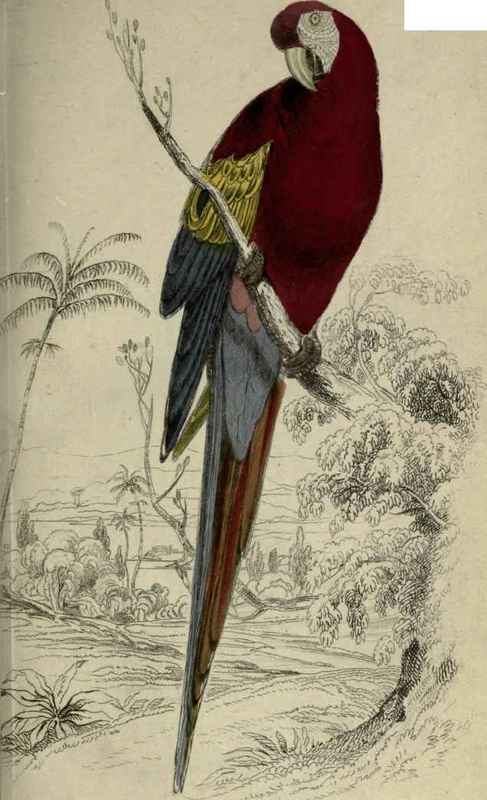
Plate 7. Macrocerus Aracanga.
E. Lear del.
Red and Blue Maccaw.
Native of Guiana.
Lizars sc.
Immediately following the Maccaws, and nearly related to them by the strength and thickness of the bill, and the naked skin which still occupies the orbits, and more or less of the face, is a group to which we would restrict the title of Psittacara, Vigors, typified by his Psittacara frontata, but not embracing all the birds which he included in it, several of them having their station among the Araras, or that group to which the Patagonian species belongs. The genus Psittacara is distinguished by a large, deep, and massive bill, the upper mandible with the culmen imperfectly biangulated, the tip drawn suddenly to a fine sharp point, the to-mia sinuated, or imperfectly toothed, the under mandible very large and thick, the tip quadrate, the orbits, and space between the bill and eyes, to a greater or less extent naked. Nostrils round, patent, in the cere at the base of the bill. Wings rather long, acuminate, the three first feathers of nearly equal length, wide at the base, narrowing suddenly toward their tips. Tail rather long, and moderately graduated. The passage from the Maccaw to the Parrot division, appears in one point to be effected by the apparent connection that subsists between the birds of this genus and those of genera Tanygnathus and Triclaria of Wagler, the latter of which, by the nearly even or slightly cu-neated tail, leads to the true or typical Parrots. The subject of the next illustration is the Noble Parrot Maccaw.
Continue to:


My Books

