


Blue And Yellow Maccaw
Description
This section is from the book "Parrots", by Prideaux John Selby. See also: Alex & Me: How a Scientist and a Parrot Uncovered a Hidden World of Animal Intelligence.
Blue And Yellow Maccaw
Macrocercus ararauna. - Auctorum.
Psittacus maximus cyano-virens, Aldrov. Will. - Ara bleu et jaune, Buff. PL Enl. 36 - L'Ara-rauna, Le Vaillant, i. t. 3. - Psittacus ararauna, Shaw's Zool v. viii. p. 391. pl. 54.
This beautiful species is rather inferior in size to the great Scarlet Maccaw, but being less common than that bird, and possessing all the typical characters of the group, we have thought that an accurate figure of the rarer bird would be more acceptable to our readers, than one of a kind better known, although the plumage of the latter may boast of greater richness and brilliancy of colour. In length, it measures about 39 inches, the tail alone being about 24. The bill is entirely black, very large and strong. The upper mandible, measuring from the forehead to the tip, three inches and a quarter: it is greatly deflected, and bends immediately from the base; the under mandible is short and massive, rapidly ascending, and describing when closed, a right angle with the upper. The cheeks are white, and nearly naked, with three fine narrow striae of small black plumes beneath the eyes. The irides are yellowish-white. Immediately beneath the under mandible is a broad black fascia, extending upwards to the ears, and encompassing the greater part of the naked white space. The whole of the upper plumage is of a beautiful rich blue, passing into green upon the forehead, crown, rump, and some of the smaller wing-coverts. The greater quills and tail are of a deeper tint, approaching to violet. The under surfaces of the wings and tail are yellow. The sides of the neck, breast, and inferior parts of the body, are rich saffron-yellow. The legs and feet blackish-grey, the scales defined by whitish lines. Like all the other members of the genus, it is a native of tropical America, and is met with in the Brazils, particularly upon the banks of the river Amazons, in Guiana, and Surinam, etc. It affects the woods, particularly such as occupy swampy grounds, and which abound in a species of palm, upon whose fruit it principally subsists. It is said generally to keep in pairs, though occasionally to assemble in large flocks, and when this is the case, their united screams are heard to a great distance. The dimensions and form of their wings, and long cuneiform tail, indicate a powerful and vigorous flight, and accordingly we are informed that in this respect they are inferior to none of the tribe, their flight being often at a high elevation, and accompanied with a variety of aerial evolutions, particularly before alighting, which is always upon the summits of the highest trees. They deposit their eggs, which never exceed two in number, in the hollow trunks of decayed trees, and generally have two broods in the year. Both sexes are reported to sit alternately upon the eggs, and are equally assiduous in cherishing and conveying food to the young. When taken at an early age, they are easily tamed, but their imitative powers are not equal to those of the Grey Parrot, and it is seldom that they can be taught to articulate clearly, or more than a few words. Their natural notes are very unpleasant to the ear, consisting of loud and piercing screams, interrupted with hoarse croaking murmurs. Living specimens of this species are sometimes seen caged in England. A very fine one is completely domesticated at Dr Neill's, Canonmills (near Edinburgh), and allowed the freedom of several apartments : when desirous of being noticed, it calls out "Robert," the name of its earliest master, very distinctly; but it has not acquired more than one other conventional sound. Beautiful examples may be studied in the aviaries of the Zoological Gardens. Our next figure represents another species very nearly related to the Scarlet Maccaw: it is the Red and Blue Maccaw.
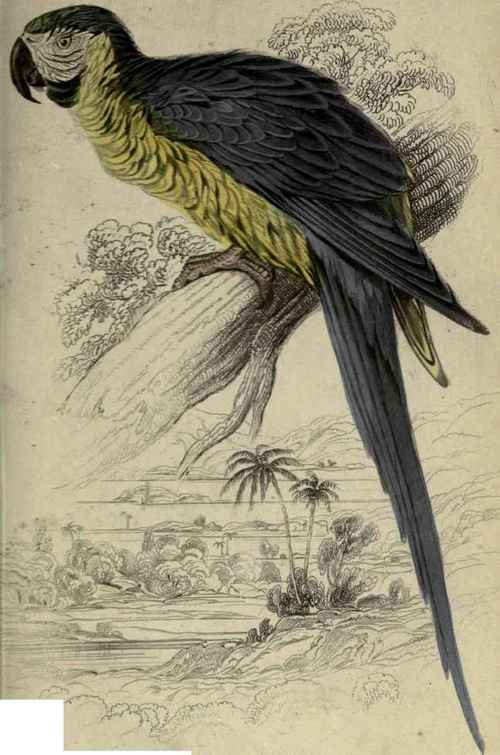
Plate 6. Macrocercus Ararauna.
E. Lear del.
Blue and Yellow Maccaw Native of Brazil.
Lizars sc.
Continue to:


My Books

