


Southern Nestor
Description
This section is from the book "Parrots", by Prideaux John Selby. See also: Alex & Me: How a Scientist and a Parrot Uncovered a Hidden World of Animal Intelligence.
Southern Nestor
Nestor hypopolius - WaglEr.
Nestor hypopolius, Wag. Mon. Psitt. in Abhand- & c, p. 505 and 696 - Psittacus nestor, Lath. Ind. Orn. 1, p. 110 sp. 85; Kuhl, Consp. Psitt. in Nov. Act. etc, p. 86 -Psitt. Australis, Shaw, Mus. Lever, p. 87. - Southern Brown Parrot, Lath. Syn. 1, p. 264, 70.
This curious and remarkable-looking bird, which, in some respects, appears to approach the Cockatoos, particularly the black species, or Geringores, is a native of New Zealand. Of its natural history we have no particulars in the descriptions given by Latham, Wagler, etc, these being merely confined to the form of the parts and the colour of the plumage. Its differently-shaped bill, which, in addition to a greater elongation than that of the other Parrots, possesses other peculiarities of structure, and the denuded tips of the shafts of the tail-feathers seem, however, to indicate an economy in some respects dissimilar to that of the other groups with which it is for the present associated. The bill, which is large, is of a grey colour, with the tip darker. The forehead and crown are greyish-white, slightly tinged with green; the face and ear-coverts are yellow, tinged near the base of the bill with red. The sides of the neck, breast, and abdomen are all dull red; the feathers margined with oil-green. The back and wings are of a brownish oil-green. The rump and vent are deep red. The tail is brownish-green. The legs and feet are grey, tinged with brown.
The next primary division is that of the Cockatoos, or subfamily Plyctolophina, Vigors, representing the Rasorial Order, in the circle of the Psittacidae. It contains, besides the true Cockatoos, distinguished by their white or light coloured plumage, the various black or dark coloured birds belonging to the genus Calyptorynchus, Vigors, which we here designate Geringores, a name given to some of the species by the natives of New Holland, in which interesting country they are chiefly met with. The birds of this division are among the largest of the Parrot tribe, and most of them, in a greater or less degree, are crested. The bill in the Geringore group, though short, and nearly concealed by the projecting feathers of the face, is remarkable for its strength and depth at the base. In addition to seeds, they are said to feed upon the roots of bulbous plants. In disposition, the birds of this subfamily are generally wilder and less tractable than many of the other groups of the Psittacidae. They breed in the holes of decayed trees, and their eggs are seldom more than two in number. The first group we have to notice is that of the genus Plyctolophus, Vieillot, of which the characters are: - Bill deep at the base, greatly arched and strong, the upper mandible forming nearly the fourth part of a circle, the tip narrowed and acute, overhanging the lower mandible; the tomia or cutting edges sinuated or toothed; under mandible narrower than the upper; the tongue thick, fleshy, and smooth; nostrils lateral, in the cere at the base of the bill; head crested, the crest composed of two rows of acuminate feathers, the tip directed forwards, and which can be erected or depressed at will; cheeks plumed; tail rather short, even; plumage compact, the tips of the feathers rounded, truncate; feet robust; tarsi short and reticulated.
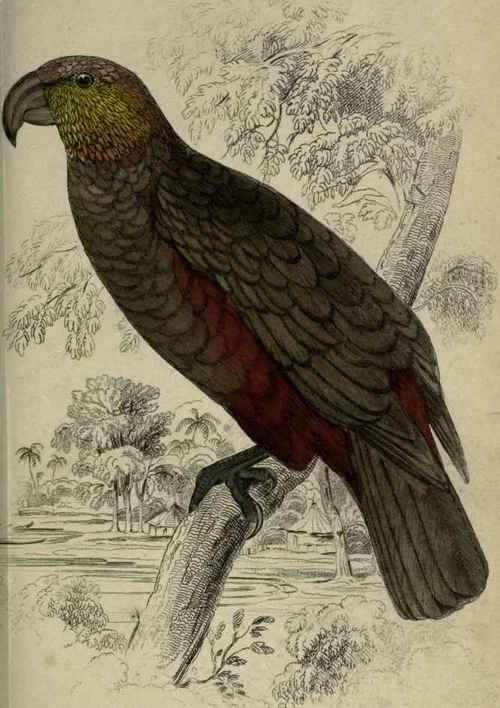
Plate 12. Nestor Hypopolius.
E Lear del.
Southern Nestor. Native of New Zealand.
Lizars sc.
The Cockatoos, so called from the usual call-note of the species, form a well marked genus, readily distinguished from the other groups of the Psittaci-dae by their light and uniform colour, which is white, or white tinged more or less, according to the species, with sulphur-yellow or rose-red, by their peculiar shaped crest, and by their short and even tail. The massive and powerful bill, as well as the robust scan-sorial feet of this section, evidently point to the situation they hold in the family; and, with the nearly allied genus Calyptorynchus and some other forms which sustain the connexion with more distant groups, they are considered as representing the Rasorial group of the family. They are natives of Australia and the Indian Isles, where they inhabit the woods and forests of these luxuriant climes. They feed upon the seeds of various trees and plants, being able, with their powerful bill, to break the stones of the hardest fruits. Their nidification is similar to that of the great body of the Psittacidae, the holes of decayed trees being the receptacle for the eggs and young. They are easily tamed when taken at an early age, but do not possess the imitative powers of the true Parrots, seldom being able to acquire more than two or three words besides their own peculiar note or cry of cockatoo. The first we have to notice is the Plyctolophus Leadbeateri.
Continue to:


My Books

