


The Great Green Maccaw
Description
This section is from the book "Parrots", by Prideaux John Selby. See also: Alex & Me: How a Scientist and a Parrot Uncovered a Hidden World of Animal Intelligence.
The Great Green Maccaw
Sittace militaris, Wagler in Abhand. etc., p. 668. - Psittacus militaris, Auct. - L'Ara Militaire, et le Grand Ara Mili-taire, Le Vaillant, 1. c. p. 11, t. 4, et 1. c. p. 15, t. 6. - Great Green Maccaw, Edw. pl. 13.
In this beautiful species, the ground or prevailing colour of the plumage becomes more assimilated to that of the great body of the long-tailed division, than some of its congeners, for, with the exception of the forehead, the region of the eyes, the lower back, wings, and tail, the remainder is of a fine and lively green. Edwards, in his valuable work, "The Gleanings of Natural History," seems to have first figured and described this Maccaw, which, though ignorant of at the time, he rightly conjectured to be an American bird. It is now ascertained to be a native of Mexico and Peru, inhabiting the warmer districts of the Andean Chain, and attaining to an elevation of about 3000 feet. According to Wagler, its habits differ considerably from those of its congeners, as it does not confine itself to the recesses of the forests, or its food to the fruits there produced, but attacks in congregated flocks the fields of maize, and other cultivated grain and fruits. Upon these it frequently commits serious depredations, to such an extent, indeed, as to require the constant attention and watching of the inhabitants during the period of maturation. When engaged in their predatory excursions, a guard is constantly left by the flock in some elevated station, generally the summit of a tree, from whence, should danger be apprehended, an alarm is given by a loud and peculiar cry, which is responded to by the immediate flight of the wary depredators. They are also said to feed upon the flowers of the Erythinae, and some species of Thi-baudiae, before the ripening of the grains, but whether this is merely to obtain the nectarious juice, as practised by the Asiatic Lories and Australian Tri-choglossi, or for the thick and fleshy substance of the flower and embryo pod or seed-vessel, does not appear from Wagler's account. During the period of the rains, which commence in October, the great body of these birds migrate to other districts, and do not return till the maize begins to ripen, which takes place in January and February. It is easily tamed, and of a docile disposition, but can rarely be taught to articulate more than a few words. It appears to have been a favourite among the ancient Peruvians, as we are told it was frequently presented to the Incas, by their subjects, as an acceptable gift. In size, it is inferior to several of the Maccaws, its extreme length being about twenty-nine inches. The bill is strong, typical in form, its colour blackish-brown. The orbits and cheeks are naked, and of a flesh colour, with striae of small blackish-brown feathers; the irides are composed of two rings, the outer of a rich yellow, the inner greyish-green. The forehead is of a rich crimson, the chin feathers reddish-brown, and passing rapidly into the green of the neck. The rest of the head, the neck, lesser wing-coverts, the mantle, and all the under parts of the body, are of a fine and lively green, in some lights shewing tints of azure blue on the back of the neck and head. The lower back and upper tail coverts, as well as the greater wing-coverts and quills, are of a fine blue. The tail feathers on the upper surface are scarlet, with blue tips, the under surface and that of the wings orange-yellow. The legs and toes are red, tinged with grey. The claws are strong, hooked, and black.
Macrocercus militaris.
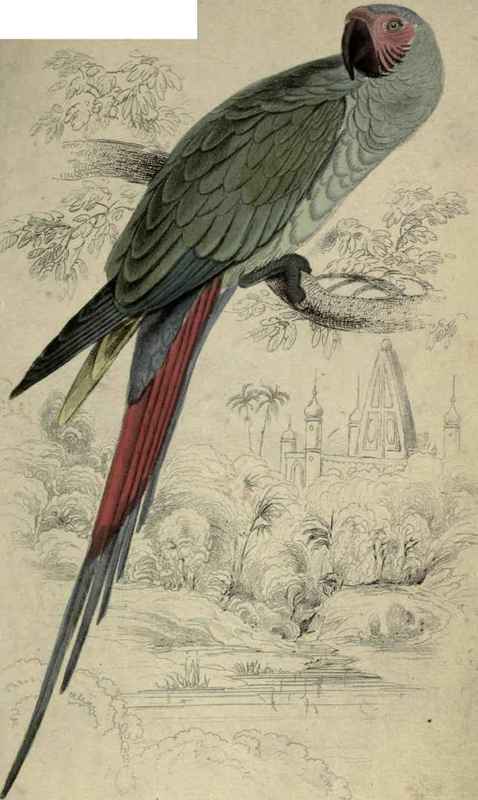
Plate 5. Macrocercus Militaris. The Great Green Maccaw. Native of Mexico & Peru.
E. Lear del.
Lizars sc.
The second illustration of this magnificent group, is the Blue and Yellow Maccaw.
Continue to:


My Books

