


The Clamps. Part 2
Description
This section is from the book "Welding Theory, Practice, Apparatus And Tests Electric, Thermit And Hot-Flame Processes", by Richard N. Hart. Also available from Amazon: Welding: Theory, Practice, Apparatus And Tests, Electric, Thermit And Hot-Flame Processes.
The Clamps. Part 2
When full range of sizes is to be welded or when the smaller sizes only are to be welded, a current controller is furnished with the welder.
Energy Absorbed In Electric Welding - Prof. Thomson's Process
Iron and steel | ||||
Area in " | Watts in primy. of welders | Time in " | H. P. applied to dynamos | Foot-lbs. unit 1000 |
0.5 | 8550 | 33 | 14.4 | 260 |
1. | 16700 | 45 | 28.0 | 692 |
1.5 | 23500 | 55 | 39.4 | 1191 |
2. | 29000 | 65 | 48.6 | 1738 |
2.5 | 34000 | 70 | 57.0 | 2194 |
3. | 39000 | 78 | 65.4 | 2804 |
3.5 | 44000 | 85 | 73.7 | 3447 |
4. | 50000 | 90 | 83.8 | 4148 |
Brass | ||||
Area in □ " | Watts in primy. of welders | Time in " | H. P. applied to dynamos | Foot-lbs. unit 1000 |
.25 | 7500 | 17 | 12.6 | 117 |
•5 | 13500 | 22 | 22.6 | 281 |
•75 | 19000 | 29 | 31.8 | 508 |
1. | 25000 | 33 | 42.0 | 760 |
1.25 | 31000 | 38 | 52.0 | 1087 |
1.5 | 36000 | 42 | 60.3 | 1390 |
1.75 | 40000 | 45 | 67.0 | 1659 |
2. | 44000 | 48 | 73.7 | 1947 |
Area in " | Watts in primy. of welders | Time in " | H. P. applied to dynamos | Foot-lbs. unit 1000 |
.125 | 6000 | 8 | 10. | 44 |
•25 | 14000 | 11 | 23.4 | 142 |
•375 | 19000 | 13 | 31.8 | 227 |
•5 | 25000 | 16 | 42. | 369 |
.625 | 31000 | 18 | 51.9 | 513 |
•75 | 36500 | 21 | 61.2 | 706 |
.875 | 43000 | 22 | 72.9 | 872 |
1. | 49000 | 23 | 82.1 | 1039 |
Iron And Copper
Sp. heat | Cond. | Melting point, deg. Cent. | Arcing volts | |
Iron ................ | 0.113 | 374 | 1635 | 25 |
Copper ........ | 0.095 | 898 | 1080 | 23 |
Copper requires two or three times as much power and only 0.6 time as long time as iron. Rectangular pieces require 25 to 50 per cent, more power than circular. A machine that will weld 2-inch iron will take 1 1/4-inch brass and 7/8-inch copper.
As is seen by the tables, the actual time of welding after the current is turned on is often less than one minute per weld; the advantage of quick handling, automatic clamping, and automatic current shut-off are very apparent. With skilled labor and automatic machines, many firms are now turning out from 500 to 3000 welds per machine per ten-hour day.
For job work the welder is slower and a skilled man should be the operator. If he is called on to weld a succession of different sizes, shapes, and different metals he will have to use his gray matter continually in the regulation of the current, clamps, and the amount of uspet and time of cooling before removal from the clamps. Many firms use this welder for job welding, though it is not specially adapted to job work.
A number of precautions are necessary in the different steps of welding. In the first place, the metal should be very clean, both at the clamps and at the points of contact where the weld is to be made. The metal can be cleaned in a number of ways. If the metal pieces are at all oily they are first dipped in a bucket of lye and then in a bucket of water. If the pieces have any petroleum oil on them, the lye will not clean them, and they must first be wiped down with waste. Sand-blasting and tapping will remove the scale. Any remaining dirt can be forced out into the upset.
Then the clamps must be set lightly on the pieces, and the contact surfaces must be as large as possible so that there will be good electric conductance. If the contact at the clamps is imperfect the clamps will become heated.
The distance between the clamps varies with the diameter of the metal pieces and also with the kind of metal. In a general way, the distance between clamps is equal to twice the diameter, with iron; is three times as great as the diameter, with brass; and four times, with copper. This difference, of course, is caused by the higher conductivity of copper, which requires the immense volume of 60,000 amperes per square inch of metal.
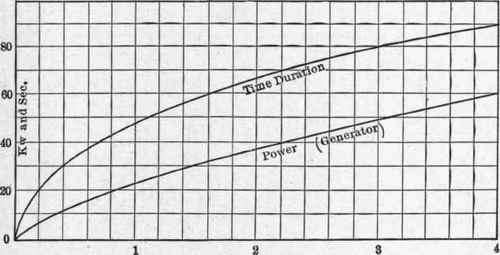
Area in Sq. in.
Fig. 22. - Power and time required to weld iron (Standard Handbook for Electrical Engineers).
Some metals are best heated rapidly. Steel, rolled copper, and like metals, which are easily ruined by heat, must be handled with care. They must be heated as quickly as possible; and they must not be overheated, or they will lose their structure. The act of forcing the hot ends together and squeezing the metal helps to maintain the structure and prevent crystallization. Such metals should be worked or hammered while cooling. In welding tool steel the ends are forced together until the overheated metal is all forced out of the joint into the upset. Of course, any scale or dirt is also forced out. When copper wire is welded, it should be upset and then drawn down to the proper gauge. In this way joints of nearly equal strength can be made. While quick heating is a good thing, the joint can easily be heated so rapidly that it will be overheated. No metal can stand overheating.
Contrary to common conception, the welding heat is not caused by imperfect contact at the joint. The pieces should fit as closely as possible before welding. A poor contact will simply delay the heating.
Rapid welding calls for larger dynamo and welder at greater cost, but the increased efficiency will more than pay for the outlay.
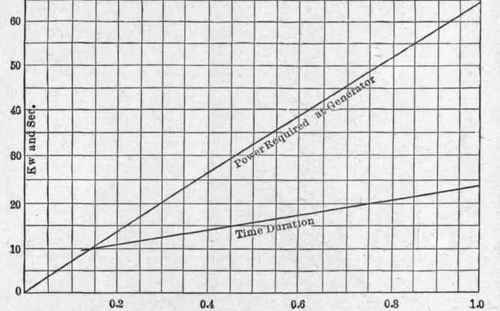
Area in Sq. in.
Fig. 23. - Power and time required to weld copper (Standard Handbook for Electrical Engineers).
Seven-horsepower minutes is given as the approximate figure for bringing one cubic inch of iron to welding heat.1 If the metal clamps conduct the heat away rapidly, from 10 - to 15-horsepower minutes are required.
All of the metals of commerce have been welded by this process, both to themselves and to each other. Those metals which are most plastic at welding heat and which have the widest range of plasticity will weld the most readily. Metals which oxidize can be fluxed with borax, sand, sal ammoniac, zinc chlorid, etc., but in most cases fluxing is not necessary. The oxid at the contact can be forced out into the upset. Brass is generally fluxed.
1 The Engineering Magazine, Hermann Lemp, Aug., 1894.
In most cases fluxing is not necessary. The oxid at the contact can be forced out into the upset. Brass is generally fluxed.
Continue to:


My Books

