


The Clamps. Part 3
Description
This section is from the book "Welding Theory, Practice, Apparatus And Tests Electric, Thermit And Hot-Flame Processes", by Richard N. Hart. Also available from Amazon: Welding: Theory, Practice, Apparatus And Tests, Electric, Thermit And Hot-Flame Processes.
The Clamps. Part 3
Prof. Thomson has in his possession a metal bar of 3/8-inch diameter which is made of nine different metals welded together. However, the Thomson Company does not recommend its machine for cast iron or similar metals of well-defined melting point and which are brittle up to that melting point. Cast-iron pieces can be melted in the welder and their ends stuck together. It is necessary to build up a clay or asbestos form around the joint so that the metal will not run away when it melts. Brass must be treated in the same way. On cooling it will become brittle and crystalline. This is a trouble, however, which is common to all the welding processes. If you are welding a troublesome metal you may as well expect doubtful results. The welding of copper by this process has been a disappointment to some, while others claim complete success for their copper welds. It is evident that the difference between good and bad welds in many instances is due to the skill employed.
Adaptability
In the last decade the Thomson or similar machines have forced their way into many of the metal trades. In factories where stock welds are made, this process is invaluable. There is a long list of implements that are now welded in the process of making. Those industries which are most benefited are the wagon and carriage, bicycle, tools, wire, chain, pipe and pipe bending, and miscellaneous, which includes angle welding, typewriters, printers' chases, wire fence, tool steel to steel, springs, bands and rings, umbrella rods, etc.
Occasionally the joining of two different kinds of metals or of metals of unequal sizes will call forth the ingenuity of the workman. Copper and brass are frequently welded to iron. When metals of unequal electrical conductivity are welded, the clamps are placed according to the conductivity of the metal. Thus, for copper on iron, the iron clamp would be placed one diameter away from the end of the iron, and the copper clamp three times the diameter away from the end of the copper piece. Copper and iron weld fairly well because their melting points are fairly close and they will alloy at the contact. On account of the great difference in conductivity, however, the iron will become much hotter than the copper piece, unless the latter is pointed or whittled down as shown in figure 24.
Another problem has been to join a bar of iron to an iron plate. In this case, the current, under ordinary conditions, would flow off of the surface of the bar on account of the larger area of the plate. The bar would become heated only on the periphery of the end, and the plate would not be heated to redness. To prevent the current from spreading at the junction, a circular channel is cut into the plate at the proposed junction, as shown in figure 25. In a similar way a large bar can be butted on to a smaller bar by cutting or whittling the end of the large bar.
Wire factories can butt-weld their wire ends, thus saving waste pieces and allowing them to make any length of wire specified.
The carriage and bicycle trades have been much benefited by the Thomson process. Frames, hubs, spokes, steps, etc., are welded by this process. In bicycle manufacture, tubes, forks, pedals, crank hangers, mud-guards, etc., are welded. Automobile making is equally dependent on electric welding.
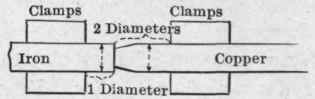
Fig. 24. - Welding iron to copper. Showing adjustment of clamps and shape of copper.
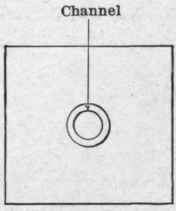

Fig. 25. - Showing how a bar is welded to a plate.
Iron or brass pipe is butt-welded and also heated preparatory to bending. In England wrought-iron pipes are flanged very successfully.
A number of firms weld printers' chases by this method. The bars are held in the hands of the operator, are butt-welded, and then right-angled on a frame. The burr or upset is trimmed off on a metal saw and ground even on a wheel.
Chain is being welded by the electrical process; as fast as two links a minute can be turned out on the smallest sizes. In this case some of the current, approximately 10 to 30 per cent.,1 travels around the ring instead of over the joint. This loss of current is expensive and stands in the way of the general adoption of this process to chain welding. But it is also claimed that this short-circuiting of part of the current causes the ring to heat sufficiently to bend with ease when the ends of the link are closed. It is claimed that a bar magnet thrust through the link to be welded will largely prevent the current from traveling around the link.

Fig. 26. - Thomson specimens. Type bars, steel to brass; angle weld; bicycle fork; hoe; corner angle weld; chain, two welds; chain showing fin after welding; chain welded and fin removed.
In the welding of hoops and rings this same objection appears. The loss of current is much less for rings of large diameter and small gauge, and can be further reduced by placing the clamps closer than is the custom.
1 Iron Age, W. S. Gorton, July 27, 1905.
Electric welding is much used in the manufacture of projectiles and the parts of machine guns. A special high-carbon head can be welded on to a soft-steel projectile cartridge.
Brass heads are joined to steel shanks for use in switchboards.
Garden rakes that were once made of cast iron are now made much lighter and stronger by putting the teeth on a bar. Both teeth and bar are of wrought iron or steel, and are lighter and much stronger than the old cast rake.

Fig. 27. - Thomson specimens. Tee weld in pipe; furrule; wire handles; bicycle head; sheaves; band saw steel automobile rim; pipe; tee weld; wire mesh.
Wheelbarrows are made of welded-steel wheels and frames. In the wheels, the rim is welded into a hoop, and the spokes are welded both to the rim and to the hub.
The heads of cap screws are now successfully welded onto the shanks. This allows the manufacturer to cut his thread in the hard outer layer of steel. Formerly the screw was cut from a billet of the diameter of the head. The head was harder than the thread which was turned out of the softer metal near the core. It is claimed that the increased strength of the thread and the decreased cost of turning down the shank offset the cost of welding.
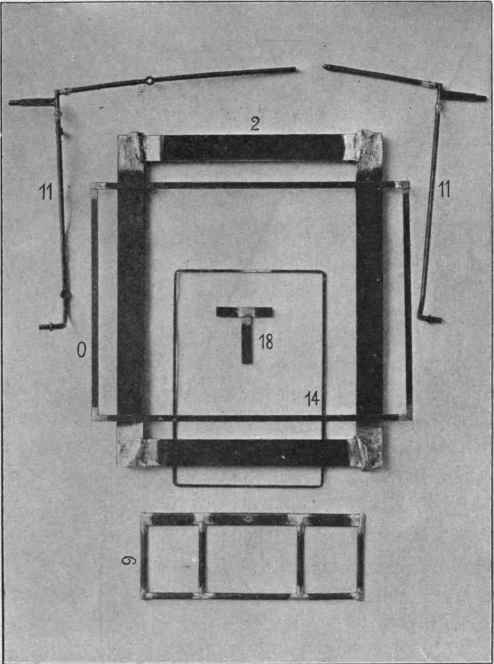
Fig. 28. - Thomson specimens. Printer's chase; carriage rail; bag frame flat; T weld; bag frame on edge; dash frame.
Continue to:


My Books

