


The Crucible
Description
This section is from the book "Welding Theory, Practice, Apparatus And Tests Electric, Thermit And Hot-Flame Processes", by Richard N. Hart. Also available from Amazon: Welding: Theory, Practice, Apparatus And Tests, Electric, Thermit And Hot-Flame Processes.
The Crucible
With the exception of butt-welding, where an ordinary hot crucible is used, the crucible for all thermit-welding is a cone-shaped affair that taps at the bottom. It is an evolution of the thermit process, and is so designed that the molten iron can be drawn off before the slag (Fig. 65).
It is in the shape of an inverted cone, having a rounded iron top which is clapped on as soon as the charge is fired to prevent spattering and loss of heat. The crucible is tapped through a hole in the bottom. It is supported on a tripod or can be slung from a crane or overhead arm.
The body is of pressed steel, lined with several inches of magnesia. Magnesia is slightly more refractory than silica and it has the advantage that it will not unite so readily with the molten steel. Hence the steel remains basic.

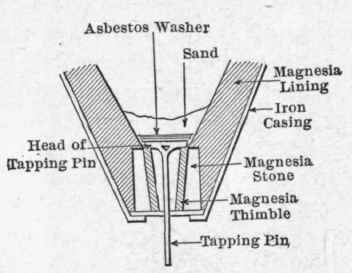
Fig. 65. - Thermit crucible with detail of lap hole.
The tap hole is the vital part of the crucible. It must remain fluid-tight until tapped, and must then withstand the rush of molten steel under pressure. As shown in figure 65, the bottom of the crucible holds a large cylindrical magnesia stone which has been placed in position before the magnesia lining has been tamped in. Resting inside the stone is another conical-shaped magnesia stone, called the "thimble." It is also hollow, and its core is the channel for the molten steel. An iron tapping pin, haying a long shank and a flat head, is dropped into the hole in the thimble; its head acts as a plug to the channel. An asbestos washer is dropped on the head of the tapping pin, then an iron washer, and next an inch of silica sand is poured on the iron washer. This makes a plug to the crucible that is fluid-tight for at least a minute, long enough for the reaction to take place.
This plug is tapped by driving the pin up from the outside by hitting it with a spade. The fluid rushes out and melts the tapping pin as it goes.
A new tapping pin is needed with each reaction; a new thimble every eight or ten reactions; a new crucible lining every twenty to more reactions.
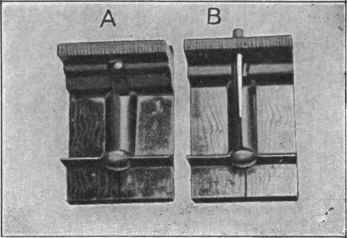
Fig. 66. - Rail patterns.
The lining of the crucible is a mixture of tar and magnesia, which is tamped in between the crucible steel and an iron matrix. When lined, the crucible is baked at a red heat for six hours, when the lining becomes hard. Even such a substance as magnesia melts away under the heat of the thermit reaction, and after several melts the interior resembles the walls of a Bessemer crucible.

Fig. 67. - Rail mold boxes.
Continue to:


My Books

