


The Oxy-Hydrogen Process
Description
This section is from the book "Welding Theory, Practice, Apparatus And Tests Electric, Thermit And Hot-Flame Processes", by Richard N. Hart. Also available from Amazon: Welding: Theory, Practice, Apparatus And Tests, Electric, Thermit And Hot-Flame Processes.
The Oxy-Hydrogen Process
General
The oxy-hydrogen flame is the first, historically, of the high-temperature flames. It was used long before the discovery of industrial electrolysis of water or the production of oxygen by liquid-air process. The first flames were fed with oxygen generated from potassium chlorate and manganese dioxid or from the decomposition of sodium and potassium peroxids with water or similar methods, and with hydrogen from zinc and hydrochloric acid or similar methods. Both the hydrogen and the oxygen can be used independently for the following combinations, the hottest first: 1. Oxy-hydrogen.
1 Comptes rendu, 121, 1144.
2. Oxygen-coal gas.
3. Air-hydrogen.
Apparatus
The first efficient apparatus was devised by Newman,1 who used pure oxy-hydrogen (detonating gas) under 2 or 3 atmospheres' pressure. The burner was a glass tube about 4 inches long, of 1/80-inch bore. The flame was kept at the tip by reason of the pressure and the narrow bore. In 1847, Robert Hare, of Philadelphia, fused 2 pounds of platinum with a blowpipe of his own invention. He also used detonating gas; and as a safety device, to prevent back-fire explosion, a handle packed tight with copper rods, through which the gas was forced to the tip. This acted on the principle of the Davy lamp. In 1859 Deville and Debray revived this flame for platinum welding, and since then it has been employed in working that metal and also, sometimes, for gold and silver.
At the present time the oxy-hydrogen flame is much used in laboratories for production of high heat and to a limited extent in repair and boiler shops. It has long been the preferred method for sealing lead chambers for sulphuric acid manufacture by the contact process. Before the advent of the electric arc, bright light was obtained by heating a chunk of lime in this flame. This once widely advertised light is almost unknown at present. Before industrial oxygen and hydrogen were made by electrolysis of water, this flame was quite expensive, and recently it has been crowded severely by the oxy-acetylene process. But in platinum welding, lead soldering, and laboratory research it holds its own.
Detonating gas is made by the decomposition of water without separating the resultant gases. It can be used for soldering and welding, provided the burner is protected from back-fire, by passing the gas through a safety chamber filled with fine porous material or guarded by a water valve. Detonating gas is comparatively cheap, though the railroads often object to handling it.
1 Encyclopedia Britannica, Vol. XVIII, p. 105.
Separate oxygen and hydrogen are to be preferred on account of safety.
The outfit consists of tanks of the gases, tubes, and a burner (see Fig. 59). To prevent one gas from flowing into the other gas supply tank, if the pressure of the second gas should fail, each leading tube is provided with a safety water valve. The burner is a tube in a tube: the inner tube carrying oxygen, the surrounding tube hydrogen. Both have cocks. The hydrogen is first turned on and lighted; then turn on the oxygen. This burner is also suited for oxygen-coal gas.
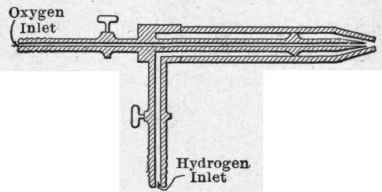
Fig. 59. - Oxy-hydrogen blowpipe.
Figure 60 shows the air-hydrogen torch; the hydrogen is injected at the handle and draws in air through holes in the tip. The amount of air is regulated by a ring. This burner resembles the Bunsen burner, and is used for small work, where great heat is not needed. The hydrogen may be produced by the zinc-acid process.
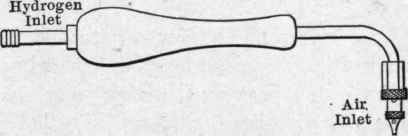
Fig. 60. - Hydrogen-air blowpipe.
M. U. Schoop,1 the welding expert, recommends the burner shown in figure 61 for large-scale work. The torch has two chambers. The first is filled with oxygen. The hydrogen tube passes through this chamber into the second. The injected hydrogen draws oxygen from the first chamber into the second, where they mix before coming out at the nozzle. This torch is liable to back-fire, but it gives a perfect combustion and prevents free oxygen in the flame.
1 Electrochemical and Metallurgical Industry, July, 1905.
The air-hydrogen process is apparently cheaper, but when it is considered that much less heat is evolved and that three hours' time are needed to one hour for oxy-hydrogen, it turns out to be dearer. Schoop claims that it is more dangerous than oxy-hydrogen. It is the preferred flame for "lead burning," as the sealing of lead seams is called. C. H. Fay1 has explained the apparatus and process in great detail. He used apparatus of the Kirkwood & Herr Hydrogen Machine Company, of Chicago. It included: an air gasometer; a hydrogen-generating apparatus, using zinc and sulphuric acid; and a regular burner with two cocks. If the hydrogen was used under pressure up to 30 pounds, the air gasometer could be done away with, and air introduced by injection instead.
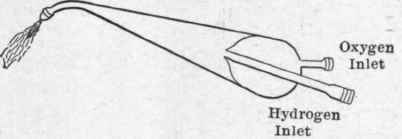
Fig. 61. - Oxy-hydrogen burner allowing perfect mixing of the gases.
The Flame
Oxygen and hydrogen for combustion are mixed in a long-shanked burner at the lower end of the handle. They burn at the tip with a pale blue, almost colorless flame. The theoretical formula of combustion is
2H2+02 = 2H20.
Though these gases will unite as low as 155 deg. Cent.,2 the action is slow. Explosive ignition of mixtures of the gases in different proportions occurs at an average temperature of 825 deg. Cent. Richards3 gives the temperature of the hottest part of the flame as 3191 deg. Cent., and of the air-hydrogen flame as 20101 deg. Cent. Bunsen's experiments gave a maximum of 2844 deg. Cent. The former temperature, of course, is not to be found throughout the flame, if at all. The actual temperature is probably not much above 2000 deg. Cent, under working conditions, and while this is above the fusion point of most of the metals, it is none too high when conduction is reckoned on. The heating value of the hydrogen flame is much less than the acetylene, being 67,940 calories.
1 "Lead Burning," 1905.
2 Electrochemical and Metallurgical Industry, May, 1905.
3 Roscoe and Schorlemmer, Vol. I, p. 287, "Treatise on Chemistry."
Practice
In using the oxy-hydrogen flame it is necessary to use an excess of hydrogen over the theoretical amount of two volumes to one of oxygen. Otherwise there is danger of oxidizing the metal surface with hot oxygen. Platinum is the exception. This metal absorbs hydrogen and swells up. When cooling, it occludes the gas and becomes rough and pocked. One writer1 recommends 4 to 5 volumes of hydrogen to 1 of oxygen for ordinary welding. This is so in the case of iron, copper, aluminium, and other oxidizable metals, when the unmixed-gas type of burner is used. But no such excess is necessary where the gases are mixed before ignition.
In lighting the oxy-hydrogen burner, turn on two-thirds of the hydrogen first and light it, then turn on oxygen until you have a pale blue conical flame. Then turn the hydrogen on full. If the burner is of the type shown in figure 61, do not light for at least ten seconds; and turn the oxygen off first when extinguishing.
The air-hydrogen flame, being cooler, must be larger. Hydrogen is turned on and lighted first. The flame will be about 3 inches long, pale red, and will burn unsteadily. Now turn on air until the flame shortens to 2 inches and has a fixed, pale blue cone. If you are using an injector air-burner, you regulate the air by turning the air ring.
In using either flame do not bring the end of the cone of oxygen against the work in hand. If you do, you are liable to burn your metal.

Fig. 62. - Lap welding lead sheets with air-hydrogen flame.
1 Electrochemical and Metallurgical Industry, May, 1909.
The operator is advised to use a flame of such size that it will not melt the metal at once. Slow melting will make a better job, and the metal will not be so apt to run away from the joint before he is prepared for it. Operators commonly weld a drop at a time as shown in figure 62. They then go back over the seam a second time to smooth off the surface.
Different metals require different treatment. There are little points in the handling of this flame that the operator will have to work out for himself. Like any highly efficient tool, it requires a skilled workman.
"The time1 for welding 1 meter of sheet iron 3 mm. in thickness is about 15 minutes, while for welding 1 meter of sheet metal of o. 5 mm. thickness, it is from 4 to 6 minutes."
1 Electrochemical and Metallurgical Industry, F. C. Perkins, May, 1906.
Continue to:


My Books

