


On The Evolution Of Forms Of Ornament. Part 5
Description
This section is from "Scientific American Supplement". Also available from Amazon: Scientific American Reference Book.
On The Evolution Of Forms Of Ornament. Part 5
We now come to the third group of forms - the so-called Cashmere pattern, or Indian palmetta. The developed forms, which, when they have attained their highest development, often show us outlines that are merely fanciful, and represent quite a bouquet of flowers leaning over to one side, and springing from a vessel (the whole corresponding to the Roman form with the vessel), must be thrown to one side, while we follow up the simpler forms, because in this case also we have no information as to either the where or the when the forms originated. (Figs. 17, 18, 19.)
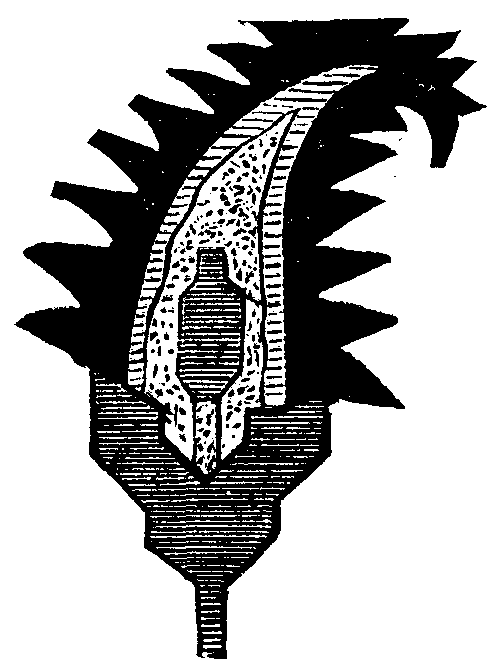
FIG. 17.
Here again we are struck by resemblances to the forms that were the subjects of our previous study, we even come across direct transitional forms, which differ from the others only by the lateral curve of the apex of the leaf; sometimes it is the central part, the spadix, that is bent outward, and the very details show a striking agreement with the structure of the aroid inflorescence, so much so that one might regard them as actually copied from them.
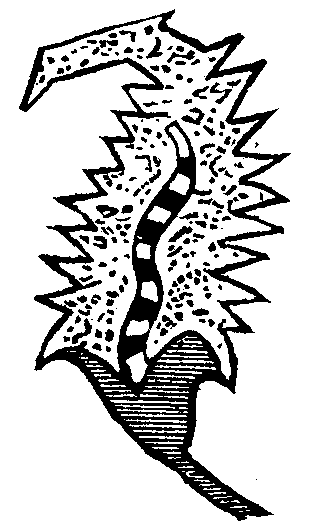
FIG. 18.
This form of ornament has been introduced into Europe since the French expedition to Egypt, owing to the importation of genuine Cashmere shawls. (When it cropped up in isolated forms, as in Venice in the fifteenth century, it appears not to have exerted any influence; its introduction is perhaps rather to be attributed to calico-printing.) Soon afterward the European shawl-manufacture, which is still in a flourishing state, was introduced. Falcot informs us that designs of a celebrated French artist, Couder, for shawl-patterns, a subject that he studied in India itself, were exported back to that country and used there (Fig. 20).
In these shawl-patterns the original simple form meets us in a highly developed, magnificent, and splendidly colored differentiation and elaboration. This we can have no scruples in ranking along with the mediaeval plane-patterns, which we have referred to above, among the highest achievements of decorative art.
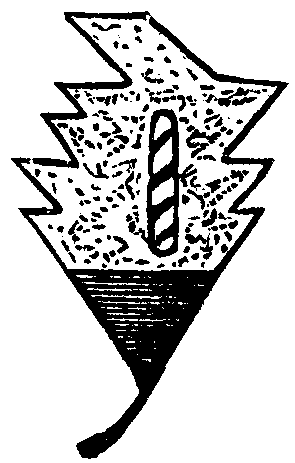
FIG. 19.
It is evident that it, at any rate in this high stage of development, resisted fusion with Western forms of art. It is all the more incumbent upon us to investigate the laws of its existence, in order to make it less alien to us, or perhaps to assimilate it to ourselves by attaining to an understanding of those laws. A great step has been made when criticism has, by a more painstaking study, put itself into a position to characterize as worthless ignorantly imitated, or even original, miscreations such as are eternally cropping up. If we look at our modern manufactures immediately after studying patterns which enchant us with their classical repose, or after it such others as captivate the eye by their beautiful coloring, or the elaborative working out of their details, we recognize that the beautifully balanced form is often cut up, choked over with others, or mangled (the flower springing up side down from the leaves), the whole being traversed at random by spirals, which are utterly foreign to the spirit of such a style, and all this at the caprice of uncultured, boorish designers.
Once we see that the original of the form was a plant, we shall ever in the developed, artistic form cling, in a general way at least, to the laws of its organization, and we shall at any rate be in a position to avoid violent incongruities.
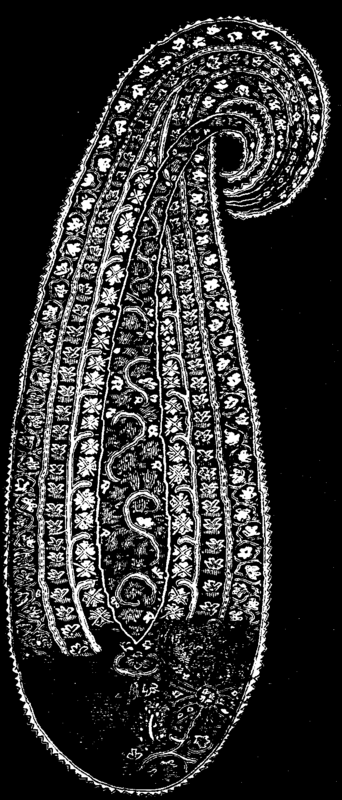
FIG. 20.
I had resort, a few years ago, to the young botanist Ruhmer, assistant at the Botanical Museum at Schöneberg, who has unfortunately since died of some chest-disease, in order to get some sort of a groundwork for direct investigations. I asked him to look up the literature of the subject, with respect to the employment of the Indian Araceae for domestic uses or in medicine. A detailed work on the subject was produced, and establishes that, quite irrespective of species of Alocasia and Colocasia that have been referred to, a large number of Araceae were employed for all sorts of domestic purposes. Scindapsus, which was used as a medicine, has actually retained a Sanskrit name, "vustiva." I cannot here go further into the details of this investigation, but must remark that even the incomplete and imperfect drawings of these plants, which, owing to the difficulty of preserving them, are so difficult to collect through travelers, exhibit such a wealth of shape, that it is quite natural that Indian and Persian flower-loving artists should be quite taken with them, and employ them enthusiastically in decorative art.
Let me also mention that Haeckel, in his '"Letters of an Indian Traveler," very often bears witness to the effect of the Araceae upon the general appearance of the vegetation, both in the full and enormous development of species of Caladia and in the species of Pothos which form such impenetrable mazes of interlooping stems.
In conclusion, allow me to remark that the results of my investigation, of which but a succinct account has been given here, negative certain derivations, which have been believed in, though they have never been proved; such as that of the form I have last discussed from the Assyrian palmetta, or from a cypress bent down by the wind. To say the least the laws of formation here laid down have a more intimate connection with the forms as they have come down to us, and give us a better handle for future use and development. The object of the investigation was, in general words, to prepare for an explanation of the questions raised; and even if the results had turned out other than they have, it would have sufficed me to have given an impulse to labors which will testify to the truth of the dead master's words:
 "Was Du ererbt von deinen Vätern hast,

Erwirb es, um es zu besitzen."
[1]From a paper by Prof. Jacobsthal in the Transactions of the Archaeological Society of Berlin. - Nature
Continue to:


My Books

