


Exercises That Bring Grace Amd Beauty. Part 3
Description
This section is from "Every Woman's Encyclopaedia". Also available from Amazon: Every Woman's Encyclopaedia.
Exercises That Bring Grace Amd Beauty. Part 3
After completing the Back Twists, the arms must be straightened upwards and directed slightly forwards before starting the Front Swings. It will be noticed that the Back Twists have to be slightly modified, as the straightening of the arm takes place during the last quarter of the twist. The beginner will probably find herself unconsciously reversing the circles.
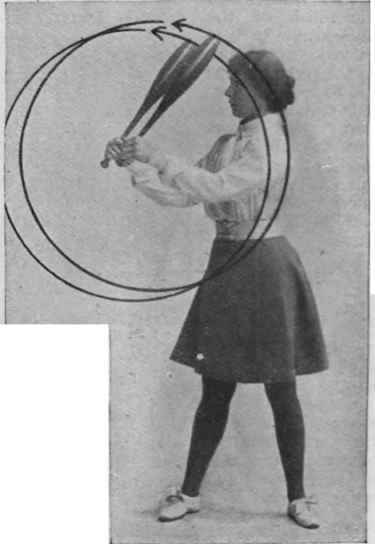
\ Fig. 16. B Clubs c
passing through last quarter
If a circle is started to the right, all the succeeding swings and twists must also start to the right, until the series is finished.
If the learner really swings her clubs, and does not stop between the circles, they can not be reversed, as the clubs naturally tend to swing on in the same direction in which they were started.

Repeat up to 16, then swing to the left.
To start this exercise turn the right shoulder slightly back (shoulders half right), and place the hands so that the right hand is opposite the right side of the chest, and about 12" or 14" from it, and the left hand level with the right hand and about 6" from it. Now make the clubs descend forwards and swing up past the shoulders, keeping as close to the outside of the arms as possible. Fig. 16 shows this position ; the clubs are just completing the last quarter. Repeat the Twist twice ; then, just as the clubs are nearing the finish of the second Twist, raise the arms with a curved movement to the right to start the Front Swings.
It will be noticed that the Front Swings are here modified, as they have to be started lower and to the side, instead of upwards.
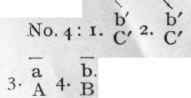
Repeat up to 16, then do exercise starting on the left.
Stand as for the last exercise. The clubs make the same Twists as described in exercise 3, but in the reverse direction - i.e., the clubs will swing towards the shoulders first.

Repeat up to 16, then do the exercise starting on the other side.
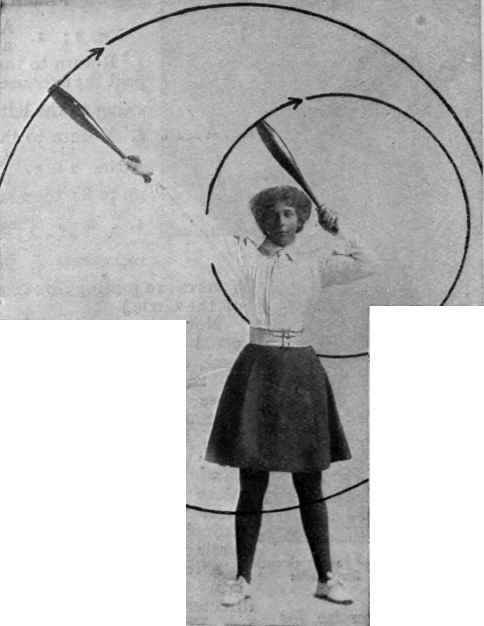
Fig. 17. Combined parallel circles. Right hand. Inward front swing (a). Left hand. Outward back twist (B). Position just completing circles
See Fig. 17, which shows the Outward Back Twist (left) combined with the Inward Front
Swing (right) or a
This exercise is rather more advanced, as in the second movement the right arm is doing a Swing while the left is doing a Twist. At first this will be found difficult, and the second movement a
B should be practised alone. Start with the right arm raised ready for the swing, and the left hand close to the ear in position for the Back Twist ; and repeat these two circles several times.
No. 6 :
a A
b. A
This exercise is the same as the last, except that the right hand now makes an Inward Back Twist, and the left an Outward Front Swing. It may be combined with the last exercise to form a continuous series, thus :
a A
b
a A
a. B
Repeat up to 16, then do it on the other side.
passing through third
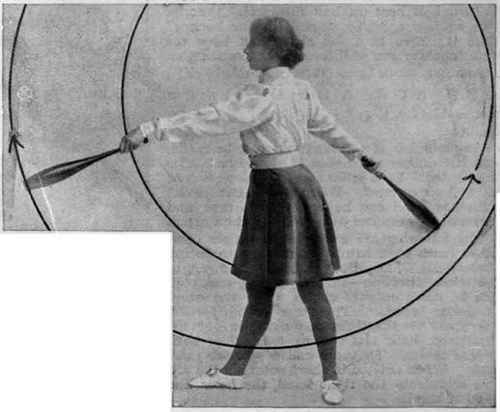
Fig. 18. D The clubs A quarter
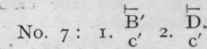
This exercise starts with the hands in the same position as for exercise 4 (see page 4101, Vol. 6), but the shoulders are full right. Just as the right club is nearing the completion of the Back Twist, the hand is raised, and the arm straightened for the Back Swing, whilst the left hand is kept in its place and continues to do Cross Front Twists.
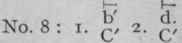
This exercise is the same as No. 7, but the circles are in the reverse direction.

Repeat up to 16, then do the exercise on the other side.
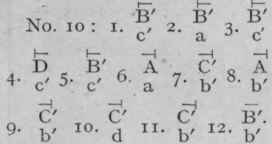
This shows how several exercises may be combined to form a longer series. The turn to shoulders full left is made at 6, during the Front Swings.
These examples are sufficient to show how the circles can be combined. The learner will find great interest in putting together other combinations. If she is wise, she will write down, in short notation, the exercises she devises.
A few examples of Alternate Circles will now be given : also

the reverse

(for a a see Fig. 14).
No. 12 : I.
(see
Fig. 2 in first article), also the reverse I.
a b
b. a

See Fig. 18, which shows Outward Back Swing, right hand, combined with Outward
Front Swing, left hand (D).
(A) At first it will be found rather difficult not to reverse the swing of the right hand at
2. To avoid this, the points to remember are : to turn on the heels in time, just as
A the clubs are completing A ; to keep the way through first quarter Photos, Stephanie Maud and Martin Facolette shoulders loose, and not to check the swing of the clubs.
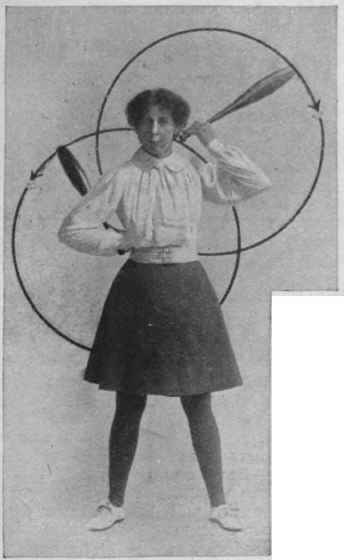
Fig. 19. 1/2 L B 1/2 A. The position when half-

For the position at 3 see Fig. 16, the

only difference being that the left club is now making an outward instead of an inward cross front twist, as in the picture. In passing from C to B the left hand must describe an upward curve to the left.
Examples of exercises introducing the remaining circles E to M will now be given.
also the

reverse. Care must be taken to keep the clubs parallel throughout this exercise.
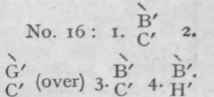
At 2 the right hand is crossed over the left, the wrists close together. At 4 the left hand is crossed over the right.

This exercise is rather more effective if the hands in 2 and 3 are kept level with the top of the head.
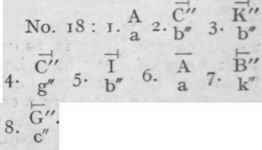
This is a good exercise for the wrist and fingers. At 6.
A a clubs make a circle and a half, as they start from the horizontal after 5.
and have to continue till they

reach the horizontal on the other side for 7.


Fig. 19 shows the position at 2 ; the clubs are passing through the first quarter of circle.
Continue to:


My Books

