


Lessons In Cooking. Part VII. Marketing And Cuts Of Meat
Description
This section is from the book "Lessons In Cooking Through Preparation Of Meals", by Eva Robeeta Robinson. Also available from Amazon: Lessons in Cooking Through Preparation of Meals.
Lessons In Cooking. Part VII. Marketing And Cuts Of Meat
The best way to study marketing and the cuts of meat is to go right to the market, select the meat and ask questions of the butcher. If this is done in the right way a great deal of valuable information can be obtained. The average housekeeper knows two or three cuts of meat, namely, the round, porterhouse and rib roast. Some of the most nutritious cuts are the cheapest, and if one knows how to cook them properly, these will be much more satisfactory than some of the most expensive cuts.
The following is a list of the cuts arranged according to price and use:
Steaks
Tenderloin
Porterhouse
Sirloin
Jump
Round
Flank
Skirt
Roasts Fillet Rib Loin
Pot Roasts
Rump
Round
Shoulder
Flank
Stews and
Casseroles
Rump
Round
Shoulder
Flank
Neck
Corning Plate Brisket Navel
The tenderloin is the long tender muscle that lies under he back bone. It is very tender, and has a delicate flavor but contains no fat. In the best beef it is sliced with the porterhouse and sirloin steaks, but with the poorer beef it is removed whole and sold either as a fillet, or sliced. It should be larded, baked at a low temperature, and served are. It is the most expensive and least nutritious in proportion to the cost, of all the cuts of beef.
The porterhouse are the cuts of steak lying between the ibs and the hip bone. The back bone forms a T shape and hence they are sometimes called the T-bone steaks.
The sirloin steaks begin with the hip bone and contain a piece of it as well as part of the back bone. These as well as the porterhouse are tender steaks, can be cooked quickly, and should be served rare.
The rump; steak, requiring a peculiar cutting, is , rarely offered for sale in the ordinary markets, but is a delicious steak.
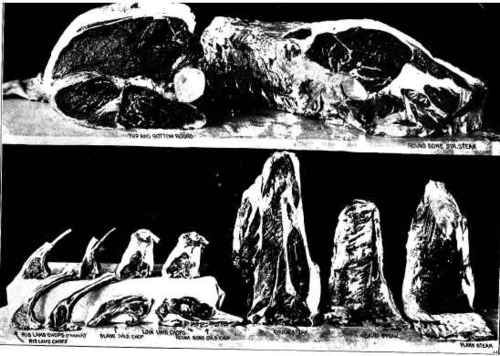
The round, cut from the thigh and containing a small piece of bone, is one of the commonest cuts. The first cuts of the round may be used as a steak when taken from good beef, but usually it is not tender enough to permit of quick cooking. However, it is one of the most nutritious and cheapest cuts of the animal and lends itself to a great variety of ways in cooking.
Flank steak, of which there are only two steaks in each beef, lies to the front of the hind leg on the flank. It is a flat muscle and the grain runs with the cut instead of across it. It is not used as much as it should be, for it is very rich in flavor and nutriment. By rolling and slicing it across the grain, it can be cooked as an ordinary steak, and. served rare. Like round, it can be made very delicious and tender when subjected to long, slow cooking.
The skirt steak is similar to the flank and can be cooked in the same way.
For oven roasts, the fillet, rib, and loin are the best. The rib roast when bought with rib on, is called a standing rib roast. When the rib has been removed and the roast is rolled it is called a rolled rib roast.
For pot roasts the rump and round are the best, being solid pieces of meat without much bone and having excel-. lent flavor. The shoulder and flank rank next.
For stews and, casseroles and other cooking at low temperatures the tougher cuts can be used the same as in pot roast. In mutton, lamb, veal, and pork, the cuts are much the same, the chop in each case corresponding to the rib roast and porterhouse steak of the beef. The leg furnishes steaks corresponding to the round steaks of the beef, but are generally used for roasts. The tougher parts are used for stews, etc.

Roasts Of Beef, New York Market. Courtesy of the Department of Domestic Science, Columbia University.
Continue to:


My Books

