


Chapter V. Part 5
Description
This section is from the book "Food And Feeding", by Sir Henry Thompson. Also available from Amazon: Food And Feeding.
Chapter V. Part 5
A standard illustration of effective stewing or common braising exists in the production of a well-known French dish, boeuf d la mode, which is always good, when served in a simple, inexpensive manner for the people, and may be rendered most excellent with more care and refinement, so as to be suitable at a table of the highest rank. I shall subjoin Gouffe's receipt; he regards the process as an important and typical one, and gives it at length. See Appendix, p. 288.
Stewing.
On the principle by low temperature.
Stewing; " boeuf a la mode."
Braising. Of this there are two methods, one simple, another more complex. In the former, the meat may be just covered with a strong liquor of vegetable and animal juices (technically called braise or mirepoix) in a closely covered vessel, from which as little evaporation as possible is permitted, and is cooked in the same manner as that above recommended here for stewing. By this treatment tough fibrous flesh, even if old, whether of poultry, of cattle, or meat unduly fresh, such as it is difficult to avoid during the summer heat in towns, is made tender and easily digestible. Moreover, it becomes impregnated with the odours and flavour of fresh vegetables (carrots, turnips, celery, onions) and sweet herbs, while the liquor itself, slowly reduced in the process, furnishes the most appropriate, fragrant, and delicious sauce, with which to surround the portion when served at table. Thus, also, meats which are dry, or with little natural flavour, as veal, become saturated with vegetable juices, and combined with sapid substances, which render the food succulent and delicious to the palate. Small portions sufficing for a single meal, however small the family, can be thus dealt with; so that a rechauffe, or cold meat for to-morrow, is not a thing of necessity, but only of choice when preferred. To judge by the braised products which rarely appear on English tables, and by such descriptions of it as exist in our cookery books, the process itself is scarcely understood. Certainly it is not one uniform method, to which the term is applied, and consequently an ordinary cook's conception of it is apt to be somewhat loose and indefinite.
Braising; two methods; what it accomplishes; should be more popular than it is.
Braising, two Modes.
The first principle essential to a braise is, that the meat so to be treated must be very slowly cooked, that is, at a comparatively low temperature, and in a closely covered vessel, and with a small quantity of liquid.
The second principle is, that the meat shall be impregnated in this process with the flavours of vegetables, herbs, of highly flavoured cured meats, and some spices, and, if desired, with wine. This may be done without the mirepoix above described, namely, by placing in the braise-pot around the meat, slices of ham, smoked sausage, or bacon, cut carrots, parsnips, turnips, onions, various herbs, a bay leaf, cloves or other spices, together with a small quantity of good meat stock. Another way of conducting the braise, as already intimated, is to make beforehand a strong decoction of all these materials, with stock and wine, serving in part to flavour and in part to preserve the liquor or mirepoix, so that it may be kept for a time, ready for use when wanted. A small quantity of this is then to serve as the fluid in which the portion of meat or bird, etc., is to be braised.
Perhaps no better illustration of the process can be afforded than the method of cooking a ham, which I have adopted for a good many years, with results known to not a few of my friends, as successful in producing this favourite dish as a hot entremet, full of flavour, while the lean portion is absolutely tender and digestible.
Principles of braising.
I have carefully formulated the steps of the process here, after experiments at different temperatures, and times devoted thereto.
Receipt For Cooking A Ham At A Low Temperature Long Continued
I prefer a thick, plump ham, say from 10 to 12 lbs. for a moderate sized party (12 to 16), York or Cumberland by choice. It must first lie some hours in cold water; if a highly smoked one, and you desire to retain the flavour, 8 or 10 hours will suffice; if it is not much smoked, but has been fully salted, it should remain 12 hours or more. This process should be concluded at least 36 hours before the hour fixed for dinner. As soon as it is removed from the cold water, scour with a softish scrubbing brush, so as to remove all dirt from the surface. You will have already prepared the day before a good meat stock well flavoured with vegetables, carrots, turnips, parsnips, onions, and a faggot of kitchen herbs.
The ham is to be placed in an oval cooking-pot just adapted to its size; sufficient of the above stock to cover the ham is to be added, allowing room for a few slices of the fresh vegetables just named to be put in also. Place the pot on the fire, and bring the stock soon to the boiling point, maintaining this for five minutes only, no more. Then withdraw the pot from the fire so that the stock may gradually cool to a temperature about 1700, but not exceeding that. Keep it thus 12 hours. For this purpose it is best to place it over a gas ring, which is easily regulated; and to have a thermometer which ranges up to 2120, the boiling point, precisely like a "bath thermometer," that is, with a tin receptacle at the lower end guarding the bulb, only that the bottom of the receptacle should be cut away for kitchen use, otherwise organic matter would lodge there, soon decompose, and become noxious.*
Receipt for cooking a ham, to occupy 36 hours.
Previous preparations.
Slow Cooking; for a Ham.
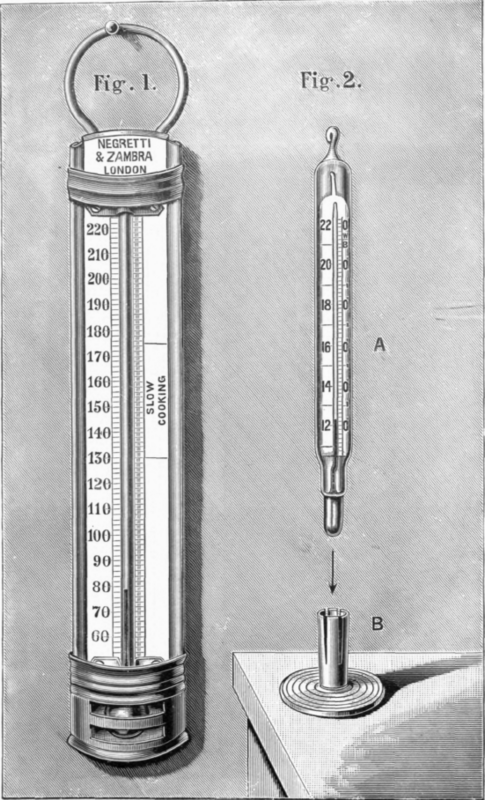
Thermometers Used In Cooking.
Fig. 1 is used in large braising pots, as for a ham. Range of temperature from 60° to 220° Fahr., so as to safely cover the boiling point 212° when required. The usual range for "slow cooking" is marked on the scale as lying between 130° and 175°. Its length is eight inches not reckoning the ring at the upper end.
Fig. 2. (A) is a smaller instrument with a range of temperature from 120° to 220° Fahr., for use in a small saucepan or shallow stewpan.
(B) represents a metal socket in which it stands upright, so that the temperature may be read with ease. In hashing a few slices of meat, for example, the temperature should never exceed 135° to 140°, at which heat no hardening takes place, and this is the best kind of instrument to employ. In its socket it is five-and-a-half inches in length.
Continue to:


My Books

