


The Grape Vine
Description
This section is from the book "The Gardener V3", by William Thomson. Also available from Amazon: The New Organic Grower: A Master's Manual of Tools and Techniques for the Home and Market Gardener.
The Grape Vine
With two exceptions the Grape Vine (Vitis vinifera) is the earliest fruit-bearing plant of which there is any record. From earliest ages it has occupied a prominent and very important position amongst the fruits of the earth. There is strong presumptive evidence that it was cultivated by the antediluvians; and it is specially referred to as having occupied the attention of Noah as soon as the waters of the flood had subsided from the face of the earth. When Moses sent the heads of the children of Israel to spy the land of Canaan, and to bring back word whether it was " fat or lean," they brought back an example of the Grape to prove that it was worthy of their promised possession. Through the long ages that have lapsed since then, with their ever-varying tastes and habits, the luscious Grape has been an important product of cultivation; and it has lost none of its early popularity. At the present time it is more extensively cultivated under glass than ever it was at any period of the world's history; and in this country hot house Grapes are now an article of commerce to a much greater extent than ever they were, with every likelihood of their becoming increasingly important.
It is much to be regretted that a destructive parasite (Phylloxera vastatrix) is threatening to become a formidable destroyer of the Vine, both in the vineyards of the Continent and in the vineries of Britain. It is to be hoped it will be successfully " stamped out" where it has appeared, and that the prestige of the Grape Vine may not be tarnished.
It must be regarded as somewhat strange that the native country of the Grape Vine has not been definitely settled by botanists. It can be safely assumed that it is indigenous to a great part of Asia, the climate of which is suited to its growth. From Asia it was no doubt introduced into Egypt and Greece, and from these parts found its way into France, Spain, and other Continental countries, where it has so long held a position of much importance. It is supposed that its cultivation in France dates as far back as the second century. Its introduction into Britain has been attributed to the Phaenicians, as early as the days of Solomon, when trading for tin to the southern coast of England; others ascribe its entrance into this country to a short time after the Christian era, when the Romans had full possession of the country.
There is no doubt that it was at one time cultivated in the south of England for wine-making with very considerable success. It is authentically recorded that at Arundel Castle, in Sussex, great quantities of wine were made from the produce of a vineyard there, and that in 1763 there were 70 pipes of wine in the castle cellars, all produced from Grapes grown in the Arundel vineyard. The first mention of artificial heat being applied to the Vine is in 1718, when the Duke of Rutland, at Belvoir Castle, forced it by means of heated walls. In Switzer's ' Practical Fruit Grower' there is to be found the first plan of a vinery, with directions for forcing Grapes under glass. As a branch of horticulture Grape-growing under glass has certainly more than kept pace with any other, both in its general diffusion and its improvement, until it may be looked upon as of national importance.
Site For Vineries
There are two extremes of circumstances which are inimical to the most successful culture of the Grape Vine, and these are considerably dependent on; the site where vineries are erected. A low damp position, into which the water in its immediate vicinity finds its way, and from which it cannot be drained to the depth of at least 3 feet, should be avoided; for stagnant water is ruinous to Vines, and such a site may be regarded as the very worst. An elevated, excessively dry site, with a gravelly subsoil which suffers very soon and severely from drought, should also be avoided if possible, as excessive drought is also very unfavourable to the production of fine Grapes. A site sloping gently to the south, from which water can be effectually drained, is the best, and should always be chosen when available. Shelter from north and east winds is also of importance. But the sheltering objects should never be so near the vinery as to prove injurious by their shade. When Vine-borders have from necessity to be made near large growing trees, an effectual barrier - such as a brick and cement wall - should be provided against the inroads of the tree-roots.
Vinery For Early Forcing
What I intend to be understood by the term "early forcing," is that which produces ripe Grapes in March, April, and May, and which necessitates the commencement of forcing in October, November, and December respectively. The forcing thus extends over a period during which the days are short, sunless, and cold - conditions which, it need scarcely be said, are adverse to vegetation of every kind. Even the most ignorant of the art of forcing through such a season will at once conclude that the production of good Grapes in early spring, in this ever-changing climate, must be one of the most difficult tasks of the horticulturist. Whatever structure it is that insures the greatest possible amount of light, and is at the same time the most easily heated to and maintained at the necessary temperature, must of necessity be the best for early forcing. Very little consideration will serve to convince any one that the form of vinery which presents almost its entire surface of glass to the south, so as to catch every gleam of sunshine, must be the best.
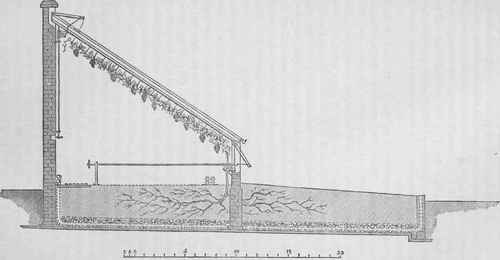
Fig. 16.
The "lean-to" as represented by fig. 6 is beyond all doubt the best for early forcing. Indeed it is a good form for producing Grapes at any season of the year, but especially at the time now under consideration. The wood-work should not be any heavier than gives sufficient strength, and it should be glazed in large panes with 22-ounce British sheet-glass. The amount of pipes for heating it should not be less than six rows of 4-inch pipes the whole length of the house and round both ends, besides a steaming-tray. The whole of the inside wood-work and back wall should be white, so as to reflect as much light as possible on the tender growths of the Vine. Reference to the engraving shows the arrangement of the drainage and depth of soil as referred to under the head of "Border-making".
In forcing that has to commence in any of the winter months, there can be no doubt that artificial heat judiciously applied by hot-water pipes to the soil from beneath is a great advantage. In arranging for this the pipes should be immediately over the concrete, and covered over in a shallow chamber by pavement, and the drainage placed over the pavement; or the pipes may be surrounded with an open or honeycombed brickwork drain, which drain can be connected with similar open drains running right and left among the open rubble, of which the drainage is composed. A border 24 feet wide should have four rows of hot-water pipes running underneath it.
The ventilation, especially of vineries where early forcing is carried on, is of very great importance. For it is, especially in those days of large panes of glass and close laps, of great importance to keep the air fresh, and constantly renewed. The ingress of cold currents of air is most objectionable. It is of much importance to heat it before it enters the body of the vinery and plays on the tender foliage and fruit. Many ways have been recommended to effect this end; but the best way is that invented by William Thomson, and illustrated by him in his ' Treatise on the Vine.' * It is termed the "hot-air ventilator,"
* All who require the best and most elaborate information bearing on everything connected with Grape-growing, should read Mr Thomson's ' Practical and consists of a sheath of " copper placed over or incasing a row of the front pipes. The diameter of the sheath is one inch more than the hot pipe it encloses, consequently there is an open space of half an inch all round the pipe inside the sheath. This cavity is fed with fresh air from the exterior of the house, by a pipe 5 inches in diameter, which springs from the lower surface of the sheath and passes through the front wall of the house to the external air. There is a valve in this feed-pipe to modify the supply of fresh air at pleasure. In the upper surface of the sheath is a double row of holes, so that the moment the cold air comes into the chamber round the pipe and gets hot, expanded, and lighter, it makes its exit through these holes into the general atmosphere of the house".
Continue to:


My Books

