


A Visit To The House And Garden Of The Late A. J. Downing. Part 3
Description
This section is from "The Horticulturist, And Journal Of Rural Art And Rural Taste", by P. Barry, A. J. Downing, J. Jay Smith, Peter B. Mead, F. W. Woodward, Henry T. Williams. Also available from Amazon: Horticulturist and Journal of Rural Art and Rural Taste.
A Visit To The House And Garden Of The Late A. J. Downing. Part 3
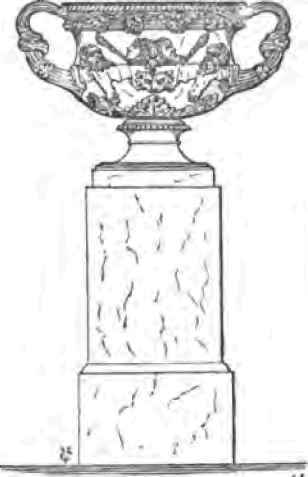
This vase, which is a cast of one in the gardens of the Villa Borghese, near Florence, is of bronze, and is covered with bacchanalian figures in very high relief. The artist Cranch has painted a lovely view of the garden from a spot on the opposite side of this lawn, toward the Hermitage; where the mountains on the opposite shore, with the sail-covered river flowing between, and this vase in the foreground, combine to form a landscape more beautiful than is often seen, and of which the vignette placed at the head of our article can give but a faint idea.
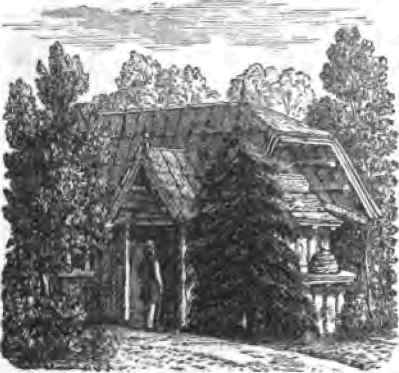
THE HERMITAGE.
It will be remembered that before Mr. Downing took this place, by far the greater part of it was planted as a nursery; and in altering it to its present shape, a large proportion of the fruit trees had to be entirely given up or transplanted. Such as remained were placed where they would be most useful as screens and yet not intrude upon the sight, since a tree cultivated for its fruit alone is seldom an ornamental object; - beautiful of its kind it may be, but seldom as seen side by side with other trees. Wherever the nursery trees could be left without interfering with the proposed arrangement of the grounds, they were so; and thus we find the path at the northern end of the garden, in which we are now walking, walled on one side with fruit trees mingled with flowering shrubs. The lawn, around which this path runs, is studded with those circular beds of flowers to which I have before alluded, - beds of verbenas and roses, but chiefly of petunias - piled blooms of purple and white, - flowering far into the autumn months. Beside these, there is a pretty conceit - a guilloche bed of verbenas shaded from the richest scarlet up to pure white, and two hanging tents of wire covered with the beautiful cypress vine.
On this walk, too, is a little Rustic Arbor, sitting in which on summer days, one saw the freighted river and flowing mountain line, which, clear against the sky, divided its paler blue from their deep azure; and the village on the rolling land between the water and the hills, with its clustered houses thick in one place but scattered on the outskirts, with here and there a larger house or stately mansion.
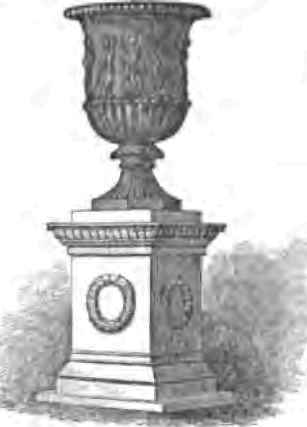
BORGHESE VASE.
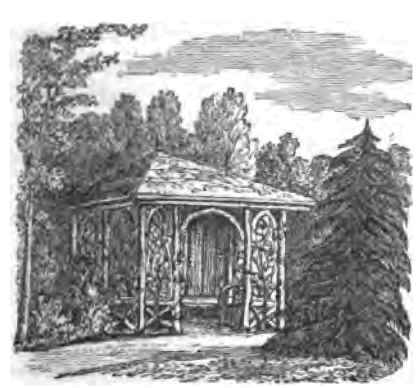
ARBOR.
"Bosomed high in tufted trees," and gladdening the eye with its hints of home and hospitality amid the universal tender green. Continuing on this path, it becomes narrower, and leads through the shrubbery to the carriage road, which widens at the north end of the house sufficiently to admit of a turn, and then, resuming its original width, leads to the rear of the building and to the fruit orchard, hidden from the view by the espalier with its leafy curtain of nectarine and peach. Extending from the western side of the house we see the office, giving to the structure a pleasing irregularity, and having on the south the little Entrance Porch which is before shown in our vignette.
The orchard contained Mr. Downing's choice fruit - principally plums, nectarines, and peaches, with some of the finer sorts of pears. In other parts of the garden there were fine beds of strawberries - many sorts, and each in its perfection; raspberries also were in great abundance and beauty, together with fine apples and, as we have seen, great store of grapes. At the end of the orchard the carriage road again widens, and at the left a narrow path running in front of the greenhouse, connects the two ends of this road with each other. Over this path is trained the Wistaria Vine on a rustic trellis, and through it you get a lovely picture of the river and the Fishkill mountains circled by the leafy and luxuriant climber for a frame. I have thus led the reader through the garden, and endeavored to convey to him some idea of a place which can not long remain as the owner left it, and which he died without carrying to perfection. It is not an extensive place; it had no great vinery, no mammoth hot-house nor conservatory; there is no aviary, no fountain, no Victoria Regia, no pinery, no palm-house. In the garden one looks in vain for a complete collection of any one plant Mr. Downing had no passion for evergreens; no absorbing desire to include in his garden's attractions every species of heath, or rose, or dahlia.
In the house there are no rare paintings, no marbles, no cabinets of gems, no portfolios of rare engravings, no shelves laden with costly books. If Mr. Downing's fortune did not warrant this, no less did his taste forbid his running to extremes of any kind. His garden is small indeed; but it had more beauty of arrangement, more beauty of natural scenery, artistically made a part of the place, than many a place we know of, whose owner is possessed of far greater wealth. Many of Mr. Downing's trees, both fruit and ornamental, were rare and costly specimens, either imported from abroad or presents from his friends; many of them were natives of our American woods, of which he was justly proud. All were treated with the most assiduous and scientific care, and were models of their kind. Mr. Downing has shown in his garden and in his house how much beauty and comfort lie at the doors of those whose means are not very extensive, but who are willing to bestow care, and able to bestow taste upon their places, however small.
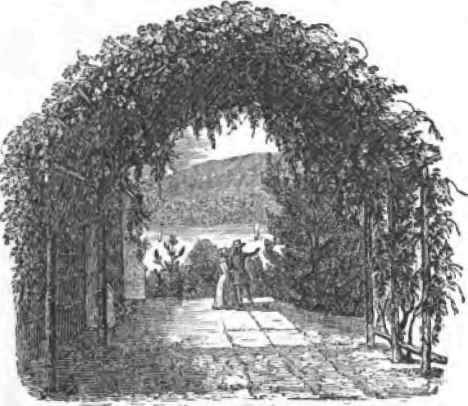
WISTARIA TINE.
We have no doubt that many a man who looks at the plan which accompanies this sketch, will be inclined to wonder at the praises which have been bestowed upon the garden. But when he comes to examine, step by step, the nice arrangement, the artistic eye guiding the hand in the planting of every shrub and tree, the hundred effects of light and shade, the charming landscape, now revealed between the thickets, and now stretching before him with a foreground of lovely flowers and shrubs; and when he comes to learn that none of this is the effect of chance, but that in the owner's mind there existed the capability of seeing beforehand the result of his labor, and that he thus worked with certain knowledge of its final issue; he will understand that no common skill has been at work upon this haunt of beauty, and that in its completeness of design and perfection of execution it is the successful competitor of far grander and more ostentatious places.
We are glad to be able to show the friends, to whose immediate ear Mr. Downing month after month so acceptably appealed, a view of the place in which he lived and labored, which he loved as the spot where he was born, and where so many happy hours had been passed, and which to every lover of the beautiful in nature, and to every friend of those arts which surround our homes with refining beauty, will be a place around which affectionate memories will gather, as long as affection and gratitude endure.
THE WARWICK VASE.
Continue to:


My Books

